
Almost every new owner makes a few feeding mistakes, and most are easy to fix. The trouble is that they often look like kindness: an extra scoop because the puppy seems hungry, a new food because a friend recommended it, a biscuit because the puppy was good. A growing puppy is sensitive to such changes, in its stomach and in its weight. This guide lists the mistakes that cause the most trouble, shows the arithmetic behind each and gives a simple fix. It is general information; your vet knows your puppy and should guide any specific decisions.
Mistake 1: changing food suddenly
A puppy’s gut is adapted to the food it has been eating. Switching overnight can cause loose stools, vomiting or refusal to eat. In a small puppy, diarrhoea can lead to dehydration quickly, so it is more than a nuisance.
Fix. Keep the breeder’s food for the first days, and if you want to change, do it gradually over about a week (25%, 50%, 75%, 100% new food at two-day steps). Slow down if stools soften. Our guide to how to switch dog food gives the schedule.
Mistake 2: measuring by cup
A cup is a volume, and kibble varies. The same “cup” can hold 10 to 20% more or less food depending on the scoop and how it is filled. For a puppy that needs 126 g a day, a 15% error is 19 g, about 72 kcal, which is 15% of the day’s calories. Over weeks, that is a lot of extra weight.
Fix. Weigh meals in grams on a kitchen scale. If you only know cups, weigh a level cup, and use the Dog Food Cups to Grams Calculator. Then mark the scoop or weigh each time.
Mistake 3: feeding by age or by the bag alone
Bag charts are written to be safe for the average puppy and often generous. They also tend to use age bands or weight bands that are wide. Two puppies of the same age can differ in weight by many kilograms.
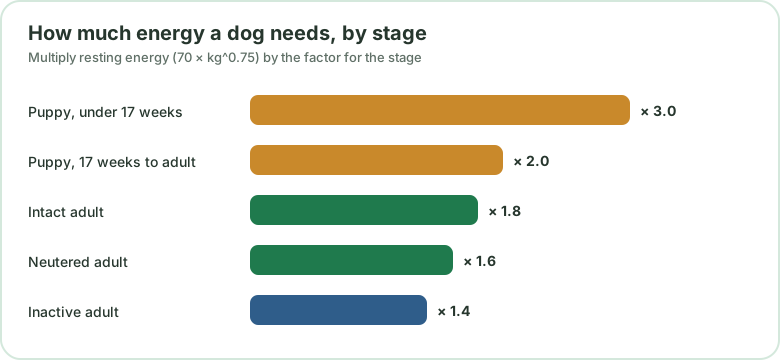
Fix. Use weight and age stage together. At 3.0 times resting energy for under 17 weeks and 2.0 after, a 5 kg puppy needs 702 kcal under 17 weeks and 468 kcal after; see the puppy feeding chart. The Puppy Food Calculator does the sums.
Mistake 4: forgetting the stage change
At about 17 weeks the factor drops from 3.0 to 2.0 times resting energy. A puppy that is heavier at 18 weeks than at 16 weeks may need fewer daily calories, not more. Owners who keep raising the amount may overshoot. A puppy of 8 kg at 16 weeks needs 999 kcal, and 666 kcal at 18 weeks. Continuing to feed 999 would be 50% more than the chart suggests.
Fix. Track age in weeks, using the Puppy & Kitten Age Calculator, and recalculate when the stage changes.
Mistake 5: not counting treats
Training treats, chews and scraps are calories. At 10% of 479 kcal, a 3 kg puppy has about 48 kcal for treats, which is about 16 small pieces of 3 kcal each. A single dental chew of 60 kcal can use the whole allowance. Over a week, uncounted treats can add up to a meal.
Fix. Count everything, measure out the day’s training kibble from the daily allowance and reduce meals when you give extras. See training treats without weight gain.
Mistake 6: free feeding
Leaving food out all day makes it hard to know how much the puppy ate, and it can lead to overeating and make house-training harder because toilet times are less predictable.
Fix. Offer measured meals at set times, take away what is left after 15 to 20 minutes and keep fresh water available. See how many times a day a puppy should eat.
Mistake 7: supplements without advice
Complete and balanced puppy foods are designed to supply the nutrients a growing puppy needs. Adding calcium or vitamins “to be safe” can upset the balance, particularly in large breeds where growth is sensitive to feeding.
Fix. Do not add supplements unless your vet recommends them. If you are using a home-made diet, ask your vet or a veterinary nutritionist to check it for balance.
Mistake 8: skipping weigh-ins
Without weights, you are guessing. A puppy can gain weight steadily and look fine to the eye until the extra kilograms are a problem.
Fix. Weigh weekly on the same scale, record the numbers and check body condition: ribs easy to feel under a thin layer of padding and a waist when viewed from above. The Dog Body Condition Score tool describes the scale.
Mistake 9: feeding the wrong food for the puppy’s size
A food for small breeds may not suit a giant puppy, and an adult food is not designed for growth. Large-breed puppies are sensitive to energy and mineral balance in particular.
Fix. Ask your vet which food suits your puppy’s expected adult size. See large-breed puppy feeding.
Mistake 10: ignoring appetite changes
A puppy that suddenly stops eating, vomits, or seems lethargic is not being fussy. Young puppies can become unwell quickly.
Fix. Call your vet if a puppy refuses food for a meal or two, or shows any other signs of illness. Do not wait to see.
A mistakes-and-fixes table
| Mistake | Typical effect | Quick fix |
|---|---|---|
| Sudden food change | Loose stools, vomiting | Switch over about a week |
| Cup measuring | Over- or underfeeding by 10–20% | Weigh in grams |
| Bag guide only | Too much food | Use weight and age stage |
| Missing the stage change | Overshoot after 17 weeks | Recalculate at about 17 weeks |
| Uncounted treats | Hidden calories | Count within 10% |
| Free feeding | Hard to track; house-training harder | Measured meals |
| Supplements | Imbalance | Only if your vet advises |
| No weigh-ins | Missed trends | Weigh weekly |
| Wrong food for size | Growth issues | Ask your vet |
| Ignoring illness signs | Delay in care | Call your vet |
Putting it right: a one-page routine
- Weigh the puppy on the same day each week.
- Look up the stage from the age in weeks.
- Calculate the calories and grams.
- Divide into meals.
- Count treats and subtract them from meals.
- Check body condition and stools.
- Write everything down, and bring the log to the vet.
Questions to ask your vet
- Is my puppy’s weight on track?
- Which food and amount do you suggest?
- When should I switch to adult food?
- Are there signs of overfeeding I should watch for?
- What should I do about treats?
A one-week fix-it plan
If you recognise several of these mistakes, do not try to fix everything at once. A week-long plan makes it manageable.
| Day | Task |
|---|---|
| 1 | Weigh the puppy; note age in weeks; find the food’s kcal per kg |
| 2 | Calculate the daily calories and grams with the Puppy Food Calculator |
| 3 | Weigh the food in grams for each meal; write the numbers on the container |
| 4 | Count the treats and chews for the day; subtract their calories from meals |
| 5 | Check body condition with the Dog Body Condition Score tool; take photos |
| 6 | Set up a weekly weigh-in routine and a log sheet |
| 7 | Review with the household: one treat jar, no table scraps, same routine |
By the end of the week you will have a calculated target, a measured routine, a record of the starting point and a plan to review. Then repeat the weigh-in weekly, and recalculate when the stage changes at about 17 weeks.
Working out the cost of a mistake
It helps to see what a mistake does. A 5 kg puppy under 17 weeks needs 702 kcal. If the owner feeds by cup and over-scoops by 15%, that is 105 kcal a day extra. If two small biscuits of 30 kcal each are added, that is 60 kcal more. If a dental chew of 70 kcal is given, that is 70 more. Together, the puppy gets 235 kcal above the target: 33% too much. In a growing puppy that is a recipe for a rapid gain, not a vague worry. The sums also show that no single mistake is dramatic; it is the combination that matters.
Tummy trouble: what is normal and what is not
Puppies often have the odd soft stool when they move home, change food or eat something odd, and a single episode is not unusual. What deserves a call to the vet is a puppy who is very young, has repeated vomiting or diarrhoea, has blood in the stool, seems dull or refuses food. Puppies dehydrate fast. When in doubt, call; do not wait to see whether it passes. After any upset, return to the plan: a calm routine, measured meals and no new foods unless your vet advises.
Household agreement
Mistakes often come from several people feeding differently. Agree on one routine: who feeds which meal, where the treats are kept, what counts as a treat and what the puppy may not have from the table. Put a note on the food container with the daily grams. Children can help with weighing, but an adult should check. Consistency is the quickest route to a healthy, well-behaved puppy.
Mistakes with grams: a closer look
The difference between a scoop and a scale shows up in numbers. A 3 kg puppy needs 126 g a day of a 3,800 kcal/kg food. Four meals of a level scoop that happens to hold 36 g each make 144 g, which is 14% too much. Four heaped scoops of 45 g make 180 g, which is 43% too much. These are not unusual errors; a heaped scoop is easy to make. At 43% above target, the puppy takes in 685 kcal against a need of 479. The fix costs very little: a kitchen scale and ten seconds per meal.
When appetite really is low
If a puppy is eating less than the calculated amount, do not coax it with extras that change the balance. Check for simple causes: a new home, a change of food, teething, heat or an upset stomach. Offer the meal in a quiet place for 15 to 20 minutes, then take it away and offer the next meal on time. If the puppy misses more than a meal or two, or seems unwell, call the vet. Young puppies can drop their blood sugar if they do not eat, so do not wait.
A reminder to enjoy the puppy
Feeding is only one part of raising a puppy. A calm routine, measured meals and regular weigh-ins make the rest easier, so you can focus on play, training and enjoying your growing companion.
Quick summary
- Change food gradually over about a week, never overnight.
- Weigh food in grams, not cups.
- Use weight and age stage together, and recalculate at about 17 weeks.
- Count treats within 10% of the daily calories.
- Use measured meals, weigh weekly and skip supplements unless advised.
- Use the Puppy Food Calculator each week.
Frequently asked questions
What is the most common puppy feeding mistake?
Overfeeding, often because the bag's guide is generous, food is measured by cup and treats are not counted.
Why does my puppy have loose stools after a food change?
A sudden switch can upset a young puppy's stomach. Change foods gradually over about a week, and call your vet if loose stools persist.
Should I leave food out all day for a puppy?
Measured meals at set times make it easier to track intake and house-train. Ask your vet about the right pattern for your puppy.
How do I know if I am overfeeding?
Weight rising faster than expected, ribs hard to feel and a rounded belly are signs. Weigh weekly and score body condition.
Do puppies need supplements?
A complete and balanced puppy food normally provides what is needed. Extra supplements, especially calcium, can upset the balance, so ask your vet first.
Can I feed my puppy human food?
Scraps add uncounted calories and can upset the stomach. Ask your vet which foods are suitable and count any you give.
How often should I recalculate the amount?
Weekly or fortnightly while the puppy is growing fast, using the new weight.
Sources
- NRC (2006) Nutrient Requirements of Dogs and Cats, National Academies Press
- WSAVA Global Nutrition Guidelines
- AAHA (2019) Canine Life Stage Guidelines. Journal of the American Animal Hospital Association 55:267-290
Related calculators
- Puppy Food CalculatorCalculate how much a growing puppy needs, how many meals a day, and how much per meal.
- Dog Food Cups to Grams CalculatorConvert cups of dog food to grams (and back) using the energy values printed on your bag.
- Dog Treat Calorie CalculatorCheck how many treats your dog can have a day without unbalancing its diet — the 10% rule.
Keep reading
- Puppy Feeding Chart: Calories by Age StageA puppy feeding chart with calories and grams by weight for two stages: under 4 months and 4 months to adult, plus meals per day and how to move to adult food.
- How Much to Feed an 8-Week-Old PuppyHow much an 8-week-old puppy should eat: calories and grams for 1.5 to 8 kg puppies, four-meal schedules, switching from the breeder's food and weekly checks.
- When to Switch Puppy Food to Adult FoodWhen to move a puppy to adult food: AAHA's stage guide, why large breeds switch later, the 20% energy drop to recalculate and a 7-day transition plan.
- Wet vs Dry Puppy Food: Calories, Cost and RoutineWet and dry puppy food compared on calories per gram, moisture, cost per 1,000 kcal and convenience, with worked examples for a 5 kg puppy and mixing advice.