
Changing a dog’s food should be simple: open a new bag and pour. But the digestive system of a dog is adapted to what it has been eating, and a sudden change can bring loose stools, gas, vomiting or a dog that sulks at the bowl. The remedy is gradual mixing, and a little arithmetic to make sure the new food delivers the right calories. This guide gives a seven-day plan, a slower plan for sensitive dogs, advice on matching calories between foods that differ in energy and a troubleshooting table. It is general information; if your vet has prescribed a diet or your dog has a health condition, follow their instructions.
Why gradual is better
The bacteria in the gut adapt to the food they are given, and enzymes adjust to its balance of fat, protein and fibre. A fast change gives the gut little time to adapt, and the result can be digestive upset. Dogs vary: some seem to eat anything, while others react to small changes. As you cannot tell in advance which type you have, the safe approach is to go gradually. The same logic applies when moving between brands, between dry and wet, between life stages and from home-made food to commercial.
The 7-day plan
| Day | Old food | New food |
|---|---|---|
| 1 | 75% | 25% |
| 2 | 75% | 25% |
| 3 | 50% | 50% |
| 4 | 50% | 50% |
| 5 | 25% | 75% |
| 6 | 25% | 75% |
| 7 | 0% | 100% |
Each percentage refers to the share of the day’s meal, by calories where possible (see below). Mix the foods well in the bowl, and offer the usual number of meals. Keep treats and extras the same during the switch, so that if there is an upset you know it is the food.
The 14-day plan for sensitive dogs
For dogs with a history of upsets, older dogs and puppies, a slower change is kinder.
| Days | Old food | New food |
|---|---|---|
| 1 to 3 | 90% | 10% |
| 4 to 6 | 75% | 25% |
| 7 to 9 | 50% | 50% |
| 10 to 12 | 25% | 75% |
| 13 to 14 | 0% | 100% |
If stools soften at any step, stay at the previous step for a few days. If the dog is unwell at any point, stop and call your vet.
Match the calories, not just the grams
Foods differ in energy density. A dry food might have 3,400 kcal/kg and another 4,200 kcal/kg, and a wet food might have 1,000 kcal/kg. If you replace 300 g of a 3,400 kcal/kg food with 300 g of a 4,200 kcal/kg food, the dog’s calories rise from 1,020 to 1,260, which is 24% more, enough to gain weight within weeks.
| Food | kcal per kg | Grams for 1,059 kcal (neutered 20 kg adult) |
|---|---|---|
| Lower-energy dry | 3,400 | 311 g |
| Mid-energy dry | 3,800 | 279 g |
| Higher-energy dry | 4,200 | 252 g |
| Wet | 1,000 | 1,059 g |
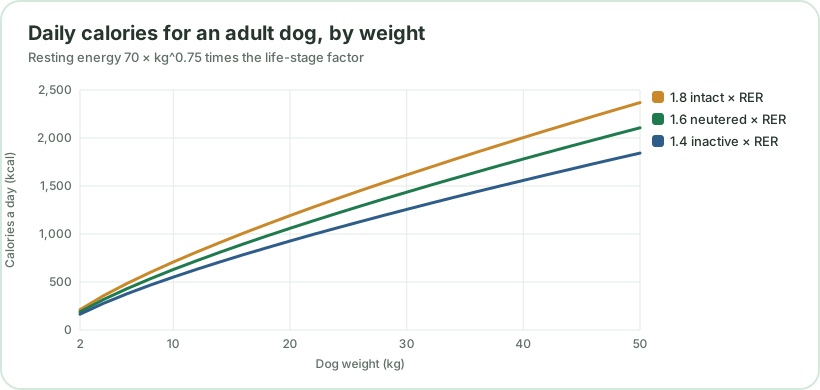
To switch properly, recalculate the daily grams for the new food. A 20 kg neutered adult needs about 1,059 kcal. If the new food is 4,200 kcal/kg, the full amount is 252 g, not the 311 g of the old food. During the mixing days, calculate the calories for each part: on day 3 (50/50), half the calories come from each food. The Dog Food Calculator gives the daily calories, and the Dog Food kcal Calculator works out the energy value of a label if the maker does not give kcal. If you mix wet and dry foods, the Dog Wet & Dry Food Calculator splits the calories.
A worked mixing day: the new food is 4,200 kcal/kg and the old is 3,400. On day 3 (50/50), 530 kcal come from each: 530 ÷ 3.4 = 156 g of the old food and 530 ÷ 4.2 = 126 g of the new. That is 282 g in total, rather than 311 g of old food, so the bowl looks a little smaller than usual, which is correct.
What to watch during the switch
| Sign | What it may mean | What to do |
|---|---|---|
| Slightly soft stools | The gut is adapting | Stay at this step for a day or two |
| Watery diarrhoea | The change is too fast, or another cause | Go back a step; call your vet if it lasts more than a day or the dog is unwell |
| Vomiting | Upset stomach or another cause | Stop the change and call your vet if it repeats |
| Gas | Fibre or protein change | Slow the transition |
| Refusal | Taste or texture | Hold the step, make it smaller or slower |
| Itching or skin signs | Possible sensitivity | Tell your vet |
| Weight change | Calories not matched | Recalculate the amount |
Stool is the main indicator: firm and well-formed is the target. Keep a short log of stool quality and appetite for each day of the switch.
Special cases
Puppies. Young puppies have sensitive guts, and a switch should be slow and planned with your vet. See when to switch puppy food to adult food.
Senior dogs. Take it slowly, and ask your vet if the new food suits any health conditions.
Dogs with health conditions. Follow your vet’s instructions for prescription diets.
Dry to wet, or wet to dry. Treat it the same way, and recalculate amounts, since wet food has about a quarter of the calories per gram.
Home-made or raw to commercial. Go slowly and ask your vet.
Brand to brand within the same line. Even a “same type” food may differ in ingredients and fat, so mix gradually.
When to go back to the old food
If your dog has persistent vomiting or diarrhoea, will not eat, has blood in the stool or is lethargic, return to the previous food (if that was suitable) and call your vet. Do not push through a bad reaction.
Common mistakes
- Switching overnight.
- Changing treats at the same time.
- Using the same grams for a food with different energy.
- Not checking stools.
- Rushing because the old bag is nearly empty (buy the new bag early).
- Mixing too many new foods at once.
- Ignoring a refusal.
A worked 7-day schedule in grams
A 20 kg neutered dog moves from food A (3,400 kcal/kg) to food B (4,000 kcal/kg). The daily target is 1,059 kcal. The table converts the percentage of calories into grams of each food.
| Day | Share new | Calories old | Grams old | Calories new | Grams new | Total grams |
|---|---|---|---|---|---|---|
| 1 | 25% | 794 | 234 | 265 | 66 | 300 |
| 3 | 50% | 530 | 156 | 530 | 132 | 288 |
| 5 | 75% | 265 | 78 | 794 | 199 | 277 |
| 7 | 100% | 0 | 0 | 1,059 | 265 | 265 |
Notice the total weight in the bowl falls from 311 g of food A at the start to 265 g of food B at the end, because food B is more energy dense. Treat this like any recipe: weigh each portion.
Switching in special circumstances
Allergic or sensitive dogs. Ask your vet; a trial diet has rules about what else the dog may eat.
Dogs with kidney, heart or other conditions. Your vet may specify a diet and a transition. Do not improvise.
Puppies. Use the slower plan, and keep the first food for the first days in a new home.
Seniors. Take it slowly, and check that the new food suits any health issue.
After illness. If your dog has had an upset stomach, wait until it has settled before switching, and ask your vet.
Keeping a switch log
A log makes problems easy to diagnose.
| Day | % new | Appetite | Stool (1 firm to 5 watery) | Energy | Notes |
|---|---|---|---|---|---|
| 1 | 25 | ||||
| 2 | 25 | ||||
| 3 | 50 |
If the scores worsen, go back a step and tell your vet if they do not improve in a day or two.
Why labels and recipes differ even within a brand
A brand’s “adult” and “puppy” formulas, or its “chicken” and “lamb” versions, differ in energy, fat, fibre and ingredients. Treat any change of formula as a new food. Even a “new recipe” from the same maker can change the digestive load. Check the energy value each time, and mix gradually. Keep the old bag until the transition is complete, in case you need to go back. If you buy online, order the new food a few days before the old runs out.
Switching between dry, wet and home-prepared food
Moving from dry to wet food changes the water, fat and fibre, and the calories per gram. Use the calorie method: decide the new target in kcal, then convert. When moving to home-prepared food, ask your vet or a veterinary nutritionist for a balanced recipe, because many online recipes lack essential nutrients. Go slowly, and keep records. Our guide to wet and dry dog food together shows the arithmetic for mixing.
A checklist before you start
- Confirm that the new food is complete and balanced for your dog’s life stage.
- Check its energy value and calculate the daily grams.
- Choose the 7-day or 14-day plan.
- Buy enough of the old food to finish the transition.
- Plan not to change treats or other foods at the same time.
- Set up a simple daily log for stools and appetite.
- Pick a quiet week, not holiday or boarding time.
- Tell the household and sitters.
If your vet is involved, show them the plan.
What to do after the switch
For the next month, weigh weekly and score body condition, since the new food may need an adjustment of the amount. Keep the log of stool quality. If everything is steady, you can relax to monthly checks. Keep the old bag’s label for reference, and write the new daily grams on the container.
Quick summary
- Switch over about 7 days: 25%, 50%, 75%, then 100% new food in two-day steps.
- Use 10 to 14 days for sensitive dogs, puppies and seniors.
- Match calories, not grams; recalculate the amount from the new label.
- Watch stools, appetite and energy, and slow down if they change.
- Keep treats the same during the switch.
- Use the Dog Food Calculator for the new daily amount.
Frequently asked questions
How long should it take to switch dog food?
About a week for most dogs, and 10 to 14 days for dogs with sensitive stomachs. Your vet may suggest a different pace.
What percentage of new food should I start with?
Around 25% new food mixed with 75% of the old, then increase every couple of days if stools stay normal.
Why must I match calories?
Two foods can have very different energy per gram, so the same weight of each can mean very different calories. Recalculate the amount from the new label.
What are signs I am switching too fast?
Loose stools, gas, vomiting or reduced appetite. Go back a step for a couple of days, then proceed more slowly.
Can I switch from dry to wet food the same way?
Yes, gradually, and recalculate the amounts because wet food has far fewer calories per gram.
What if my dog refuses the new food?
Keep the mix at the last accepted step and go more slowly. If refusal continues for more than a day, call your vet.
Do I switch gradually if the vet prescribes a new diet?
Follow your vet's instructions, which may differ from the usual plan.
Sources
- WSAVA Global Nutrition Guidelines
- NRC (2006) Nutrient Requirements of Dogs and Cats, National Academies Press
Related calculators
- Dog Food CalculatorTurn your dog's daily calorie need into grams and cups of the food you actually feed, using the energy value printed on the bag.
- Dog Food Calorie CalculatorWork out how many calories are in a dog or cat food from the nutrient percentages (guaranteed analysis) on its label, when no kcal figure is printed.
- Dog Wet and Dry Food CalculatorSplit your dog's daily calories between wet and dry food and see the grams of each.
Keep reading
- When to Switch Puppy Food to Adult FoodWhen to move a puppy to adult food: AAHA's stage guide, why large breeds switch later, the 20% energy drop to recalculate and a 7-day transition plan.
- How Much Should I Feed My Dog? By WeightHow much to feed a dog by weight: a grams and cups chart, how to read the food label, meals per day, adjusting by body condition and common mistakes.
- Why the Feeding Guide on Your Dog Food Bag Is OffWhy a dog food bag's feeding guide often overshoots: wide weight bands, no allowance for neutering or treats, and how to fix it with a calorie calculation.
- Feeding Wet and Dry Dog Food TogetherHow to feed wet and dry dog food together without overfeeding: splitting daily calories, worked grams for a 20 kg dog, topper rules and a mixed-feeding table.