
Puppies have small stomachs, fast metabolisms and a great deal of growing to do, and that combination is why they eat more often than adult dogs. The question is how often, and how the day’s food should be divided. This guide gives the meal pattern used by the CalcuPaw puppy calculator, shows example portion sizes, explains why toy breeds can differ and gives a practical timetable.
The pattern: four, three, then two
| Puppy age | Suggested meals a day |
|---|---|
| Under 13 weeks | 4 |
| 13 to 25 weeks | 3 |
| 26 weeks and older | 2 |
This is a sensible default rather than a fixed rule. It matches the way young puppies cope with small amounts of food at close intervals, and the way older puppies can handle larger meals further apart. Your vet may recommend something different, particularly for very small, very large or unwell puppies.
The daily total does not change
Feeding more often does not mean feeding more. First work out the day’s calories and grams, then divide. The Puppy Food Calculator gives the daily total and the meal size at the right frequency for the puppy’s age in weeks. Our puppy feeding chart lists totals by weight.
Meal sizes by weight and age
The figures use a food of 3,800 kcal/kg.
| Puppy weight | Age stage | Daily food | Meals | Per meal |
|---|---|---|---|---|
| 2 kg | Under 13 weeks | 93 g | 4 | 23 g |
| 5 kg | Under 13 weeks | 185 g | 4 | 46 g |
| 8 kg | Under 13 weeks | 263 g | 4 | 66 g |
| 5 kg | 13 to 16 weeks | 185 g | 3 | 62 g |
| 10 kg | 13 to 16 weeks | 311 g | 3 | 104 g |
| 8 kg | 17 to 25 weeks | 175 g | 3 | 58 g |
| 15 kg | 17 to 25 weeks | 281 g | 3 | 94 g |
| 10 kg | 26 weeks and older | 207 g | 2 | 104 g |
| 20 kg | 26 weeks and older | 348 g | 2 | 174 g |
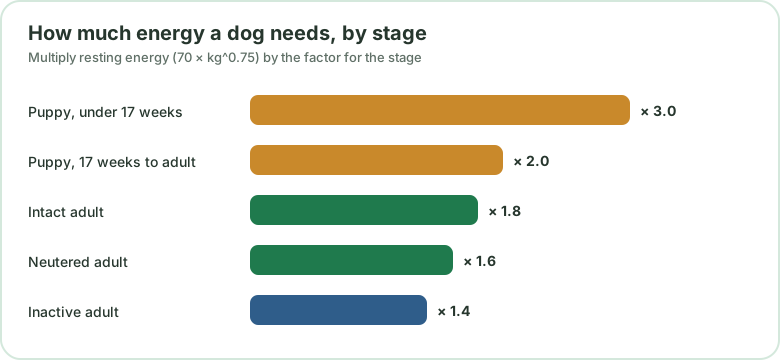
The daily food falls after 17 weeks because the energy factor drops from 3.0 to 2.0 times RER. A puppy of 5 kg in the second stage eats 123 g a day, not 185 g. The meal frequency is based on age and the energy stage on weight and age, so check both when you update.
A day in the life: sample timetables
Four meals (under 13 weeks)
| Time | What |
|---|---|
| 7 am | Breakfast, then toilet break |
| 12 pm | Lunch, then toilet break |
| 5 pm | Dinner, then toilet break |
| 9 pm | Last meal, then toilet break before bed |
Three meals (13 to 25 weeks)
| Time | What |
|---|---|
| 7 am | Breakfast |
| 1 pm | Lunch |
| 7 pm | Dinner |
Two meals (26 weeks onward)
| Time | What |
|---|---|
| 7 am | Breakfast |
| 6 pm | Dinner |
Adjust to your own day. What matters is regularity: puppies settle better with predictable times, and house-training is easier when you can predict when the puppy will need to go.
Why frequent small meals suit young puppies
A young puppy’s stomach holds only a small amount, so large meals are not practical, and the puppy needs a steady supply of energy for growth. Frequent small meals also help prevent very hungry puppies from gulping. For some toy breeds, going too long without food can make blood sugar fall, which is a reason vets sometimes advise more frequent meals for them. If you have a toy or very small puppy, ask your vet for a meal plan and for signs to watch for, such as unusual sleepiness or weakness.
Large and giant breed puppies
Large-breed puppies often grow for longer. Your vet may recommend a growth diet formulated for large breeds, fed in measured meals rather than free-fed, because steady growth is the aim. Do not assume more meals or more food will make a large puppy healthier; ask your vet which food, which amount and which pattern suit your puppy.
Timing meals around toileting and rest
Puppies often need to go to the toilet soon after eating, so a short trip outside after each meal is a good habit. After meals, let the puppy rest rather than race around, and avoid hard exercise straight after eating. A crate with a divider can give the puppy a quiet resting space; see our guide to puppy crate size and dividers.
What to do about leftovers and fussiness
- Offer the meal for 15 to 20 minutes, then pick it up.
- Do not top up with treats between meals.
- If your puppy leaves food, check the portion is not too large and that treats are not filling it up.
- Do not change food repeatedly to tempt it.
- If it refuses meals for more than a day, seems lethargic or is vomiting, call your vet. Small puppies can deteriorate quickly.
Can I use the meal size tool for other pets?
Yes. The Pet Meal Size Calculator divides any daily amount into a number of meals and shows grams, ounces and calories per meal. It is useful when you move from three meals to two and want to keep the daily total the same.
Common mistakes
- Increasing the daily total because the puppy eats more often.
- Leaving food out all day.
- Skipping the toilet break after meals.
- Changing to two meals too early for a small puppy.
- Not recalculating when the energy stage changes at about 4 months.
- Giving treats in addition to full meals.
Questions to ask your vet
- How many meals a day suit my puppy’s size and breed?
- When should we change the number of meals?
- What should I do if my puppy skips a meal?
- Which signs mean I should call you straight away?
- When should we move to adult food?
What happens when meal times slip
Puppies cope best with routine. If you are late with a meal now and then, nothing terrible happens, but a pattern of long gaps can cause trouble, especially for small puppies. Some practical rules:
- Keep meals within about 30 minutes of the usual time.
- If a meal is missed because of travel or a vet visit, offer a normal-sized portion when you can, not a double portion.
- If a young puppy has gone a long time without eating and seems weak or wobbly, call your vet.
- On vaccination or travel days, keep meals small and familiar.
If you are not sure what a gap means for your puppy, ask your vet, particularly if your puppy is a toy breed.
Moving from four meals to three, and three to two
Changes in meal numbers should be gradual. A simple approach:
| Step | What to do |
|---|---|
| 1 | Choose a week when the puppy’s routine is calm |
| 2 | Merge the two smallest meals into one slightly larger one |
| 3 | Keep the total grams the same |
| 4 | Watch appetite, energy and stools for several days |
| 5 | If the puppy seems hungry or unwell, go back a step and ask your vet |
When the puppy moves from the first energy stage to the second at about 4 months, the daily total falls, so recalculate. A puppy of 8 kg needs about 263 g a day under 17 weeks and 175 g from 17 weeks, on a 3,800 kcal/kg food. That is a large drop, so do not keep feeding the old amount.
Meal times and training
Meals are a chance to practise good habits. Ask the puppy to sit before the bowl goes down, and practise a “wait” for a second or two. Use a portion of the meal for training: it keeps the puppy interested and the calories count. Our guide to training treats without weight gain shows how.
Matching meals to the daily total
The meal count does not change how much a puppy eats in a day, only how it is divided. If a 5 kg puppy in stage 1 needs 702 kcal, that is 185 g of a 3,800 kcal/kg food. In four meals each is 46 g; in three, 62 g; in two, 93 g. The total is the same. This is why the key step is to work out the daily amount first, with the Puppy Food Calculator, and then divide.
A sample day on four, three and two meals
| Meals | Example times | Per meal (185 g/day) |
|---|---|---|
| 4 | 7:00, 11:30, 16:00, 20:00 | 46 g |
| 3 | 7:30, 13:00, 19:00 | 62 g |
| 2 | 8:00, 18:00 | 93 g |
Times are illustrations; choose times that fit your day and keep them steady. Our puppy feeding chart gives amounts by weight.
Toilet routine around meals
Puppies often need to go out soon after eating, so plan outings after each meal. A routine of feeding at fixed times makes toilet times more predictable, which helps house-training. Ask your vet or a trainer about the routine for your puppy’s age.
When to change the number of meals
Move down a meal when your puppy is leaving food, is hungry only at some meals or your vet suggests it. Make the change gradually over a week, and keep the daily total the same.
Special cases
- Toy breeds: may need more frequent meals; ask your vet.
- Large breeds: Your vet may advise particular patterns; ask.
- Puppies with a sensitive stomach: smaller, more frequent meals may suit; ask.
Quick summary
- Four meals under 13 weeks, three from 13 to 25 weeks, two from 26 weeks is the usual pattern.
- The daily total stays the same; the meals are smaller when there are more of them.
- A 5 kg puppy under 13 weeks needs about 185 g a day: 46 g in each of four meals.
- Keep meal times regular and offer a toilet break after eating.
- Ask your vet about toy and giant breeds.
- Use the Puppy Food Calculator for your puppy.
Frequently asked questions
How many times a day should a puppy eat?
Four meals under 13 weeks, three from 13 to 25 weeks and two from 26 weeks is a common pattern and the one the puppy calculator uses. Your vet may suggest something different.
Do small and toy breeds need more frequent meals?
Often yes, because small puppies can be prone to low blood sugar if they go too long between meals. Ask your vet for a plan for your puppy.
Does feeding more often mean feeding more food?
No. The daily total stays the same. More meals simply means smaller portions.
What time of day should puppies eat?
Regular times that suit your day, such as morning, midday, afternoon and evening, with a toilet break soon after each meal.
Should I leave food down all day?
It is better not to. Planned meals help you track intake, control weight and house-train.
When can I move to two meals a day?
The calculator suggests from about 26 weeks, but follow your vet's advice for your puppy's size and breed.
What if my puppy is not finishing meals?
Check portion size, treats and how the puppy seems. If it skips meals for more than a day or seems unwell, call your vet.
Sources
- NRC (2006) Nutrient Requirements of Dogs and Cats, National Academies Press
- AAHA (2019) Canine Life Stage Guidelines. Journal of the American Animal Hospital Association 55:267-290
- WSAVA Global Nutrition Guidelines
Related calculators
- Puppy Food CalculatorCalculate how much a growing puppy needs, how many meals a day, and how much per meal.
- Puppy & Kitten Age CalculatorFind your puppy's or kitten's exact age in weeks, months and days from its birth date.
- Pet Meal Size CalculatorSplit a daily food amount into meals and see how many grams (and calories) go in each bowl.
Keep reading
- Puppy Feeding Chart: Calories by Age StageA puppy feeding chart with calories and grams by weight for two stages: under 4 months and 4 months to adult, plus meals per day and how to move to adult food.
- How Much Should I Feed My Puppy? By AgeWork out how much to feed a puppy by weight and age: the calorie factors, meals per day, a grams table, a worked example and when to switch foods.
- Puppy Crate Size: Buy Once With a DividerHow to choose a puppy crate: buy for adult size, use a divider to shrink the space, a divider-position chart from your puppy's growing length and when to remove it.
- When to Switch Puppy Food to Adult FoodWhen to move a puppy to adult food: AAHA's stage guide, why large breeds switch later, the 20% energy drop to recalculate and a 7-day transition plan.