
Training is built on rewards, and food is the reward most dogs value most. The trouble is that a dog trained with treats can gain weight without anyone noticing, because the calories arrive one tiny piece at a time. The fix is not to train less but to count the rewards, make them small, and take them out of the day’s food. This guide shows how to do all three, with numbers for different dogs and a plan for training days.
The allowance for rewards
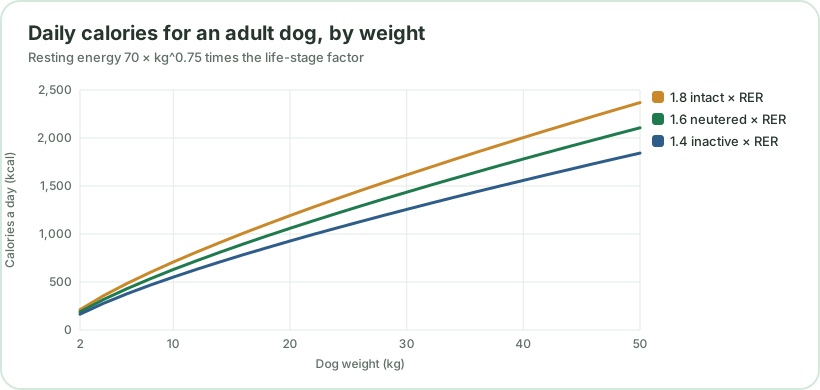
Treats, including training rewards, are limited to about 10% of daily calories (WSAVA and AAHA). The Dog Treat Calorie Calculator gives the allowance for your dog, and our guide to how many treats a dog can have lists it by weight. For a neutered adult: 63 kcal at 10 kg, 106 kcal at 20 kg and 144 kcal at 30 kg.
How many rewards that buys
The smaller each reward, the more you can give. This table shows how many rewards fit the allowance at different sizes.
| Reward size | 10 kg dog (63 kcal) | 20 kg dog (106 kcal) | 30 kg dog (144 kcal) |
|---|---|---|---|
| 1 kcal (a crumb of kibble) | 63 | 106 | 144 |
| 3 kcal (a small piece) | 21 | 35 | 48 |
| 5 kcal | 12 | 21 | 28 |
| 10 kcal | 6 | 10 | 14 |
| 20 kcal | 3 | 5 | 7 |
A dog that has a 20-minute session with 40 rewards of 3 kcal gets 120 kcal. For a 10 kg dog that is almost double the allowance, and it is why the same session needs smaller rewards or fewer repetitions for a small dog.
Four ways to keep training treats under control
1. Use the dog’s own food. Weigh the day’s meals in the morning and set aside a handful for training. Nothing is added, because the rewards are part of the measured meals. For many dogs, kibble works well after a short period of learning that it is a reward.
2. Make rewards tiny. Break a treat into pea-sized pieces, or even smaller. A dog does not need a large piece to understand a reward, and tiny pieces keep sessions fast.
3. Subtract from meals. When you use treats beyond the daily kibble, remove the same calories from dinner. For a 20 kg dog on a 3,600 kcal/kg food, 30 kcal of treats is about 8 g less at mealtime.
4. Reward with something other than food. Praise, a game of tug, a short run or a toy can be as effective as food for some dogs and in some exercises. Mix food and non-food rewards, and keep food for the hardest tasks.
A worked example
A 20 kg neutered dog goes to a training class once a week.
- Daily calories: 1,059. Treat allowance: 106 kcal.
- On class day, the owner uses 60 pieces of kibble of about 3.5 kcal each: 210 kcal.
- That is 100 kcal more than the allowance, so the owner takes 210 kcal (about 58 g of 3,600 kcal/kg kibble) out of the day’s meals and uses it as rewards.
- On other days, the owner uses a smaller amount, about 106 kcal.
- The dog’s weight is checked every two weeks; it stays steady.
The principle is that rewards come out of the day’s food, so a heavy training day is balanced by smaller meals. The Pet Meal Size Calculator divides what is left into meals.
Counting rewards you cannot weigh
Counting every piece is not realistic in a class. A practical approach:
- Weigh a portion of kibble in the morning for training. Whatever is left at the end of the day goes into dinner.
- If you use commercial treats, find the calories of one piece with the Pet Treat Energy Converter and count by pieces for the first week.
- Keep rewards in a small pouch with a set number of pieces, and stop when it is empty.
Our guide to dog treat calories explains how to read labels and weigh treats.
Special cases
- Small dogs. A 2 kg dog has about 19 kcal for treats a day, so rewards must be crumbs or use the daily food.
- Puppies. Puppies need many rewards. The allowance is 10% of a bigger total, and meals can be reduced on class days; see our puppy feeding chart.
- Dogs on a weight plan. The allowance is 10% of the plan’s calories, about 78 kcal for a 30 kg dog with a 25 kg goal. Use measured kibble for rewards and keep other treats to a few; see the dog weight loss plan.
- Dogs with health conditions or special diets. Ask your vet which rewards are suitable.
Checking that it works
Weigh your dog every two weeks and score body condition each month. If the weight rises, cut the rewards or the meals by about 10% and recheck. If your dog is losing weight without a plan, check with your vet. A training diary with the day’s rewards and the dog’s weight shows the link between them.
Common mistakes
- Giving full-sized treats as rewards.
- Not reducing meals on training days.
- Using several different treats without counting any.
- Letting several people reward the dog without telling each other.
- Forgetting the treats from the day before.
- Assuming that “small” treats are free.
A sample training session, counted
An example of a ten-minute session for a 20 kg neutered dog with a 106 kcal allowance:
| Item | Number | kcal each | kcal |
|---|---|---|---|
| Kibble pieces for easy tasks | 25 | 3 | 75 |
| Small soft treats for harder tasks | 5 | 4 | 20 |
| Tug game | 1 | 0 | 0 |
| Total | 95 |
That is 95 kcal, which leaves 11 kcal for the rest of the day. If the dog also has a chew, the owner takes the chew’s calories out of dinner. Planning the session before it starts is what keeps it inside the allowance.
The training pouch method
A habit that works well: each morning, fill a small pouch with a measured portion of the dog’s kibble for training. Whatever is left in the pouch in the evening is added to dinner. Benefits:
- The calories are counted automatically.
- The rewards are the same food the dog eats at meals, so there is less risk of upset stomachs.
- You can see at a glance how much has been used.
- It works in classes and on walks.
If the dog does not value kibble, add a few higher-value treats and count them.
Rewards that are not food
Rewards that are not food can be very effective:
| Reward | When it works |
|---|---|
| Praise and petting | Dogs that love attention |
| A game of tug or fetch | Dogs that love play |
| Access to something they want, such as going through a door or off to sniff | Dogs with strong interests |
| A short run or a walk | After a task |
| A favourite toy | Dogs that love toys |
Mixing rewards keeps training varied and lowers the calorie cost. A trainer can help you find what your dog values most.
Choosing treats by calories per piece
Not all treats cost the same. A tiny pea-sized piece of soft treat may have 2 to 4 kcal, while a biscuit may have 30 or more, and the difference matters when you give 40 in a session. Check the label for kcal per treat, or weigh the treat and use kcal per 100 g.
| Treat type | What to check |
|---|---|
| Kibble | kcal per gram from the food label |
| Soft training treats | kcal per piece; break them smaller |
| Dental chews | kcal per chew, often in the tens |
| Fresh foods | Ask your vet which are safe, then estimate kcal |
| Biscuits | kcal per biscuit; usually too large for training |
Use the Dog Treat Calorie Calculator to turn the treat’s label into a number of pieces per day.
The 10% rule as a budget
Treats stay within 10% of daily calories. A dog needing 1,059 kcal has 106 kcal for treats; a dog needing 534 kcal has 53 kcal. Subtract the treat calories from meals and the total stays on target. For the full method see how many treats a dog can have.
Training days versus rest days
On a heavy training day, plan the treat budget in the morning and cut meals to match. On a rest day, give fewer treats. Averaged across the week, the total should still match the dog’s need. A dog in a weight-loss plan should keep treats inside the plan, as described in our guide to how fast a dog should lose weight.
A weekly check
Once a week, weigh the dog and look at body condition. If the weight is stable and the ribs are easy to feel, your treat plan is working. If weight creeps up, cut treats by a third for two weeks and check again. Keep notes so you can see which sessions used the most calories.
Pairing treats with meals
Train before meals when the dog is hungry and pay in kibble, so that rewards come from the dinner bowl. On days with long sessions, serve a little less at dinner. Keep a spare container of the measured daily kibble so nothing is double-counted, and note the leftover at the end of the day. Within a week the routine becomes automatic.
Quick summary
- Keep rewards within the 10% treat allowance, which is 63 kcal for a 10 kg dog and 106 kcal for 20 kg.
- Use pieces of the dog’s measured daily food as rewards when possible.
- Break treats into pea-sized pieces, and count them.
- Take the same calories out of meals on heavy training days.
- Weigh the dog every two weeks and adjust by about 10%.
- Use the Dog Treat Calorie Calculator to set the allowance.
Frequently asked questions
How do I train with treats without my dog gaining weight?
Count every treat within the 10% allowance, use pieces of the daily food and reduce meals by the calories you give as rewards.
How many treats can I use in a training session?
As many as fit in the allowance when each is tiny. A 10 kg dog's 63 kcal allows 60 rewards of 1 kcal or 20 of 3 kcal.
Can I use my dog's kibble for training?
Yes, and it is the simplest method. Measure the day's food in the morning and use some of it as rewards.
How small should treats be?
Pea-sized or smaller, so that the reward is quick to eat and low in calories.
What about puppies?
Puppies need many rewards. Count them within the allowance, which for a young puppy is 10% of a larger daily total, and reduce meals on training days.
What if my dog is on a weight loss plan?
Use pieces of the measured daily food as rewards, and keep other treats very few.
Do I need special low-calorie treats?
Not necessarily. Tiny pieces of any suitable treat or kibble work, as long as you count them.
Sources
- WSAVA Global Nutrition Guidelines: treats at most about 10% of daily calories
- AAHA (2014) Weight Management Guidelines for Dogs and Cats
- NRC (2006) Nutrient Requirements of Dogs and Cats, National Academies Press
Related calculators
- Dog Treat Calorie CalculatorCheck how many treats your dog can have a day without unbalancing its diet — the 10% rule.
- Pet Treat Energy ConverterTurn kcal per 100 g and the weight of one treat into the calories in each treat.
- Dog Food CalculatorTurn your dog's daily calorie need into grams and cups of the food you actually feed, using the energy value printed on the bag.
- Pet Meal Size CalculatorSplit a daily food amount into meals and see how many grams (and calories) go in each bowl.
Keep reading
- How Many Treats Can a Dog Have a Day?How many treats a dog can have a day: the 10% rule, a chart of treat counts by weight and treat size, counting chews and training rewards and what to cut at meals.
- Dog Treat Calories: Reading Labels and CountingHow to find the calories in dog treats: kcal per treat or per 100 g, weighing a treat, worked label examples, a counting log and how treats fit into the daily total.
- Dog Weight Loss Plan: Calories and PaceA practical dog weight loss plan: how to set a goal weight, work out daily calories, choose a safe pace of 1 to 2% a week and track progress.
- Low-Calorie Dog Treats and Rewards: How to ChooseHow to choose low-calorie dog treats and rewards: reading kcal per treat, cutting pieces small, using the daily kibble, non-food rewards and a budget by size.