
A large-breed puppy is a rapid builder. In its first year it may go from under 2 kg to 30 kg or more, forming a skeleton and muscles that will carry that weight for a decade or longer. That makes feeding both more important and more delicate than for a small breed. Too little food can leave a puppy underweight; too much, or too rich a diet, can push growth faster than the skeleton can comfortably handle. Veterinary nutrition bodies stress steady growth and lean body condition. This guide explains what that means in practice, with calorie examples, food choice, a weekly routine and the questions to ask your vet.
What counts as large breed
There is no single definition. Many sources treat dogs expected to weigh more than about 25 kg as large and those above about 45 kg as giant, but the lines vary. Your vet or breeder can tell you the expected adult weight of your puppy, and a mixed-breed puppy may need an estimate from size and paws at an early age. What matters for feeding is that the puppy has a long road of growth ahead, and that the calories need to be matched to a steady, not a fast, climb.
Why steady beats fast
Growth in a large puppy is driven by genes, but food influences the pace. Feeding generously speeds up weight gain, and a heavy puppy places more load on joints that are still developing. Veterinary nutrition guidance, including the WSAVA guidelines, supports keeping puppies lean, so that they are at the lower end of the healthy range for condition. A lean puppy is not underfed: the ribs are easy to feel under a thin layer of padding, a waist is visible from above and the puppy is energetic and growing steadily.
You do not have to hold a puppy back on purpose; you have to avoid pushing growth with extra food, rich treats and supplements. The best check is the pattern of weights over time, together with body condition.
Calorie examples
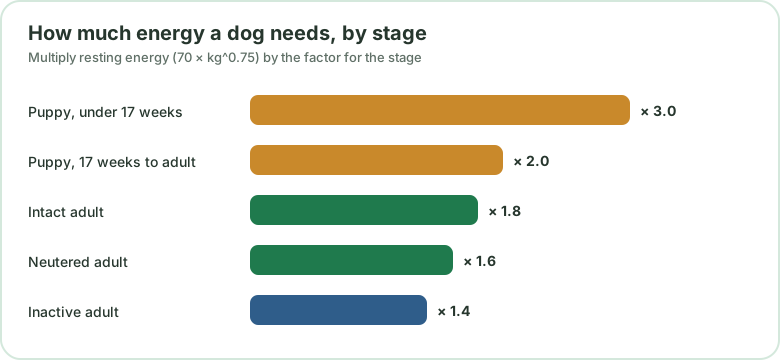
The calculators use the same method for all puppies: RER = 70 × weight in kg ^ 0.75, times 3.0 under about 17 weeks and 2.0 after. A large-breed puppy’s weight rises much more over the same weeks, so the amounts change quickly. The table shows illustrative weights and amounts at 3,800 kcal/kg, not a growth chart.
| Illustrative stage | Weight | Factor | Calories a day | Grams a day (3,800 kcal/kg) |
|---|---|---|---|---|
| 8 weeks | 5 kg | 3.0 | 702 | 185 g |
| 12 weeks | 9 kg | 3.0 | 1091 | 287 g |
| 16 weeks | 14 kg | 3.0 | 1,520 | 400 g |
| 20 weeks | 18 kg | 2.0 | 1,223 | 322 g |
| 26 weeks | 24 kg | 2.0 | 1,518 | 399 g |
| 40 weeks | 32 kg | 2.0 | 1,884 | 496 g |
The weights are examples of how a large-breed puppy might progress, and are not a target for your puppy. Notice the daily amount falls between 16 and 20 weeks, even though the puppy is heavier, because the factor drops from 3.0 to 2.0. Owners who keep raising the amount at that point are the ones who end up with a heavy puppy. The Puppy Food Calculator recalculates for each weight and age.
Choosing the food
For large and giant breeds, veterinary nutrition guidance (WSAVA, AAHA) points toward steady growth, and your vet may recommend a food made for large-breed puppies. These are formulated with attention to energy density and the balance of minerals. Look for a statement on the label that the food is complete and balanced for growth, and ask your vet. WSAVA’s guidelines suggest questions to ask manufacturers, for example whether they employ a qualified nutritionist, who formulates the diet and what quality control they use.
Do not switch to an adult food early because the puppy is large; a big puppy is still a puppy. Our guide on when to switch puppy food to adult food explains the timing and how to change gradually.
Supplements: the cautious view
It is tempting to add calcium, joint supplements or extra protein to support big bones. For a growing large-breed puppy, extra calcium in particular can disturb the careful balance of a complete food, and is generally not advised unless a vet recommends it. The same applies to feeding raw bones or a home-made diet without professional formulation; see our guide on raw feeding for puppies. If you want to use a supplement, ask your vet which, why and how much.
Meals and routine
Smaller, more frequent meals are common for young puppies, reducing over time.
| Age | Typical meals a day |
|---|---|
| Under 13 weeks | 4 |
| 13 to 25 weeks | 3 |
| 26 weeks and older | 2 |
Your vet may suggest a different pattern for your puppy. Some owners of deep-chested breeds ask about the risks of eating fast or exercising close to meals; this is a good question for your vet, who can advise on your breed. Offer meals at set times, in a calm place, and rest the puppy afterwards. Fresh water should be available.
The weekly routine
- Weigh the puppy on the same day each week, with the same scale. For a big puppy, use the vet’s scale or weigh yourself with and without the puppy.
- Record the weight and the food.
- Score body condition with the Dog Body Condition Score tool: the target is about 4 or 5 on the 9-point scale.
- Recalculate the amount, using the new weight and the age stage.
- Adjust by about 10% if the trend is too fast or too slow, and tell your vet.
- Review monthly with a growth chart if your vet provides one.
Because large-breed puppies grow so quickly, it is worth asking your vet for a breed growth curve to compare against. Do not use unreferenced charts from the internet to judge your puppy.
Exercise and growth
Large puppies are enthusiastic but their joints are still forming. Ask your vet what level of exercise suits your puppy at each age. General principles, which your vet may adjust, include short bursts of play rather than long runs, avoiding repeated jumping and twisting on hard surfaces and allowing plenty of rest. Controlled lead walks and free play on soft ground are often suggested. Your vet and trainer can help.
Treats and training
Training is important for a puppy that will be strong, and treats are a useful tool. At 10% of daily calories, a puppy needing 1,223 kcal has about 122 kcal for treats. Use small pieces, and take them out of the day’s meals. See training treats without weight gain.
Common mistakes
- Pushing growth with extra food.
- Adding calcium or other supplements.
- Using an adult food too early.
- Continuing to raise the amount after the stage changes at about 17 weeks.
- Skipping weigh-ins.
- Over-exercising a young puppy.
- Ignoring body condition.
Questions to ask your vet
- What is my puppy’s expected adult weight?
- Which food and amount do you suggest?
- Is my puppy’s growth rate right?
- Should I avoid any supplements or treats?
- When should we move to adult food?
A growth log you can copy
For a large-breed puppy, a growth log is not a luxury. It shows whether growth is steady, which is the aim, and it gives your vet something to compare with a breed curve.
| Week | Age (weeks) | Weight (kg) | Gain since last (kg) | Body condition (1–9) | Daily food (g) | Notes |
|---|---|---|---|---|---|---|
| 1 | ||||||
| 2 | ||||||
| 3 |
Look at the gain column. A large puppy may gain 1 to 2 kg a week in the fastest period, but the pattern is more important than any single week. If gains jump suddenly or condition rises toward 6 or 7, tell your vet. If gains stall and the ribs become prominent, tell your vet that too.
Feeding the whole litter-mate and sibling comparisons
Owners of puppies from the same litter often compare weights. Siblings can differ by several kilograms and both be healthy, since growth patterns vary. Compare condition and trend, not the number. A puppy that is the leanest of its siblings may be the healthiest, and one that is the heaviest may need its amount reviewed. Your vet can help you interpret differences.
Jumping, stairs and surfaces
Ask your vet about movement as well as food. Large-breed puppies’ joints are developing, and repeated jumping, long runs on hard surfaces or climbing many stairs can be hard on them. Common-sense steps include non-slip floors, ramps for the car and furniture, short play sessions and soft ground. These are general ideas; your vet may suggest more specific limits for your breed and age. Keep your puppy lean, because weight is the factor most within your control.
The adult transition
When growth is nearly finished, the move to adult food follows the same steps as for any dog, though the timing is later. Recalculate the amount with the adult factor, change over a week and keep weighing. See when to switch puppy food to adult food for the arithmetic. Many large dogs continue to fill out for some months after they reach adult height, so keep monitoring body condition.
Questions to ask the breeder
If you are getting a large-breed puppy, ask the breeder:
- How big are the parents, and what did they weigh as adults?
- What food has the puppy been eating, and how much, in grams?
- Have the parents had health tests relevant to the breed?
- What is the puppy’s weight now, and what was it at birth and at each week?
- How long do dogs in the line usually live?
- What advice do you give for feeding and exercise?
Write down the answers and share them with your vet. A good breeder will be glad to help and will keep in touch.
Large dogs and costs
Large puppies eat a lot, and the bill rises quickly. An adult 40 kg dog needs about 1,781 kcal as a neutered adult, or 495 g of a 3,600 kcal/kg food, which is about 15 kg a month. Plan for this in the monthly budget, and compare foods by cost per 1,000 kcal. The Dog Food Cost Calculator takes the bag price and daily grams and returns the monthly bill. Add the cost of larger equipment, parasite treatments priced by weight band and boarding, and use the Cost of Owning a Dog Calculator.
Quick summary
- Large-breed puppies should grow steadily, with a lean body condition.
- Use a complete food made for large-breed growth, and avoid supplements unless your vet advises.
- Calories = 70 × kg ^ 0.75 × 3.0 under about 17 weeks, then × 2.0.
- Weigh weekly, score condition, recalculate and adjust by about 10%.
- Exercise gently; ask your vet what suits your puppy.
- Use the Puppy Food Calculator each week.
Frequently asked questions
Why is large-breed puppy feeding different?
Large puppies grow for longer and for more kilograms, and they are sensitive to overfeeding and to nutrient balance during growth. Ask your vet about a food made for large-breed puppies.
Should a large-breed puppy be kept lean?
WSAVA nutrition guidance supports steady growth and a lean body condition, with ribs easy to feel under a thin layer of padding.
How many meals does a large-breed puppy need?
Commonly three or four small meals when young, reducing to two as the puppy matures. Ask your vet for your puppy.
Should I give calcium supplements?
Not unless your vet recommends them. Complete puppy foods are balanced, and extra calcium can upset that balance.
When does a large-breed puppy become an adult?
Later than small breeds. AAHA's puppy stage runs to about 6 to 9 months for many dogs, with large and giant breeds finishing growth later. Ask your vet.
How often should I weigh my puppy?
Weekly, on the same scale, and log the weights.
Is exercise a concern?
Ask your vet about suitable exercise for growing large-breed puppies and avoid repeated high-impact activity.
Sources
- AAHA (2019) Canine Life Stage Guidelines. Journal of the American Animal Hospital Association 55:267-290
- WSAVA Global Nutrition Guidelines (incl. 9-point BCS charts)
- NRC (2006) Nutrient Requirements of Dogs and Cats, National Academies Press
Related calculators
- Puppy Food CalculatorCalculate how much a growing puppy needs, how many meals a day, and how much per meal.
- Puppy & Kitten Age CalculatorFind your puppy's or kitten's exact age in weeks, months and days from its birth date.
- Dog Body Condition Score & Ideal Weight CalculatorScore your dog's body condition on the 9-point scale and estimate its ideal weight.
Keep reading
- Puppy Feeding Chart: Calories by Age StageA puppy feeding chart with calories and grams by weight for two stages: under 4 months and 4 months to adult, plus meals per day and how to move to adult food.
- When to Switch Puppy Food to Adult FoodWhen to move a puppy to adult food: AAHA's stage guide, why large breeds switch later, the 20% energy drop to recalculate and a 7-day transition plan.
- Puppy Feeding Mistakes That Cause Tummy TroubleCommon puppy feeding mistakes, from sudden food changes and cup measuring to uncounted treats and skipped weigh-ins, with the arithmetic and the fix.
- Wet vs Dry Puppy Food: Calories, Cost and RoutineWet and dry puppy food compared on calories per gram, moisture, cost per 1,000 kcal and convenience, with worked examples for a 5 kg puppy and mixing advice.