
At some point in every puppy’s life, the bag of puppy food starts to look like a mistake. The puppy has grown, the weight has levelled off, and the label says “puppy” on a dog that feels nearly adult. When should you switch, how much should you feed afterwards and how do you do it without causing an upset stomach? The honest answer to the first question is “it depends on size and your vet’s advice”, but there are principles, numbers and a simple plan that make it easy. This guide explains them.
What the guidelines say
AAHA’s 2019 Canine Life Stage Guidelines describe the puppy stage as lasting from birth to about 6 to 9 months of age, with large and giant breeds finishing growth later. Growth is the reason for a special diet: puppies need more energy per kilogram and a balance of nutrients suited to building bone and muscle. When growth ends, an adult maintenance diet fits better, and a puppy diet can lead to extra weight.
| Expected adult size | Typical time to switch (a guide only) |
|---|---|
| Toy and small breeds | Around the end of the usual puppy window, sometimes earlier |
| Medium breeds | About 6 to 9 months |
| Large breeds | Later; ask your vet |
| Giant breeds | Later still; ask your vet |
The table is a pointer to ask your vet, not a timetable. Breeds, individuals and feeding history vary. Your vet can judge the right time from your puppy’s weight, body condition, expected adult size and whether it has been neutered.
Why timing differs by size
Small dogs reach adult size in months, while large and giant dogs may keep growing for much longer. A giant puppy at 9 months may still be growing steadily, so a growth diet remains suitable for longer, though the energy amount must be controlled so growth is steady, not rapid. Large-breed puppy foods are made with this in mind. An adult food too early may not suit the growth, and a puppy food too late may supply more energy than an adult needs. The vet’s judgement balances these.
The calorie change at the switch
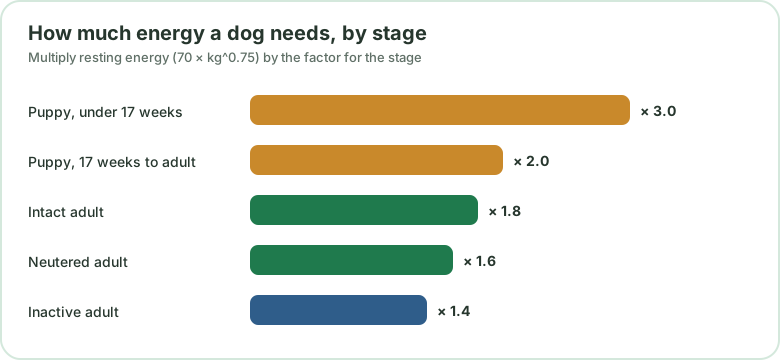
The most practical step at the switch is to recalculate the food amount, because the energy factor changes. For the same weight, a puppy of 17 weeks or more uses 2.0 times resting energy, and a neutered adult uses 1.6. That is a 20% reduction. If the dog is intact, the adult factor is 1.8, a reduction of 10%.
| Weight | Puppy (2.0 × RER) | Neutered adult (1.6 × RER) | Difference | Grams at switch (3,800 vs 3,600 kcal/kg) |
|---|---|---|---|---|
| 5 kg | 468 kcal | 374 kcal | −94 | 123 g → 104 g |
| 10 kg | 787 kcal | 630 kcal | −157 | 207 g → 175 g |
| 15 kg | 1,067 kcal | 854 kcal | −213 | 281 g → 237 g |
| 20 kg | 1,324 kcal | 1,059 kcal | −265 | 348 g → 294 g |
| 25 kg | 1,565 kcal | 1,252 kcal | −313 | 412 g → 348 g |
| 30 kg | 1,795 kcal | 1,436 kcal | −359 | 472 g → 399 g |
The last column assumes the puppy food has 3,800 kcal/kg and the adult food 3,600, to show how both changes combine. Your foods will differ, so use the labels. The Dog Food Calculator and the Dog Calorie Calculator do the sums for the adult stage.
Do not wait for weight to rise before recalculating. A dog that is fed the puppy amount of a puppy food after growth ends will gain weight quickly. Weigh weekly during the switch, and check body condition with the Dog Body Condition Score tool.
How to make the switch
A gradual change protects the stomach. Our guide to how to switch dog food has the details; the short version is a seven-day plan.
| Day | Puppy food | Adult food |
|---|---|---|
| 1 to 2 | 75% | 25% |
| 3 to 4 | 50% | 50% |
| 5 to 6 | 25% | 75% |
| 7 | 0% | 100% |
The percentages refer to the calories or the grams of the day’s total (check that the total calories match the new target). Some dogs need a slower change, and some tolerate a quicker one. If stools become loose, drop back a step for a day or two. If the problem continues, call your vet.
Signs the new food suits
- Firm stools, within a few days of the change.
- Steady, appropriate weight.
- A healthy coat and bright eyes.
- Good energy.
- Interest in meals.
If your dog has an itch, recurring loose stools or loses weight on the new food, speak to your vet. Do not assume it is the food without a check.
What if my puppy is neutered?
Neutering often takes place around the time of the switch. After neutering, energy needs fall, and many dogs gain weight if the food is not reduced. The adult neutered factor is 1.6 against 1.8 for intact adults. Ask your vet when to adjust, and weigh weekly after the operation. If you are unsure, ask the vet to recalculate with you.
Treats and extras at the switch
When the amount of food falls, so does the room for treats. A 20 kg dog on 1,059 kcal has 106 kcal for treats, whereas the puppy amount of 1,324 kcal gave 132. Keep treats within 10% of the new total, and adjust the meals. See how many treats a dog can have for counting.
Common mistakes
- Switching on a birthday rather than on advice.
- Forgetting to cut the amount.
- Changing foods suddenly.
- Staying on puppy food too long.
- Switching a large-breed puppy too early.
- Not weighing during the switch.
- Mixing foods without checking the total calories.
Questions to ask your vet
- When should my puppy move to adult food?
- Which adult food and amount do you suggest?
- Does neutering change the plan?
- How should I weigh during the change?
- What should I do if stools become loose?
A worked switch for a medium-breed puppy
Take a female medium-breed puppy of 14 kg at 8 months, neutered at 7 months. She has been eating a 3,800 kcal/kg puppy food at 2.0 times resting energy: RER = 70 × 14 ^ 0.75 = 506, so 1,013 kcal, or 267 g a day. Her vet agrees she is ready for adult food of 3,600 kcal/kg.
| Step | Working | Result |
|---|---|---|
| New daily energy | 506 × 1.6 | 810 kcal |
| New daily grams | 810 ÷ 3.6 | 225 g |
| Change in calories | 810 − 1,013 | −203 kcal (−20%) |
| Change in grams | 225 − 267 | −42 g |
| Treat allowance (10%) | 81 kcal | down from 101 |
Run the transition over seven days with the new target in mind. On day 4 (50/50), half the calories (405) come from each food: 405 ÷ 3.8 = 107 g of puppy food and 405 ÷ 3.6 = 113 g of adult food. By day 7 she is on 225 g of adult food. Weigh her on day 1, day 7 and then every week for the first month, and adjust by about 10% if her weight moves in the wrong direction.
Signs your puppy may be ready, and signs to wait
Your vet decides, but you can bring useful observations to the appointment.
| Observation | May suggest |
|---|---|
| Weight gain has slowed or levelled off | Growth is ending |
| Height and length have stopped increasing | Nearing adult size |
| The breeder or vet expects adult size soon | Close to switching |
| Weight is still rising steadily | Growth is continuing; wait for advice |
| A large or giant breed under about a year | Probably not yet |
| Body condition is above ideal on puppy food | Review the amount, with your vet |
If your puppy is chubby on the puppy amount, the answer may be to cut the amount, not to switch food. Our guide to whether a puppy is overweight shows how to check.
What happens if the switch is too early or too late
An early switch to adult food in a growing puppy risks supplying less energy and a different nutrient balance than growth requires, which is why vets want to confirm timing, especially in large breeds. A late switch leaves the dog on an energy-dense food it no longer needs, and the usual consequence is weight gain, because owners continue to feed the puppy amount. The error is easy to make and easy to fix: weigh regularly, score body condition and ask your vet. The sums in this guide let you check the calorie change yourself before you order the new bag.
Puppies on “all life stages” food
Some foods are labelled for all life stages, meaning they meet the nutrient profile for growth and reproduction as well as adult maintenance. A dog on such a food does not have to change food at the end of puppyhood, but the amount still has to change, because the energy factor falls. The quantity is what matters. Read the label’s statement, and ask your vet whether the food suits a large-breed puppy, since some all-life-stage foods are not designed for the controlled growth of large breeds.
A checklist for the day you switch
- Weigh the puppy and score body condition.
- Write down the new calorie target and the grams of the new food.
- Buy or measure the new food, and check its energy value on the label.
- Plan the seven days of mixing, with the grams of each food per day.
- Tell everyone in the household the new amounts.
- Note any change in treats; the allowance falls with the daily total.
- Put a reminder in the calendar to weigh at the end of the first week and the first month.
Questions people ask about the timing
My vet said to switch at 12 months; the bag says 9. Which is right? Follow your vet, who knows your puppy’s breed and growth.
My puppy is small for its age. Should I wait? Ask your vet; the answer depends on the reason for the size.
Can I switch gradually over weeks by mixing? A slow change is fine; the key is that the total calories match the target at each stage.
My puppy has been neutered. Does that change the timing? Neutering affects the energy factor, not the stage; but the two often coincide, so recalculate.
What about a puppy on a prescription diet? Follow your vet’s plan.
The cost side
Adult foods are often cheaper per kilogram than growth foods, but the daily amount falls, so the cost per day usually falls too. Use the Pet Food Price per 1,000 kcal Calculator to compare the two foods on cost per 1,000 kcal and per day. A 20 kg dog on 1,324 kcal of a 3,800 kcal/kg puppy food at 4.80 a kilo costs 1.67 a day; on 1,059 kcal of a 3,600 kcal/kg adult food at 3.60 a kilo, it costs 1.06 a day. The numbers are example prices, but they show that the switch can lower the bill as well as the calories.
Quick summary
- AAHA places the end of puppyhood at about 6 to 9 months; large and giant breeds are later.
- Ask your vet for a date based on size and condition.
- Recalculate at the switch: a neutered adult uses about 20% fewer calories than a 2.0-factor puppy.
- Change foods gradually over about a week.
- Weigh weekly and watch body condition and stools.
- Use the Puppy Food Calculator and the Dog Food Calculator for the amounts.
Frequently asked questions
When should I switch my puppy to adult food?
AAHA places the end of the puppy stage at about 6 to 9 months. Large and giant breeds finish growing later, so ask your vet for a date for your puppy.
Why do large breeds stay on puppy food longer?
They grow for longer, so the growth diet is used for longer. Your vet will advise on the right food and timing.
How much less should I feed after switching?
At the same weight, a neutered adult needs about 20% fewer calories than a 2.0-factor puppy (1.6 against 2.0). Recalculate from weight and the new food's label.
How do I switch foods?
Gradually over about a week, mixing in more of the new food each day. Slow down if stools go loose.
Does neutering change the amount?
Neutered dogs generally need less energy than intact ones (1.6 against 1.8 times resting energy for an adult), so recalculate after surgery.
Is it harmful to switch too early?
Adult foods are not designed for growth, so ask your vet before switching early, especially for large breeds.
Is it harmful to switch too late?
Puppy food is energy dense, and staying on it after growth ends can lead to weight gain.
Sources
- AAHA (2019) Canine Life Stage Guidelines. Journal of the American Animal Hospital Association 55:267-290
- NRC (2006) Nutrient Requirements of Dogs and Cats, National Academies Press
- WSAVA Global Nutrition Guidelines
Related calculators
- Puppy Food CalculatorCalculate how much a growing puppy needs, how many meals a day, and how much per meal.
- Dog Food CalculatorTurn your dog's daily calorie need into grams and cups of the food you actually feed, using the energy value printed on the bag.
- Dog Calorie CalculatorSee how many calories your dog needs a day: its resting energy requirement (RER) and daily maintenance energy (MER) for its life stage.
Keep reading
- Puppy Feeding Chart: Calories by Age StageA puppy feeding chart with calories and grams by weight for two stages: under 4 months and 4 months to adult, plus meals per day and how to move to adult food.
- How Much Should I Feed My Dog? By WeightHow much to feed a dog by weight: a grams and cups chart, how to read the food label, meals per day, adjusting by body condition and common mistakes.
- How to Switch Dog Food Gradually: A 7-Day PlanHow to switch dog food without an upset stomach: a 7-day and a 14-day mixing plan, how to match calories between foods, signs to slow down and when to call the vet.
- Wet vs Dry Puppy Food: Calories, Cost and RoutineWet and dry puppy food compared on calories per gram, moisture, cost per 1,000 kcal and convenience, with worked examples for a 5 kg puppy and mixing advice.