
A puppy feeding chart is a table you can glance at on the kitchen wall, and it is most useful when it shows both the calories and the grams for the puppy’s current weight and stage. This page gives that chart, explains the two stages it is built on and shows how to keep it up to date as your puppy grows. For the story behind the numbers, our guide to how much to feed a puppy explains growth, meals and switching to adult food.
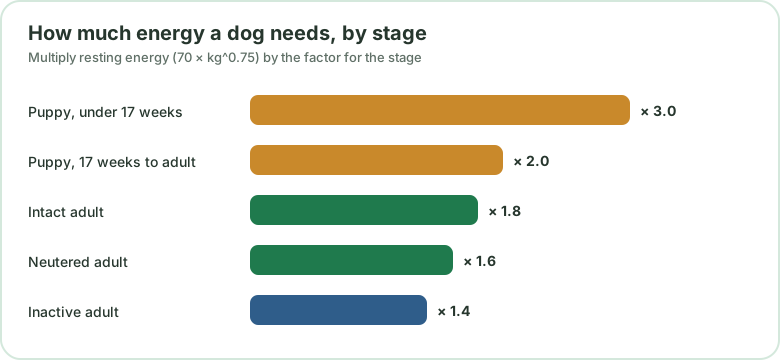
How the chart is built
Every number comes from the same two steps:
- RER = 70 × weight in kg ^ 0.75 (resting energy).
- Daily energy = RER × the puppy factor: 3.0 under 4 months and 2.0 from 4 months to adulthood.
Then food = calories ÷ (kcal per kg ÷ 1,000). The Puppy Food Calculator applies the stage from the puppy’s age in weeks, treating anything under 17 weeks as the first stage.
Stage 1: under 4 months
| Puppy weight | Calories a day (3.0 × RER) | Food a day (3,800 kcal/kg) | Per meal at 4 meals |
|---|---|---|---|
| 1 kg (2.2 lb) | 210 | 55 g | 14 g |
| 2 kg (4.4 lb) | 353 | 93 g | 23 g |
| 3 kg (6.6 lb) | 479 | 126 g | 31 g |
| 5 kg (11 lb) | 702 | 185 g | 46 g |
| 8 kg (17.6 lb) | 999 | 263 g | 66 g |
| 10 kg (22 lb) | 1,181 | 311 g | 78 g |
| 12 kg (26.5 lb) | 1,354 | 356 g | 89 g |
A puppy under 4 months weighing 10 kg is a large-breed puppy. Small breeds are usually well below 5 kg at this age. Grams are rounded.
Stage 2: 4 months to adulthood
| Puppy weight | Calories a day (2.0 × RER) | Food a day (3,800 kcal/kg) | Per meal at 3 meals | Per meal at 2 meals |
|---|---|---|---|---|
| 2 kg (4.4 lb) | 235 | 62 g | 21 g | 31 g |
| 5 kg (11 lb) | 468 | 123 g | 41 g | 62 g |
| 8 kg (17.6 lb) | 666 | 175 g | 58 g | 88 g |
| 10 kg (22 lb) | 787 | 207 g | 69 g | 104 g |
| 15 kg (33 lb) | 1,067 | 281 g | 94 g | 140 g |
| 20 kg (44 lb) | 1,324 | 348 g | 116 g | 174 g |
| 25 kg (55 lb) | 1,565 | 412 g | 137 g | 206 g |
| 30 kg (66 lb) | 1,795 | 472 g | 157 g | 236 g |
If you compare with the adult figures in our guide on how much to feed a dog, a neutered adult of 20 kg needs 1,059 kcal against 1,324 for a 20 kg puppy at this stage, so the puppy still eats noticeably more.
What the chart does not know
The chart assumes an average puppy and a food of 3,800 kcal/kg. Your puppy may be more or less active, and your food may have a different energy value. Use it as a starting point for two to four weeks, then adjust from weight gain and body condition. If the food is 3,400 kcal/kg, divide by 3.4 instead; if it is 4,000, divide by 4.0. Always read your own label.
Meals by age
The Puppy Food Calculator suggests:
| Age | Suggested meals |
|---|---|
| Under 13 weeks | 4 |
| 13 to 25 weeks | 3 |
| 26 weeks and older | 2 |
Divide the daily total evenly and keep meal times regular. Your vet may prefer different patterns for toy and giant breeds, so ask. Our guide to how many times a day a puppy should eat goes into the reasons.
A worked example
A puppy is 14 weeks old and weighs 8 kg, and the food is 3,800 kcal/kg.
- 14 weeks is under 17, so the stage is the first: factor 3.0.
- RER = 70 × 8 ^ 0.75 ≈ 333 kcal.
- Daily energy = 3.0 × 333 ≈ 999 kcal.
- Food = 999 ÷ 3.8 ≈ 263 g a day.
- At 14 weeks, 3 meals: about 88 g each.
Three weeks later the puppy is 17 weeks and 10 kg. It is now in the second stage: 2.0 × 394 ≈ 787 kcal, 207 g a day. The daily amount falls even though the puppy has grown, because the factor changed.
Keeping the chart current
A puppy that gains 0.5 to 1 kg a week is on a different row of the chart every fortnight. A simple routine keeps it accurate:
- Weigh on the same day each week.
- Look up the new weight and stage in the chart or the calculator.
- Change the daily grams, not the meal times.
- Keep a written log with date, weight and grams.
- Check body condition by feel: ribs easy to feel, waist visible.
The Puppy & Kitten Age Calculator gives the age in weeks from the birth date, which tells you when the stage changes.
When to move on to adult food
Puppyhood lasts until about 6 to 9 months for many dogs, according to AAHA’s life stage guidelines, and large and giant breeds finish growing later. Ask your vet when to switch, then change over about a week, mixing in more of the new food each day, and use the adult factor of 1.6 × RER for a neutered dog.
Treats and training
Training uses many small rewards. Count them. At 10% of daily calories, a 5 kg puppy in stage 1 has about 70 kcal for treats. Use part of the kibble, and cut meals slightly on heavy training days. The Dog Treat Calorie Calculator helps.
Common mistakes
- Using the stage 1 amount after the puppy passes 4 months.
- Forgetting to update as the puppy gains weight.
- Measuring with a cup instead of a scale.
- Assuming every food has 3,800 kcal/kg.
- Ignoring treats.
- Switching foods suddenly.
Questions to ask your vet
- What adult weight do you expect for this puppy?
- Which food and calorie target should I use now?
- When will we change meals per day?
- When should we move to adult food?
- How will we know if growth is too fast?
Chart for a puppy with a different food
The grams in the chart assume 3,800 kcal/kg. Here is how the stage 1 amounts change with the food, for a 5 kg puppy needing 702 kcal.
| Food energy | Grams a day | Per meal at 4 meals |
|---|---|---|
| 3,400 kcal/kg | 206 g | 52 g |
| 3,600 kcal/kg | 195 g | 49 g |
| 3,800 kcal/kg | 185 g | 46 g |
| 4,000 kcal/kg | 176 g | 44 g |
| 4,200 kcal/kg | 167 g | 42 g |
A puppy on the richest food eats about 19% less by weight than on the leanest, for the same calories. When you change brand, recalculate the grams; a “puppy” label does not mean the same energy density.
What a healthy growth curve looks like
Weight gain is steady but not perfectly smooth. Over a few weeks, a puppy’s weight should rise most weeks, with small pauses. A sample log for a medium-breed puppy:
| Age (weeks) | Weight | Daily calories (3.0 × RER) | Daily grams (3,800 kcal/kg) |
|---|---|---|---|
| 8 | 3.0 kg | 479 | 126 g |
| 10 | 4.0 kg | 594 | 156 g |
| 12 | 5.0 kg | 702 | 185 g |
| 14 | 6.0 kg | 804 | 212 g |
| 16 | 7.0 kg | 904 | 238 g |
| 18 (stage 2) | 8.0 kg | 666 | 175 g |
Notice that the daily grams rise for weeks 8 to 16 and then fall at week 18, when the factor drops from 3.0 to 2.0 × RER. If you keep feeding 238 g to the 8 kg puppy at 18 weeks, you give about 35% more than the chart suggests, and the puppy may get too heavy. Check your puppy’s age in weeks with the Puppy & Kitten Age Calculator and update the stage.
Using the chart with a divided day
Spread the daily grams across the day: four meals at first, three from about 13 weeks and two from about 26 weeks. For example, the 8 kg puppy at 18 weeks (175 g) on three meals eats about 58 g each time. For a younger puppy, the amounts are smaller and more frequent.
Printing and using the chart
Copy the stage 1 and stage 2 tables into a document and put the puppy’s name and food energy at the top. Add a column for the date and weight each week, and cross out the old grams as you update them. Keeping the sheet beside the food bin helps everyone in the household feed the same amount.
Noting changes in food
Whenever you change brand, write down the new kcal per kg on the chart and recalculate every row. A change from 3,800 to 3,400 kcal/kg raises the grams by about 12% for the same calories, and a change in the other direction lowers them. Mixing brands needs a weighted calculation, so keep the log up to date.
A short checklist before you rely on the chart
Confirm the puppy’s current weight on a scale, not an estimate. Check the age in weeks to pick the stage. Read the kcal per kg on the bag. Apply the factor, divide by the food’s energy and divide by the number of meals. Write the result on the chart, set a reminder to repeat next week, and call your vet if growth looks unusually fast or slow.
Quick summary
- Stage 1 (under 4 months) uses 3.0 × RER; stage 2 (4 months to adult) uses 2.0 × RER.
- A 5 kg puppy: 702 kcal and 185 g a day in stage 1; 468 kcal and 123 g in stage 2.
- Meals: 4 under 13 weeks, 3 from 13 to 25 weeks, 2 after that.
- Weigh weekly and update the row; amounts can fall at 4 months even as weight rises.
- Treats under 10% of daily calories; adult food when your vet advises.
- Use the Puppy Food Calculator for your puppy.
Frequently asked questions
How much should a puppy eat by weight?
It depends on weight and age stage. Under 4 months use 3.0 × RER, and from 4 months to adult 2.0 × RER, where RER = 70 × weight in kg ^ 0.75.
Why does the amount fall at four months?
The energy factor drops from 3.0 to 2.0 times RER, because growth slows, so the amount per kilogram falls even though the puppy is heavier.
Is this chart for large breeds too?
The factors are the same, but large-breed puppies are more sensitive to feeding, so ask your vet which food and pace suit your puppy.
Why use grams instead of cups?
Grams are accurate. Cups vary with the shape and density of the kibble, so use a scale if you can.
Do I count treats?
Yes. Keep treats within 10% of daily calories and reduce meals to match.
How often should I update the chart?
Weigh your puppy every week or two and recalculate with the new weight.
Can I use the puppy chart for a kitten?
No. Kittens use 2.5 × RER, so use the kitten feeding chart.
Sources
- NRC (2006) Nutrient Requirements of Dogs and Cats, National Academies Press
- Merck Veterinary Manual — Nutritional Requirements of Small Animals
- WSAVA Global Nutrition Guidelines
Related calculators
- Puppy Food CalculatorCalculate how much a growing puppy needs, how many meals a day, and how much per meal.
- Puppy & Kitten Age CalculatorFind your puppy's or kitten's exact age in weeks, months and days from its birth date.
- Dog Food Cups to Grams CalculatorConvert cups of dog food to grams (and back) using the energy values printed on your bag.
Keep reading
- How Much Should I Feed My Puppy? By AgeWork out how much to feed a puppy by weight and age: the calorie factors, meals per day, a grams table, a worked example and when to switch foods.
- How Many Times a Day Should a Puppy Eat?How many meals a day a puppy needs by age: four under 13 weeks, three to six months, then two. Meal-size examples, timing, toy breeds and when to ask your vet.
- How Much Should I Feed My Dog? By WeightHow much to feed a dog by weight: a grams and cups chart, how to read the food label, meals per day, adjusting by body condition and common mistakes.
- When to Switch Puppy Food to Adult FoodWhen to move a puppy to adult food: AAHA's stage guide, why large breeds switch later, the 20% energy drop to recalculate and a 7-day transition plan.