
The first days with an 8-week-old puppy are exciting and slightly alarming, and feeding is one of the biggest worries. The puppy is tiny, hungry and changing every day, the bag says one thing, the breeder said another and online charts disagree. This guide cuts through it with a clear method: work out the puppy’s daily calories from its weight, convert them to grams of its food, split them into meals and adjust each week as it grows. It gives worked examples for puppies from 1.5 to 8 kg, a sample day, advice on keeping the breeder’s food for the first days and a checklist of signs that all is going well. For the whole of puppyhood, see our puppy feeding chart.
Why weight matters more than age
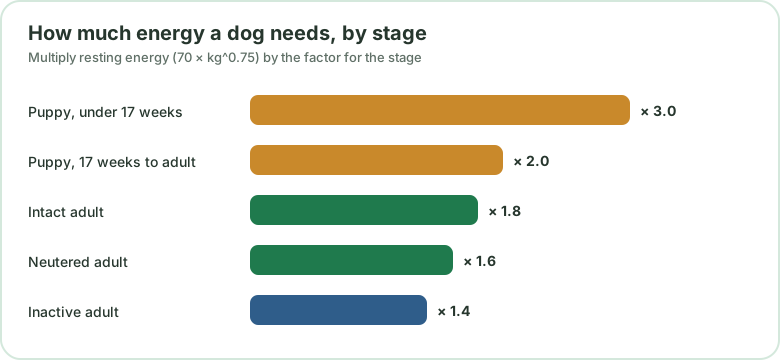
At 8 weeks, puppies differ in size enormously. A toy-breed puppy may weigh 1.5 kg and a giant-breed puppy 8 kg or more. The age tells you the stage; the weight tells you the amount. In our calculators, a puppy under about 17 weeks uses a factor of 3.0 times resting energy (RER), where RER = 70 × weight in kg ^ 0.75. A puppy of 17 weeks or more uses 2.0 times. So for an 8-week-old, the factor is always 3.0, and the weight decides the rest.
Daily calories and grams by weight
The table uses the factor 3.0 and shows grams for a typical food of 3,800 kcal/kg (3.8 kcal per gram), split into four meals. Your food may differ, so use the label.
| Puppy weight | RER | Calories a day (3.0 × RER) | Grams a day at 3,800 kcal/kg | Per meal at 4 meals |
|---|---|---|---|---|
| 1.5 kg | 95 | 285 | 75 g | 19 g |
| 2 kg | 118 | 353 | 93 g | 23 g |
| 3 kg | 160 | 479 | 126 g | 31 g |
| 4 kg | 198 | 594 | 156 g | 39 g |
| 5 kg | 234 | 702 | 185 g | 46 g |
| 6 kg | 268 | 805 | 212 g | 53 g |
| 8 kg | 333 | 999 | 263 g | 66 g |
These are starting points for an average puppy. The Puppy Food Calculator gives the same figures for your puppy’s exact weight and lets you enter your food’s energy value.
Adjusting for your food
If your food has a different energy value, the grams change. The same 3 kg puppy needing 479 kcal would eat:
| Food energy | Grams a day |
|---|---|
| 3,400 kcal/kg | 141 g |
| 3,600 kcal/kg | 133 g |
| 3,800 kcal/kg | 126 g |
| 4,000 kcal/kg | 120 g |
| 4,200 kcal/kg | 114 g |
A richer food means fewer grams for the same energy. Read the “metabolisable energy” or kcal per kg on the bag. If the label only gives cups, check how much a level cup weighs; the Dog Food Cups to Grams Calculator helps. Many feeding guides on bags are generous, so treat them as an upper guide and adjust from your puppy’s weight and condition.
A sample day
A 3 kg puppy, 8 weeks old, on a 3,800 kcal/kg food. Times are illustrations.
| Time | Meal | Amount |
|---|---|---|
| 07:00 | Breakfast | 31 g |
| 11:00 | Second meal | 31 g |
| 15:00 | Third meal | 32 g |
| 19:00 | Dinner | 32 g |
Offer each meal in a quiet place for about 15 to 20 minutes, then pick up what is left, and offer a toilet trip after eating. Fresh water should always be available. Our guide to how many times a day a puppy should eat explains the pattern as the puppy grows.
The first days: keep the breeder’s food
A move to a new home is stressful, and a change of food at the same time can cause an upset stomach. The usual advice is to ask the breeder or rescue what the puppy has been eating and to feed the same for the first days, in the same amounts. If you want to change, speak to your vet first, then switch gradually over about a week. A common schedule is shown below.
| Day | Old food | New food |
|---|---|---|
| 1 to 2 | 75% | 25% |
| 3 to 4 | 50% | 50% |
| 5 to 6 | 25% | 75% |
| 7 | 0% | 100% |
If stools go loose, slow the transition and call your vet if it persists. A puppy that is not eating, vomiting or lethargic needs prompt veterinary attention, since small puppies can become unwell quickly.
What kind of food
Choose a complete and balanced food labelled for growth or for all life stages, from a maker that follows recognised nutritional guidelines. WSAVA publishes questions you can ask a manufacturer, such as whether they employ a qualified nutritionist and how they test their foods. Large-breed puppies often need a food made for large-breed growth; ask your vet. Do not add supplements or home-made extras without advice, since the balance of nutrients matters in growth. See puppy feeding mistakes for what goes wrong.
Treats and training
Training starts early, and treats add up in a small body. At 10% of daily calories, a 3 kg puppy has about 48 kcal for treats. Use small pieces of kibble from the daily allowance, or measure out the day’s kibble and use part of it for rewards. Count anything else, from dental chews to cheese, and reduce meals to match.
Monitoring growth
A weekly routine keeps the amounts right.
- Weigh on the same day each week, with the same scale.
- Write down the weight, the food and the amount.
- Check body condition: ribs easy to feel, a tuck at the waist, not bony or round.
- Recalculate the amount for the new weight.
- Look at stools and energy: firm stools and a playful, alert puppy are good signs.
- Ask your vet if growth looks too fast or too slow.
At about 17 weeks the factor drops from 3.0 to 2.0, so the daily amount can fall even though the puppy is heavier; see puppy age in weeks for how to track it.
Common mistakes
- Feeding by age alone, without weight.
- Changing food on the first day.
- Using the generous bag guide without checking condition.
- Forgetting to count treats.
- Leaving food down all day.
- Adding supplements without advice.
- Not updating amounts weekly.
Questions to ask your vet
- What adult size do you expect?
- Which food and amount do you recommend?
- How often should I weigh?
- When should I change meals and food?
- What should I do if my puppy refuses a meal?
Four-meal days for three puppies
Three 8-week-old puppies of different sizes, each eating 3,800 kcal/kg food in four meals.
| Puppy | Weight | Daily kcal | Daily grams | Per meal | Treat allowance (10%) |
|---|---|---|---|---|---|
| Toy breed | 1.5 kg | 285 | 75 g | 19 g | 29 kcal |
| Medium breed | 4 kg | 594 | 156 g | 39 g | 59 kcal |
| Large breed | 8 kg | 999 | 263 g | 66 g | 100 kcal |
The toy puppy’s meals are tiny, 19 g each, so a scale accurate to 1 g is essential. For tiny puppies, ask your vet whether feeding more often is advisable, and watch for signs of low blood sugar, such as weakness or trembling, which need urgent veterinary attention.
Settling in: the first week routine
A new puppy has a lot to learn in the first days. A calm routine helps: meals at the same times, a toilet trip after each, a quiet place to eat and a crate or bed for naps. Keep visitors to a minimum, and handle the puppy gently. Our guides to how to crate train a puppy and puppy crate size and dividers cover the bed and crate. Expect some sleepless nights; puppies need toilet breaks and company.
Adding variety safely
Puppies can be fed the same complete food for the whole stage; variety is not necessary for nutrition. If you want to add a topper or change flavour within the same range, do it in small amounts and count the calories. Avoid sudden additions, such as rich table food, which can upset the stomach. Ask your vet before adding anything not labelled for puppies.
Common worries in the first fortnight
“My puppy leaves some food.” Puppies’ appetites vary; check the amount against weight and ask your vet if it persists.
“My puppy is ravenous.” Check the weight and body condition. Small puppies are often keen eaters. Do not add food without checking.
“My puppy’s stools are soft.” Common with a move and a change in routine. Keep the diet steady and call your vet if soft stools persist, or if the puppy seems unwell.
“My puppy vomited after a meal.” One episode after excitement may be minor; repeated vomiting needs a vet.
“The bag says to feed more.” See our guide on why the feeding guide on the bag is off.
“Should I give water with meals?” Fresh water should always be available.
Preparing for the next stage
Between 8 and 17 weeks, the factor stays at 3.0, but the weight climbs, so the amount increases every week. At about 13 weeks many puppies move to three meals, and at about 17 weeks the factor drops to 2.0. Mark these dates on a calendar. The Puppy & Kitten Age Calculator gives the age in weeks, and our puppy feeding chart shows the amounts at each weight and stage. A weekly weigh-in and recalculation keep you ahead of the changes.
A short feeding log for the first week
| Day | Weight | Meals eaten | Grams | Stools | Energy | Notes |
|---|---|---|---|---|---|---|
| 1 | ||||||
| 2 | ||||||
| 3 | ||||||
| 4 | ||||||
| 5 | ||||||
| 6 | ||||||
| 7 |
Weigh on day 1 and day 7. If your puppy has lost weight, is lethargic or has persistent diarrhoea, call your vet. Bring the log to the first appointment.
Quick summary
- At 8 weeks, a puppy needs 3.0 times resting energy; weight decides the amount.
- A 3 kg puppy needs about 479 kcal, or 126 g of a 3,800 kcal/kg food, in four meals.
- Keep the breeder’s food at first and change gradually over about a week if advised.
- Count treats within 10% of the daily calories.
- Weigh weekly, recalculate and check body condition.
- Use the Puppy Food Calculator for your puppy.
Frequently asked questions
How much should an 8-week-old puppy eat?
It depends on weight. At 3.0 times resting energy, a 2 kg puppy needs about 353 kcal, a 3 kg puppy 479 kcal and a 5 kg puppy 702 kcal a day.
How many meals a day at 8 weeks?
Commonly four small meals. Your vet may suggest a different pattern for toy or giant breeds.
What should I feed an 8-week-old puppy?
A complete and balanced puppy food, the same one the breeder or rescue used for the first days. Ask your vet before changing.
How do I switch from the breeder's food?
Do it gradually over about a week by mixing in more of the new food each day, if your vet agrees a change is needed.
Should I feed by cups or grams?
Grams are more accurate. If you only know cups, check how much a level cup weighs with a kitchen scale.
How do I know if my puppy is getting enough?
Steady weight gain, energy, firm stools and ribs you can feel under a thin layer of padding. Your vet can confirm.
Do I count treats and training rewards?
Yes. Keep them within about 10% of the daily calories and reduce meals to match.
Sources
- NRC (2006) Nutrient Requirements of Dogs and Cats, National Academies Press
- Merck Veterinary Manual — Nutritional Requirements of Small Animals
- WSAVA Global Nutrition Guidelines
Related calculators
- Puppy Food CalculatorCalculate how much a growing puppy needs, how many meals a day, and how much per meal.
- Puppy & Kitten Age CalculatorFind your puppy's or kitten's exact age in weeks, months and days from its birth date.
- Dog Food Cups to Grams CalculatorConvert cups of dog food to grams (and back) using the energy values printed on your bag.
Keep reading
- Puppy Feeding Chart: Calories by Age StageA puppy feeding chart with calories and grams by weight for two stages: under 4 months and 4 months to adult, plus meals per day and how to move to adult food.
- How Many Times a Day Should a Puppy Eat?How many meals a day a puppy needs by age: four under 13 weeks, three to six months, then two. Meal-size examples, timing, toy breeds and when to ask your vet.
- Puppy Age in Weeks: Why It MattersHow to work out puppy age in weeks from a birth date, a weeks-to-months table, which care decisions depend on weeks and how to track milestones.
- When to Switch Puppy Food to Adult FoodWhen to move a puppy to adult food: AAHA's stage guide, why large breeds switch later, the 20% energy drop to recalculate and a 7-day transition plan.