
Many owners notice one day that their cat is “getting on”, and wonder what the word senior should mean for them. Is it a number, a look, a change in habits, or a prompt for a new routine? The honest answer is that it is a bit of all four. Veterinary guidelines give an age, but the useful part is what you do with it: the label signals that it is a good time to review how your cat is eating, moving, sleeping and being checked. This guide sets out the age bands, what the label does and does not mean and a practical list of next steps.
The age bands
The AAFP/AAHA life stage guidelines (2021) divide a cat’s life into stages. The two that matter here are mature adult and senior.
| Cat’s age | Human-year equivalent | Stage |
|---|---|---|
| 6 years | 40 | Young adult |
| 7 years | 44 | Mature adult |
| 8 years | 48 | Mature adult |
| 9 years | 52 | Mature adult |
| 10 years | 56 | Mature adult to senior boundary |
| 11 years | 60 | Senior |
| 12 years | 64 | Senior |
| 14 years | 72 | Senior |
| 16 years | 80 | Senior |
| 18 years | 88 | Senior |
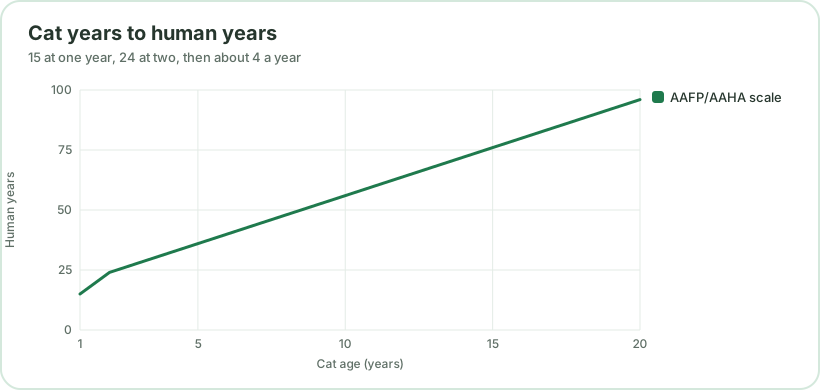
The human-year column uses the guideline scale of 15 at one year, 24 at two and about 4 more for each year after that. The Cat Age Calculator does the arithmetic for any age and names the stage.
Remember that these are bands drawn through a continuous process. A fit, lean 11-year-old with no health problems may behave like a younger cat, and a cat with long-term illness at 8 may need extra attention earlier. For the full set of stages from kitten onward, see our guide to cat life stages.
What the label does not mean
Calling a cat senior does not mean it is ill. It also does not mean it is near the end of its life, since many cats live well beyond 12, and a large UK study found an average life expectancy at birth of about 11.7 years (see how long cats live). It certainly does not mean that nothing can be done. On the contrary, the senior label is useful because it is when preventive care and early detection are most valuable.
Think of it like the 50th birthday in a person’s life. It is an arbitrary line, but it is a good prompt to schedule a check-up, review diet and exercise, and make sure that small things are not being missed.
Signs that your cat is getting older
Changes can be gradual, so owners often notice them only in hindsight. Common things to watch for include:
- Sleeping more, or choosing warm, quiet spots.
- Jumping less or hesitating before jumping onto furniture.
- Grooming less well, with a matted or greasy coat in places.
- Changes in appetite, eating more, eating less or being fussier.
- Changes in drinking, especially drinking noticeably more.
- Changes in litter-tray habits, such as missing the tray or straining.
- Weight change, up or down.
- Behaviour change, such as more vocal at night, restlessness or hiding.
None of these is a diagnosis. Each is a reason to make a note with the date and mention it at your next visit. Marked or sudden changes, or a cat that stops eating, should be checked promptly by a vet.
Weighing is the simplest tool
A cat’s weight is the most useful single number you can track. Weigh your cat monthly on the same scale, and write it down. A 4 kg cat that loses 400 g has lost 10%, which is a big change that is easy to miss by eye in a fluffy cat. A cat that gains steadily may be eating more than it needs.
You can weigh a cat by holding it on a bathroom scale and subtracting your own weight, or by placing it in a carrier on a kitchen scale and subtracting the carrier. Use the same method each time. Our guide on how many calories a cat needs shows how to turn weight into a daily target, and the Cat Calorie Calculator does the sums.
| Weight | Neutered adult (1.2 × RER) | Inactive (1.0 × RER) |
|---|---|---|
| 3 kg | 192 kcal | 160 kcal |
| 4 kg | 238 kcal | 198 kcal |
| 5 kg | 281 kcal | 234 kcal |
| 6 kg | 322 kcal | 268 kcal |
Older cats may need less energy if they are less active, but some seniors need more because they absorb less or lose muscle. This is exactly why a vet review matters rather than a rule of thumb.
Food at the senior stage
A senior cat does not always need a different food. What matters is whether the food keeps the cat at a healthy weight and body condition and suits any health issues. Points worth discussing with your vet are:
- Is my cat’s weight stable, and is the body condition right?
- Is the current food complete and balanced for adults, and do I need a change?
- Does my cat have any health condition that needs a particular diet?
- Are wet or dry foods, or a mixture, better for my cat?
- How can I keep my cat drinking enough?
Do not switch to a prescription or special diet without veterinary advice. If a change is recommended, make it gradually over about a week by mixing the new food in with the old.
Making the home easier
Small changes can make life more comfortable:
- Add a low step or ramp to a favourite perch.
- Use a litter tray with a low side that is easy to step into.
- Put food, water and tray close to where your cat spends time.
- Provide warm, soft bedding in draught-free places.
- Keep the routine steady and avoid sudden changes.
- Groom gently if your cat cannot reach everywhere.
These steps help whatever the cause of a slower cat, and they cost little. The practical details are in our senior cat care guide.
Check-ups and tests
For senior cats, Your vet may recommend more frequent check-ups than for younger adults, often twice a year, and may suggest routine blood and urine tests to establish a baseline. Whether and when to run them is your vet’s judgement. What helps most is to bring a list: weight records, notes on appetite and drinking, litter-tray changes, behaviour changes and questions.
Budgeting for senior years
Costs often rise with age, because of more frequent visits and sometimes ongoing care. If you have not already, review your plan: a savings fund, insurance if you want it or both. Our Cost of Owning a Cat Calculator helps you total the monthly cost, and pet insurance vs a savings fund compares the two ways to prepare. Note that insurers usually treat conditions that appear before cover starts differently, so read the terms.
Common mistakes
- Waiting for obvious illness before booking a check-up.
- Treating every change as “just old age”.
- Switching foods on the cat’s birthday rather than on advice.
- Skipping the monthly weight check.
- Making sudden changes to the home or routine.
- Forgetting to keep a written record.
Questions to ask your vet
- Do you consider my cat mature adult or senior?
- How often should we do check-ups?
- Would blood or urine tests help now?
- Is my cat’s weight where it should be?
- What changes at home would you suggest?
A year in the life of a senior cat
It can help to picture what a well-organised year looks like once your cat is senior.
| Month | What to do |
|---|---|
| January | Weigh, write down the year’s baseline, book the two check-ups |
| February | Review the home for steps, trays and beds |
| March | First check-up of the year, bring notes |
| April to May | Monthly weigh-ins and watch drinking in warmer weather |
| June to July | Review food amounts if weight has moved |
| August | Book the second check-up |
| September to October | Second check-up, review tests with the vet |
| November to December | Plan warmth for winter, check costs, update the savings fund |
The months are only a template, and your vet may suggest a different rhythm. What matters is that the checks are on the calendar and not left to chance.
Cats that are senior early or late
The age bands are averages. Some cats are senior in practice earlier because of long-term illness, a hard early life or inherited conditions, and some stay youthful well past the guideline. How do you tell? Look at function rather than the calendar: appetite, weight, movement, grooming, play and interest in the household. A 12-year-old who plays, jumps and eats well is ageing gracefully, and a 9-year-old who has lost weight and stopped grooming needs a vet.
A cat that came from a shelter with an unknown age adds another twist. The vet’s age estimate may be a few years off, so use the estimate to place the cat in a rough stage and focus on how the cat is doing. Our guide to how to tell a cat’s age covers estimates.
Multi-cat households
If you have several cats, one senior among younger cats may need protected access to food, water and a quiet resting place. Younger cats can block litter trays and steal food, and a senior cat that is shy may eat less without you noticing. Feed the senior cat in a separate room if needed, provide extra trays in different places and make sure the older cat can reach high perches via steps.
Watching each cat’s eating and drinking becomes harder in a group, so weigh each cat monthly and use a feeding station that only the senior cat can reach if your vet suggests one. When one cat’s weight starts to slip, you will see it in the records before you see it in the cat.
A summary for cat owners
Senior begins at about 10 years, with the mature adult stage from 7. The label is a prompt to review weight, food, check-ups and home. Weigh monthly, note changes in appetite, drinking, litter habits and mobility, and talk to your vet about the schedule. Small changes at home often make a big difference to a cat’s comfort.
Quick summary
- Cats over about 10 are senior; 7 to 10 are mature adults.
- A 10-year-old cat is about 56 in human years.
- The label is a prompt to review care, not a sign of illness.
- Weigh monthly and note changes in appetite, drinking, litter habits and behaviour.
- Ask your vet about check-up frequency, tests and food.
- Use the Cat Age Calculator to find your cat’s stage.
Frequently asked questions
At what age is a cat considered senior?
The AAFP/AAHA life stage guidelines treat cats over about 10 years old as senior. Cats from 7 to 10 are called mature adults.
How old is a 10-year-old cat in human years?
About 56 on the AAFP/AAHA scale, which gives 15 at one year, 24 at two and about 4 per year after that.
Does my cat need senior food at 10?
Not automatically. Ask your vet to review your cat's weight, health and current food, because the right energy and nutrient level depends on the individual cat.
How often should a senior cat see the vet?
Your vet may suggest more frequent check-ups for senior cats, often twice a year, but your vet will set the schedule for your cat.
What changes should I watch for in an older cat?
Weight change, appetite, drinking, litter-tray habits, jumping, grooming and behaviour. Note them with dates and tell your vet.
Is slowing down normal for older cats?
Some slowing can be normal, but sudden or marked changes deserve a check because many causes are treatable.
Can I use the calculator to find my cat's life stage?
Yes. The Cat Age Calculator converts age to human years and names the life stage.
Sources
- AAFP/AAHA (2021) Feline Life Stage Guidelines. Journal of Feline Medicine and Surgery 23:211-233
- Vogt A.H. et al. (2010) AAFP-AAHA Feline Life Stage Guidelines. Journal of Feline Medicine and Surgery 12:43-54
Related calculators
- Cat Age CalculatorConvert your cat's age into human years and see its life stage.
- Cat Age from Birth Date CalculatorEnter your cat's birth date to see its exact age, its age in human years and its life stage.
- Cat Calorie CalculatorWork out how many calories your cat needs each day, from its weight and life stage.
Keep reading
- Cat Life Stages: Kitten to Senior ExplainedThe cat life stages from kitten to senior under the AAFP/AAHA guidelines, with age ranges, human-year equivalents, what changes at each stage and how to plan care.
- Senior Cat Care: Food, Vet Visits and HomeA practical senior cat care guide: weighing, food and water, vet check-up rhythm, home changes for stiff joints, a monthly checklist and what to note for your vet.
- Is a 15-Year-Old Cat Old? Age in Human YearsIs a 15-year-old cat old? About 76 in human years on the AAFP/AAHA scale. See what that means for care, a chart from 12 to 20 years and when to talk to the vet.
- How to Tell a Cat's Age: Teeth, Eyes, CoatHow to estimate a cat's age when the birthday is unknown: what vets look at in teeth, eyes, coat, body and behaviour, why estimates are ranges and how to record one.