
If your cat has reached 15, you have been sharing your home with a very experienced animal. By the usual scale used in veterinary guidelines, a 15-year-old cat is about 76 in human terms. That is old, but it is not unusual, and it does not set a limit on the good days ahead. This guide shows the conversion, explains how to think about “old” for a cat, and gives a practical outline of care and conversation with your vet.
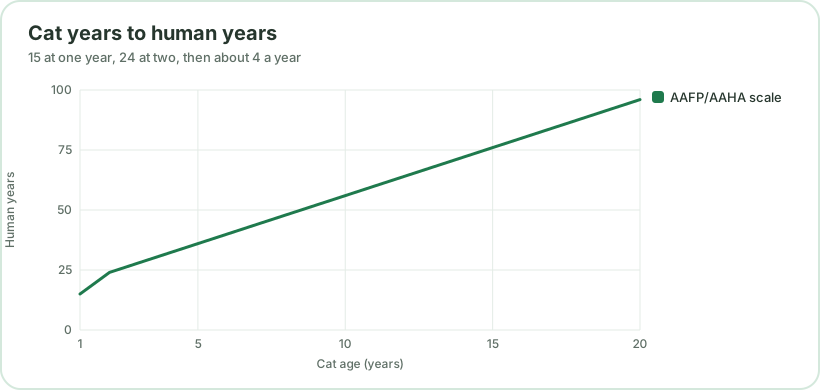
The conversion for ages 12 to 20
The AAFP/AAHA scale counts 15 human years for a cat’s first year, 24 for the second and about 4 more for every year after that.
| Cat’s age | Human-year equivalent | How to think about it |
|---|---|---|
| 12 years | 64 | Senior |
| 13 years | 68 | Senior |
| 14 years | 72 | Senior |
| 15 years | 76 | Senior, long-lived |
| 16 years | 80 | Senior, long-lived |
| 17 years | 84 | Senior, long-lived |
| 18 years | 88 | Very long-lived |
| 19 years | 92 | Very long-lived |
| 20 years | 96 | Exceptional |
The arithmetic for 15 is 24 + (15 − 2) × 4 = 24 + 52 = 76. The Cat Age Calculator does this for any age, and for ages under a year it uses the month-by-month table. If you know the birth date, the Cat Age from Birth Date Calculator gives the exact age in years and months.
How “old” should be understood
A 15-year-old cat is old on the scale, but the scale describes a stage, not a state of health. Some 15-year-olds are lean, active and bright; others live with long-term conditions and need regular treatment. Age brings more risk, but a good routine, early attention to changes and a comfortable home can make a large difference to how a cat feels.
It helps to compare with the population. A large UK study found an average life expectancy at birth of about 11.7 years (see how long cats live), which means that a cat at 15 has lived past the average. That is a credit to the cat and its owner, not a warning. Treat each year as a bonus and focus on quality of life.
What a good week looks like
For an older cat, quality of life is often easy to see in the pattern of an ordinary week. Signs of a comfortable cat include:
- Eating with interest at regular times.
- Drinking a steady amount.
- Using the litter tray without difficulty.
- Grooming itself, at least partly.
- Moving to favourite spots and showing interest in the household.
- Resting without distress and purring or relaxing when touched.
A short daily note, even a tick against these lines, makes changes visible. Our guide on senior cat care has a monthly checklist you can use.
What care changes at 15
Care at this age is a continuation of the senior habits rather than a new programme.
- Vet rhythm. More frequent check-ups, as your vet advises, with weights and questions on a list.
- Weight. Monthly weighing, with a call if there is unplanned loss.
- Food and water. Easy access, appetising food and plenty of water.
- Comfort. Soft bedding, warmth, steps and low-entry trays.
- Routine. Calm, regular days with gentle play and company.
- Records. A simple diary of appetite, drinking and behaviour.
Energy needs vary with weight and activity. A 4 kg neutered cat at a factor of 1.2 needs about 238 kcal a day, and at 1.0 about 198, but an older cat may need more or less. Your vet can set a target, and the Cat Calorie Calculator shows the arithmetic.
When to call the vet sooner
Contact your vet promptly if you notice:
- Not eating for a day or more.
- Marked weight loss.
- Much more drinking or urinating than usual.
- Difficulty using the litter tray or straining.
- Sudden changes in behaviour, such as confusion, hiding or night-time crying.
- Difficulty breathing.
- Sudden stiffness, falling or reluctance to move.
These can have many causes, and some are treatable, so do not wait to see whether they pass.
Talking about quality of life
At some point most owners of older cats think about quality of life. It is a hard but important subject, and vets are used to discussing it. Useful tools include simple scoring checklists that cover pain, appetite, hygiene, happiness, mobility and good days versus bad days. Your vet can show you one and help you review it. The goal is not to set a date but to understand how your cat is doing and what would help.
Planning ahead
Practical planning makes difficult times easier:
- Know your vet’s out-of-hours arrangements.
- Keep a copy of the cat’s records and medicines.
- Save a little each month for senior care, using the Pet Emergency Fund Calculator.
- Think about who can care for your cat if you are away or unwell.
- Discuss wishes for the end of life with your vet and family before you face the decision.
Common mistakes
- Assuming that every change is “just age”.
- Waiting too long to call the vet.
- Changing the home or routine suddenly.
- Giving human medicines.
- Overfeeding to compensate for fussiness.
- Not recording weight.
Questions to ask your vet
- What should I expect for a cat of this age with this history?
- How often should we meet?
- What would you want me to track at home?
- When is it time to change something about food or treatment?
- How will we judge quality of life?
Comparing 15 with the milestones before it
It helps to see where 15 sits on the longer road.
| Milestone | Age | Human-year equivalent |
|---|---|---|
| End of kitten stage | 1 | 15 |
| Young adult peak | 3 to 5 | 28 to 36 |
| Mature adult begins | 7 | 44 |
| Senior begins | 10 or 11 | 56 to 60 |
| Average life expectancy at birth in a UK study | about 11.7 | about 60 |
| Your cat now | 15 | 76 |
The table shows two things. First, 15 is firmly in the senior stage and well beyond the average life expectancy at birth. Second, the step from 11 to 15 adds 16 human years, about the same as the whole first year of life, which is a reminder that these years pass quickly for an animal that ages in seasons. Enjoy them.
Practical routines for a very senior cat
At this age, small routines are what make a difference.
- Warmth. Provide a heated or insulated bed in a draught-free corner, with a way to get away from the heat.
- Access. Keep food, water, bed and tray on one level, close together.
- Contact. Spend time each day stroking, brushing or sitting near your cat, which helps both of you.
- Safety. Block access to places with hard drops, and keep floors clear so the cat can navigate.
- Sleep. Let your cat sleep undisturbed, and avoid loud noises where it rests.
- Notes. Keep a dated diary of appetite, drinking, weight and behaviour.
None of this is complicated, and all of it is within reach of any owner. When the notes show a change, tell your vet.
Eyes, ears and senses
Older cats often lose some hearing or vision. Signs include not responding when called, being startled when touched, bumping into objects, or becoming more vocal. Keep furniture in the same places, add night lights if your cat seems to struggle in the dark and approach gently from the front. A vet can check eyes and ears and tell you whether anything can be done.
A diary template for the later years
A diary does not need to be long. A single page per month with a few columns is enough, and it gives your vet far more than memory can.
| Date | Weight | Appetite (good / less / more) | Drinking (usual / more) | Litter tray notes | Mobility | Mood and behaviour |
|---|---|---|---|---|---|---|
Photograph the same view of your cat each month, such as from above while standing and from the side, because a gradual loss of muscle along the back is easy to miss day to day. If you share the home with others, put the diary where everyone can write in it, so that a dip noticed by one person is not lost.
Everyday comfort at 76 in human terms
Seventy-six is an age at which most people appreciate warmth, soft seating, quiet and company, and cats are much the same. Think about the details of a typical day. Where does your cat sleep in the morning sun, and is it warm enough? Is the route from bed to bowl free of obstacles? Can your cat reach the tray quickly? Is there somewhere high and safe to watch the household, reached by steps rather than a jump? A few changes of this kind often matter more than any product.
Handle your cat gently, supporting the hind end when you lift, and let it choose when to be picked up. Brush softly, avoiding sore areas. Keep the household routine steady, and introduce changes slowly, since some older cats are unsettled by new furniture, visitors or house moves.
Feeding a very senior cat
Food and weight need extra attention at this age. Offer food at room temperature, in a shallow dish, in a quiet place, and in smaller portions more often if your cat prefers. Record what is eaten. Do not make sudden changes to the diet, and ask your vet before using a different food, since the best choice depends on your cat’s health. The Cat Calorie Calculator gives a starting point for the daily energy, but your vet may adjust it, and the guide to how many calories a cat needs explains the factors.
If your cat’s weight is falling, do not wait. A 4 kg cat that has lost 400 g has lost a tenth of its body weight, and your vet will want to know.
A final thought
A 15-year-old cat has lived beyond the average and deserves comfort, attention and good care. Keep the routine steady, watch for change and stay in touch with your vet. Enjoy each day; with regular care, many cats at this age remain content and affectionate.
Quick summary
- A 15-year-old cat is about 76 in human years.
- That is old, and above the average life expectancy, but not a verdict.
- Keep up monthly weighing and regular vet visits.
- Make the home easy to use and keep the routine calm.
- Call the vet about marked changes in eating, drinking, weight or behaviour.
- Use the Cat Age Calculator for any age.
Frequently asked questions
How old is a 15-year-old cat in human years?
About 76 on the AAFP/AAHA scale: 24 at two years plus 13 years at about 4 each.
Is 15 a good age for a cat?
It is a long life by the standards of the average. A large UK study found an average life expectancy at birth of about 11.7 years, so a cat of 15 has done well.
What care does a 15-year-old cat need?
Regular vet check-ups, monthly weighing, easy access to food, water and a litter tray, warmth and gentle play. Your vet will tailor advice.
How many more years can a 15-year-old cat live?
It varies a great deal. Life tables give averages for groups, but they cannot predict an individual cat, so focus on comfort and regular care.
How often should a 15-year-old cat see the vet?
Usually more often than a younger cat, often twice a year. Your vet will advise.
Is it normal for a 15-year-old cat to sleep a lot?
More sleep is common in older cats, but sudden changes in activity or behaviour are worth a call.
How do I celebrate an older cat's birthday?
Keep it gentle: a favourite treat within the daily calorie allowance, extra attention and a warm place to rest.
Sources
- AAFP/AAHA (2021) Feline Life Stage Guidelines. Journal of Feline Medicine and Surgery 23:211-233
- Teng K.T. et al. (2024) Life tables of annual life expectancy and risk factors for mortality in cats in the UK. Journal of Feline Medicine and Surgery 26
Related calculators
- Cat Age CalculatorConvert your cat's age into human years and see its life stage.
- Cat Age from Birth Date CalculatorEnter your cat's birth date to see its exact age, its age in human years and its life stage.
- Pet Birthday CalculatorFind your pet's next birthday, how many days away it is and how old it will turn.
Keep reading
- When Is a Cat Senior? Age, Signs and Next StepsWhen a cat counts as senior: the AAFP/AAHA age bands, what the label does and does not mean, early signs worth noting and how to adjust check-ups, food and the home.
- Cat Years to Human Years: Age ChartA clear cat age chart from kitten to 20 years, how the AAFP/AAHA scale works, the cat life stages and how long cats usually live.
- How Long Do Cats Live? What Studies ShowHow long cats live: what a large UK life-table study found, why averages hide wide variation, factors that influence lifespan and what the numbers mean for planning.
- Cat Age from Birth Date: Exact Years and WeeksHow to find a cat's exact age from its birth date in years, months, weeks and days, then read it on the AAFP/AAHA human-years scale, with three worked cats.