
Caring for an older cat is less about a special product and more about a set of small habits done steadily. The aim is to keep your cat comfortable, to keep weight and appetite steady, and to spot changes while there are still many options. This guide sets out those habits in order of usefulness, with numbers where numbers help and with questions for your vet where the answer depends on the individual cat. If you are unsure whether your cat counts as senior yet, start with when a cat is senior.
Habit 1: weigh every month
Weight tells you more than almost anything you can measure at home. A cat’s weight in kilograms is small, so small changes are large in percentage terms. For a 4 kg cat, a loss of 200 g is 5%, and a loss of 400 g is 10%. A steady upward drift of 100 g a month would add 1.2 kg in a year, which is 30%.
How to weigh at home:
- Use the same scale each time, at the same time of day.
- Weigh yourself holding the cat and subtract your own weight, or weigh the cat in a carrier and subtract the carrier.
- Write the date and weight in a notebook or phone.
- Plot or scan the list for a trend.
If the weight is falling without a diet change, or rising steadily, tell your vet. Unplanned weight loss in an older cat is a reason to book a visit rather than wait.
Habit 2: feed to a calorie target
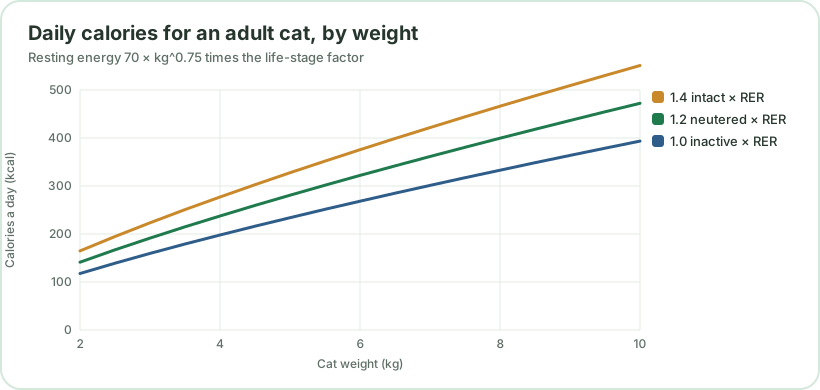
A calorie target keeps feeding objective. Resting energy is 70 × weight ^ 0.75, and a neutered adult uses 1.2 times that. Inactive cats use 1.0, and a cat on a weight-loss plan uses 0.8 of the resting energy for the ideal weight. Older cats may fall into any of these groups.
| Weight | Resting energy | 1.2 × | 1.0 × |
|---|---|---|---|
| 3 kg | 160 kcal | 192 kcal | 160 kcal |
| 4 kg | 198 kcal | 238 kcal | 198 kcal |
| 5 kg | 234 kcal | 281 kcal | 234 kcal |
| 6 kg | 268 kcal | 322 kcal | 268 kcal |
Use the Cat Calorie Calculator for your own cat, then convert to grams with the energy value on your food’s label: for example 238 kcal is 238 g of a 1.0 kcal/g wet food or about 66 g of a 3.6 kcal/g dry food. Our guide on how much wet food a cat should eat walks through mixed feeding. A vet may adjust the target because many older cats have health conditions that change energy needs.
Habit 3: make water easy
Water matters at every age, and in older cats it is worth a little extra thought. Offer fresh water in several places, away from the litter tray and from food if your cat seems to prefer that. Some cats like wide, shallow bowls so their whiskers do not touch the sides, and some like running water. Wet food contributes water too.
Watch for changes in drinking. A cat that is drinking noticeably more than before, or standing at the bowl for long periods, deserves a note and a call to the vet. It is easier to measure than to remember: fill a measuring jug for a few days and record how much goes down.
Habit 4: ease movement
Stiffness can creep in slowly. Cats are good at hiding it, so you might only notice that your cat no longer jumps to the windowsill or takes the long route around the sofa. Easy fixes include:
- A step or ramp to the bed, sofa or window.
- A litter tray with a low entry.
- Soft beds at ground level and a warm spot in the sun or near a radiator, safely guarded.
- Food and water on the same floor as the bed.
- Non-slip mats on smooth floors.
If your cat seems to be in discomfort, speak to your vet. Do not give a human painkiller, because many are unsafe for cats; this is a matter for your vet.
Habit 5: keep the vet rhythm
Your vet may suggest seeing senior cats about twice a year, and they may suggest routine tests to set a baseline. The aim is to find changes early, when there are more options. Bring a short list of notes and a recent weight record. Our guide to cat life stages puts the visits in the context of a lifetime.
A monthly checklist
| Check | What to look for | Write down |
|---|---|---|
| Weight | Up or down trend | kg and date |
| Appetite | Eating less, more, or fussier | Notes |
| Drinking | More than usual | Rough millilitres |
| Litter tray | Frequency, straining, accidents | Notes |
| Coat and grooming | Matting, greasy fur | Notes |
| Mouth | Bad smell, dropping food | Notes |
| Movement | Jumping, stairs, stiffness | Notes |
| Behaviour | Night calling, hiding, confusion | Notes |
A ten-minute check on the first of the month makes it a habit. Bring the notes to each vet visit.
Teeth and mouth
Dental disease is common in older cats, so Your vet may will look at the mouth at every check-up. Owners can look out for bad breath, drooling, dropping food, chewing on one side or pawing at the mouth. Do not try to scale or clean teeth without guidance. Ask your vet what home care, if any, suits your cat.
Enrichment and company
Older cats still need play and attention. Short, gentle sessions with a wand toy, a puzzle feeder with a few kibbles or a window perch can keep body and mind active. Keep sessions low impact, and stop when your cat shows signs of tiring. Company matters too, and a cat that used to be independent may now want more lap time.
Budgeting for senior care
Senior years often cost more, mainly because of more frequent visits. Add a line to your budget, and consider a savings pot. The Monthly Pet Budget Calculator helps, and the monthly cost of a cat lists lines to include. If you hold insurance, check how it treats long-term conditions.
Common mistakes
- Waiting for obvious illness to arrange a check-up.
- Assuming a lost appetite is “just age”.
- Changing food suddenly.
- Leaving a litter tray that is hard to enter.
- Giving human medicines.
- Not keeping records.
Questions to ask your vet
- How often should my cat be seen from now on?
- Are baseline tests worth doing?
- Is the weight where you would like it?
- What should I do if appetite or drinking changes?
- What home changes would suit my cat?
Medicines and supplements
Many older cats take a regular medicine or supplement at some point. A few rules apply to any of them. Give medicines exactly as the vet has directed, and ask for a demonstration if you find it hard. Keep a written list of everything your cat takes, with the name, the reason, the schedule and the start date, and bring the list to every visit. Never give a medicine or supplement made for people or for another animal, because some are unsafe for cats. If your cat refuses a medicine, call your vet rather than skipping it, since there are often other forms or ways to give it.
When appetite changes
Appetite is one of the most useful signs in a cat. A cat that suddenly eats much less, or stops eating for a day or more, needs veterinary attention. A cat that eats more than usual while losing weight also does. Gradual fussiness is common, and small changes can help, such as warming wet food to room temperature, offering a shallow dish, trying a different texture and serving small meals more often. Do not change the main diet quickly, and do not rely on appetite stimulants or human foods without your vet’s advice.
Keep a record of what your cat eats in a day for a week. Weighing the food before and after a meal on a kitchen scale gives you grams; multiply by the food’s calories per gram to get kcal. This lets your vet see exactly what has changed.
Grooming help
Older cats often groom less, especially along the back and hind end. A soft brush used gently for a few minutes a day keeps the coat tidy, reduces matting and gives you a chance to feel for lumps and sore spots. Use a comb with blunt teeth for any knots, and ask your vet or a groomer before cutting a mat close to the skin. Trim claws as your vet shows you, since older cats often have thicker nails that can curl into the pad.
Litter tray tips
The tray is a window into health, so keep it where it is easy to reach and clean it daily. A low-sided tray, or one with a low cut-out, helps stiff cats. Use the same litter, because changes can put a cat off. Place a tray on every floor of the home so your senior never has to climb stairs in a hurry. Note the frequency and size of urine clumps, any straining and any change in stools, and tell your vet about changes, which can be early signs of a problem.
A sample day for a senior cat
A day that supports comfort and routine looks something like this. The times are examples.
| Time | Activity |
|---|---|
| 07:00 | Fresh water, breakfast portion (warmed if wet), clean the tray |
| 08:00 | Gentle brush, a look over: eyes, nose, coat |
| 12:00 | A short play or lap time if the cat is keen |
| 17:00 | Dinner portion, fresh water |
| 20:00 | Quiet time, a warm bed in a favourite spot |
| 22:00 | Last tray check and a small snack within the daily allowance |
The routine takes little time, but it gives the cat predictability, and gives you a regular chance to notice changes. Write down anything unusual, however small.
Adjusting as the years go on
Needs change gradually. A cat that jumped easily at 11 may need a step at 14. A cat that ate well at 12 may be fussy at 15. Review the home, the food and the routine every few months, and ask your vet at each visit what to adapt. The Cat Age Calculator shows where your cat is on the scale, and our guide to cat life stages places the whole journey in context. Flexibility, patience and attention are the main ingredients.
Quick summary
- Weigh monthly and keep the numbers.
- Feed to a calorie target agreed with your vet.
- Keep fresh water in several places and watch drinking.
- Ease movement with steps, low trays and soft beds.
- Keep up regular vet visits, usually more often than for younger adults.
- Use the Cat Calorie Calculator to set a starting target.
Frequently asked questions
How often should a senior cat see the vet?
Your vet may suggest check-ups about twice a year for senior cats, but your vet will advise the right rhythm for your cat.
How much should a senior cat eat?
It depends on weight, activity and health. A neutered 4 kg adult needs about 238 kcal at a factor of 1.2; inactive cats use lower factors. Ask your vet for a target and adjust from weight trends.
Should I buy senior cat food?
Only if your vet agrees it suits your cat. Check the label's life stage statement and calories, and compare with the current food.
How can I tell if my senior cat is in pain?
Cats hide discomfort. Reduced jumping, less grooming, hiding or changes in litter habits can be clues. Tell your vet; do not give human medicines.
How do I help a senior cat drink more?
Offer fresh water in several spots and clean bowls daily. Ask your vet about wet food or a fountain if your cat drinks little.
What home changes help an older cat?
Low-sided litter trays, ramps or steps to favourite spots, soft warm beds and food and water close to resting places.
Should I weigh my cat at home?
Yes, monthly. A steady record shows trends sooner than your eye can.
Sources
- AAFP/AAHA (2021) Feline Life Stage Guidelines. Journal of Feline Medicine and Surgery 23:211-233
- NRC (2006) Nutrient Requirements of Dogs and Cats, National Academies Press
- Merck Veterinary Manual — Nutritional Requirements of Small Animals
Related calculators
- Cat Calorie CalculatorWork out how many calories your cat needs each day, from its weight and life stage.
- Cat Age CalculatorConvert your cat's age into human years and see its life stage.
- Cat Food CalculatorWork out your cat's daily calories and how to split them between wet and dry food.
Keep reading
- When Is a Cat Senior? Age, Signs and Next StepsWhen a cat counts as senior: the AAFP/AAHA age bands, what the label does and does not mean, early signs worth noting and how to adjust check-ups, food and the home.
- Cat Life Stages: Kitten to Senior ExplainedThe cat life stages from kitten to senior under the AAFP/AAHA guidelines, with age ranges, human-year equivalents, what changes at each stage and how to plan care.
- How Many Calories Does a Cat Need a Day?How many calories a cat needs: the RER formula, factors for neutered, intact, inactive and kitten cats, a calorie table by weight and how to adjust.
- Indoor Cat Calorie NeedsHow many calories an indoor cat needs: RER × 1.0 if inactive versus 1.2 if neutered, a 3 to 6 kg table in kcal and grams, and how to adjust by weight trend.