
A cat does not age in a straight line. In the first year it goes from a few hundred grams to nearly full size, then it spends years as a settled adult, and later its needs shift again toward comfort, mobility and monitoring. Veterinary bodies describe these changes as life stages, and knowing which one your cat is in helps you choose the right food, the right check-up routine and the right questions to ask. This guide explains the five stages used in the AAFP/AAHA 2021 guidelines, what tends to change in each and how to use the stage in everyday decisions.
The five stages at a glance
| Stage | Typical age | Human-year equivalent | Main focus |
|---|---|---|---|
| Kitten | Birth to 1 year | 0 to 15 | Growth, vaccines, socialising, neutering decision |
| Young adult | 1 to 6 years | 15 to 40 | Steady weight, dental care, play, yearly check-up |
| Mature adult | 7 to 10 years | 44 to 56 | Weight watching, earlier screening, joint comfort |
| Senior | Over 10 years | 60 and up | More frequent check-ups, comfort, monitoring |
| End of life | Any age, when advised | Not age-based | Comfort and quality of life |
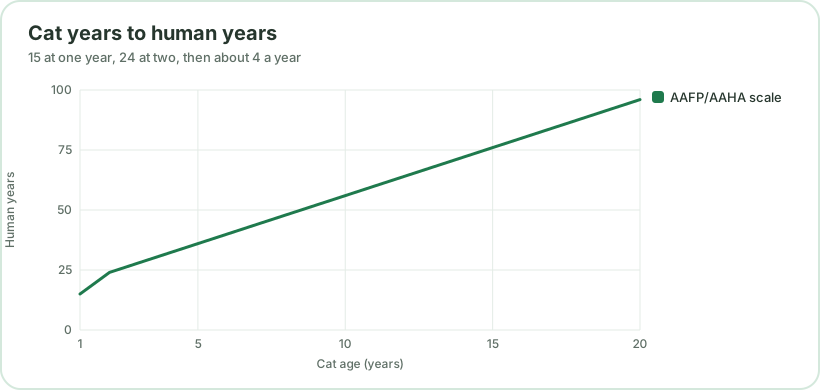
The human-year figures come from the AAFP/AAHA scale: 15 at one year, 24 at two, then about 4 more per year. The Cat Age Calculator applies the scale to any age in years or months. The boundaries are conventions rather than switches, so a healthy 11-year-old may feel younger than the table suggests, and a cat with long-term illness may need senior-style care earlier.
Stage 1: kitten (birth to about one year)
A kitten grows fast. Its needs are high per kilogram: the kitten factor in our calculators is 2.5 times resting energy, more than double the 1.2 used for a neutered adult. At 2 kg, resting energy is 118 kcal, so a kitten of that weight needs about 295 kcal, while a neutered adult of the same weight would need only about 142. That is why kitten food is energy dense and why meals are small and frequent.
The age in months matters more than the age in years at this point. The AAFP/AAHA table treats a 3-month-old kitten as about 4 human years and a 6-month-old as about 10. Use the Cat Age from Birth Date Calculator if you know the birth date, and see our kitten feeding chart for amounts by weight. Early vet visits, vaccination courses, parasite control and a talk about neutering all belong in this stage, and your vet sets the timing.
Stage 2: young adult (about 1 to 6 years)
The young adult stage is long and, for most cats, quiet. Growth is over, so the energy factor falls: 1.2 for a neutered adult, 1.4 for an intact adult. The main risk in this stage is gradual weight gain. Neutering lowers energy needs, indoor cats move less, and a bowl that is topped up out of habit can add a few hundred grams over a year, which is a large share of a 4 kg cat.
Good habits begun now pay off later: weigh monthly, count treats, brush teeth if your vet recommends it, and keep play going. Our Cat Calorie Calculator gives a daily target for a given weight, and the guide to how many calories a cat needs explains each factor.
Stage 3: mature adult (about 7 to 10 years)
In the mature adult stage, a cat is in human terms somewhere between about 44 and 56. Most cats look and act much as they did, but this is when Your vet may suggest paying closer attention. Typical points include watching weight in both directions, checking teeth and gums, noticing changes in jumping, grooming and litter-tray habits, and asking about earlier screening tests. The goal is to catch changes while they are small.
Food usually does not need to change just because a cat has a seventh birthday. Ask your vet whether your cat’s current food suits its weight, activity and health. Do not switch to a “senior” food on age alone without that advice, because the label does not guarantee the right energy or nutrient level for an individual cat.
Stage 4: senior (over about 10 years)
From about 10 years the guidelines call a cat senior, equal to 60 or more in human terms (a 10-year-old is about 56, a 12-year-old 64, a 15-year-old 76). Seniors often benefit from more frequent check-ups, commonly twice a year, though your vet decides. Weight loss, drinking more, litter-tray changes, stiffness or a change in appetite can all be early signs worth a call. Our guides on when a cat is senior and senior cat care go into the practical side.
End of life
The final stage is defined by the cat’s condition, not its age. It means the focus has moved to comfort, dignity and quality of life. Vets can help owners judge this, using tools such as quality-of-life checklists, and can explain the options. It is a difficult subject, and a calm conversation with your vet well before a crisis makes decisions easier.
A worked example across a cat’s life
Take a cat who stays around 4 kg as an adult and is neutered. The numbers below use the calculator formulas.
| Age | Stage | Weight | Resting energy | Factor | Daily energy |
|---|---|---|---|---|---|
| 4 months | Kitten | 1.5 kg | 95 kcal | 2.5 | 237 kcal |
| 1 year | Young adult | 4.0 kg | 198 kcal | 1.2 | 238 kcal |
| 8 years | Mature adult | 4.2 kg | 205 kcal | 1.2 | 246 kcal |
| 12 years | Senior | 3.8 kg | 191 kcal | 1.2 | 229 kcal |
The factor stays the same through the adult years; the weight is what moves the number. This is why regular weighing is the single most useful habit, and why a vet should look into unexplained weight change at any age, especially in a senior cat.
Using the stage in everyday decisions
- Food. Match the food’s life stage statement to the cat’s stage, and calculate the amount from weight, not from the stage name.
- Check-ups. Ask your vet how often to visit at the current stage.
- Home. From the mature stage on, think about low-sided trays, steps to favourite perches and warm, quiet resting places.
- Records. Keep weights and dates in one place so trends are easy to see.
- Insurance and savings. Costs often rise with age; see our monthly cost of a cat for a budget template.
Common mistakes
- Treating the stage names as strict cut-offs.
- Changing food on age alone.
- Skipping weight checks in the long, quiet young-adult years.
- Assuming a slowing cat is “just old” without a check-up.
- Using a kitten food long after the kitten stage ends.
- Mixing up cat and dog scales: cats age faster than the old “seven to one” rule suggests in the first two years and more slowly afterwards.
Questions to ask your vet
- Which stage do you consider my cat to be in, and what should change now?
- How often should we meet for check-ups at this stage?
- Is my cat’s weight and body condition where it should be?
- Is the current food the right choice, or do you suggest a change?
- Are there early checks worth doing before signs appear?
Stage by stage: a care calendar
A simple calendar turns the stages into routines you can follow.
| Stage | Weigh | Vet contact | Home checks | Money |
|---|---|---|---|---|
| Kitten | Weekly | Course of early visits set by your vet | Safe space, scratching post, play | Heaviest one-off costs |
| Young adult | Monthly | Usually a yearly check-up | Litter tray, teeth, play | Steady monthly costs |
| Mature adult | Monthly | Yearly, ask about earlier screening | Jumping, grooming, appetite | Start a health fund |
| Senior | Monthly or more | Often twice a year, per your vet | Steps, warm beds, easy access | Higher vet costs likely |
| End of life | As advised | Regular contact | Comfort, easy access, quiet | Plan ahead |
Write the date of each check on a calendar when you book it. A cat that is seen on schedule has its changes spotted when they are small, which usually gives more options.
What changes in behaviour at each stage
Kittens are energetic and curious, which means short bursts of play, climbing and exploring. Young adults settle into a routine and may become more territorial or more independent. Mature adults often sleep a little more and play in shorter bursts, but should still be active, curious and interested in food. Seniors may sleep longer, groom less, jump less and show more need for warmth.
The useful rule is to compare your cat with its own normal. A cat that has always been quiet is not worrying for being quiet; a cat that was lively and has stopped playing deserves a check. Keep a note of unusual changes with dates, because a short timeline helps your vet.
Life stage and food labels
Pet food labels carry a statement about which life stage the food is complete and balanced for, such as growth, adult maintenance or all life stages. That statement is a legal and nutritional claim, so it is worth reading. A food made for growth is richer in energy and some nutrients than an adult maintenance food, so feeding it to an inactive adult can add weight. Conversely, adult food is not designed to support a growing kitten.
Once you know the stage, work out the amount from weight with the Cat Food Calculator, and compare foods by calories and cost, not just by price per bag. For a kitten, read our guide on how much a kitten should eat.
Summary for planning
Use the stages as a calendar for care: weekly weighing for kittens, monthly for adults, monthly or more for seniors; yearly vet visits for adults, more often for seniors; budget changes at each stage. Keep a record of weights and dates, and review your cat’s food and home at each transition.
Quick summary
- Five stages: kitten, young adult (1 to 6), mature adult (7 to 10), senior (over 10), end of life.
- Human-year scale: 15 at one year, 24 at two, then about 4 per year.
- The kitten factor is 2.5 times resting energy; neutered adults use 1.2.
- Weigh monthly in every stage and act on trends.
- Ask your vet how often to visit as the stage changes.
- Use the Cat Age Calculator to find your cat’s stage.
Frequently asked questions
What are the life stages of a cat?
Kitten, young adult, mature adult, senior and end of life. The kitten stage is the first year, young adult runs to about 6, mature adult from 7 to 10 and senior is over 10.
When is a cat fully grown?
Most cats finish the kitten stage at about one year, though some larger breeds keep filling out for longer. Your vet can advise on when to move to adult food.
Do cats need different food at each life stage?
Yes. Kittens use a higher energy factor (2.5 times resting energy) and a growth diet, while neutered adults use 1.2 and inactive or overweight-prone cats 1.0 or less. Ask your vet about senior needs.
How old is a 10-year-old cat in human years?
About 56 on the AAFP/AAHA scale: 24 at two years plus 4 for each of the next eight years.
How often should a cat see the vet at each stage?
Kittens need a series of early visits, adults commonly have a yearly check-up and senior cats often benefit from more frequent checks. Your vet will set the schedule.
Are the life stages the same for every cat?
They are a guide. Individual cats vary with genetics, lifestyle and health, so use the stages to plan care, not to predict how long your cat will live.
What is the end-of-life stage?
A stage in which the focus moves to comfort and quality of life. It is not tied to an age, and your vet can help you recognise it and plan.
Sources
- AAFP/AAHA (2021) Feline Life Stage Guidelines. Journal of Feline Medicine and Surgery 23:211-233
- Vogt A.H. et al. (2010) AAFP-AAHA Feline Life Stage Guidelines. Journal of Feline Medicine and Surgery 12:43-54
- NRC (2006) Nutrient Requirements of Dogs and Cats, National Academies Press
Related calculators
- Cat Age CalculatorConvert your cat's age into human years and see its life stage.
- Cat Age from Birth Date CalculatorEnter your cat's birth date to see its exact age, its age in human years and its life stage.
- Cat Calorie CalculatorWork out how many calories your cat needs each day, from its weight and life stage.
Keep reading
- Cat Years to Human Years: Age ChartA clear cat age chart from kitten to 20 years, how the AAFP/AAHA scale works, the cat life stages and how long cats usually live.
- How to Tell a Cat's Age: Teeth, Eyes, CoatHow to estimate a cat's age when the birthday is unknown: what vets look at in teeth, eyes, coat, body and behaviour, why estimates are ranges and how to record one.
- When Is a Cat Senior? Age, Signs and Next StepsWhen a cat counts as senior: the AAFP/AAHA age bands, what the label does and does not mean, early signs worth noting and how to adjust check-ups, food and the home.
- Senior Cat Care: Food, Vet Visits and HomeA practical senior cat care guide: weighing, food and water, vet check-up rhythm, home changes for stiff joints, a monthly checklist and what to note for your vet.