
“How long do cats live?” is a question with a number-shaped answer that is easy to misuse. A figure like 11.7 years sounds like a prediction, yet it describes a whole population, and your cat is one individual with its own history. This guide explains where the best current number comes from, how to read it, which factors are known to matter and how to turn lifespan into practical decisions about care and money, without promising anything the evidence cannot support.
The headline number and where it comes from
A 2024 paper in the Journal of Feline Medicine and Surgery (Teng and colleagues) built life tables from the primary-care veterinary records of cats in the UK and reported an average life expectancy at birth of about 11.7 years. Life tables are the same tool human demographers use. They take the observed deaths in each year of age and work out how many more years a cat of a given age can expect, on average.
Three points follow. First, the figure belongs to a particular population: UK cats seen by vets in a particular period. Cats in other countries may differ. Second, it is an average, so some cats die young and some live far longer. Third, it is measured at birth. A cat that has already reached 10 has, by definition, survived the early risks, so its expected remaining years are not simply 11.7 minus 10. Life tables show this by giving a separate expectancy at each age.
Why averages hide so much
Imagine two groups of 100 cats that both average 12 years. In one group almost every cat lives between 11 and 13. In the other, a few die at 2 or 3 years old and many reach 16. The average is the same but the experience is not. The same is true here: the 11.7 average mixes cats that died of accidents, infection or illness early with cats that lived into their late teens.
A useful way to think about it is as a range of likely outcomes rather than a point. Many cats live into their teens. A smaller number live to 20 or beyond. Those outcomes are possible, but none is guaranteed, and your own cat’s health and care will matter more than the average.
Factors that are known to influence lifespan
Studies of pet cats point to several factors that are linked with how long cats live. They are associations, so they show patterns in groups of cats rather than guarantees for one.
| Factor | What is generally observed | What you can do |
|---|---|---|
| Body weight | Overweight is linked with more disease | Weigh monthly; feed to a calorie target |
| Neutering | Often linked with longer average life | Ask your vet about timing |
| Lifestyle (indoor/outdoor) | Different risks (accidents vs boredom, weight) | Ask your vet about safe enrichment |
| Preventive care | Vaccines and parasite control reduce risks | Keep to the schedule your vet sets |
| Dental health | Dental disease is common in older cats | Ask about dental checks |
| Breed and genetics | Some breeds carry inherited risks | Ask a breeder or vet |
None of these replaces regular veterinary care, and the effect of each depends on the cat. If you want one practical thing to act on, control weight: the Cat Calorie Calculator gives a daily target for any weight, and our guide on how many calories a cat needs shows how it is worked out.
Lifespan and life stages
Lifespan statistics fit neatly with the life stage scheme in the AAFP/AAHA guidelines: kitten, young adult (1 to 6 years), mature adult (7 to 10), senior (over 10) and end of life. Our guide to cat life stages explains each. Because many cats live to around 12, a cat is usually in the senior stage for a good part of its life, which makes senior care a major topic rather than an afterthought. If you want to see how a given age compares with human years, the Cat Age Calculator converts it.
Turning lifespan into a budget
A cat’s cost is a long, steady stream, so lifespan matters for the arithmetic. With a one-off cost of 750 and monthly costs of 85, each extra year adds 1,020. Over 12 years the total is 750 + 12 × 1,020 = 12,990; over 16 years it is 750 + 16 × 1,020 = 17,070. The four extra years add 4,080 at the same monthly cost, and senior years are often more expensive than the average year because of more frequent vet visits.
| Planning horizon | Total at 85 a month plus 750 one-off | Total at 100 a month plus 750 one-off |
|---|---|---|
| 10 years | 10,950 | 12,750 |
| 12 years | 12,990 | 15,150 |
| 15 years | 16,050 | 18,750 |
| 18 years | 19,110 | 22,350 |
These figures are illustrations in a single currency. Use the Cost of Owning a Cat Calculator with your own quotes, and read how much it costs to own a cat for the full list of cost groups. If you worry about a large bill, the Pet Emergency Fund Calculator shows how long a savings plan takes.
How to use the number in a conversation with your vet
Instead of asking “how long will my cat live?”, which no one can answer, try questions that are about the cat in front of you:
- What risks are most relevant for a cat of this age, breed and lifestyle?
- What can I do now that makes the biggest difference?
- How often should we meet for check-ups?
- What would you want me to watch for at home?
- Which tests, if any, are worth doing early?
These questions turn a statistic into a plan, which is the useful part.
Myths worth dropping
- “Nine lives.” Cats are resilient, but no cat has more than one.
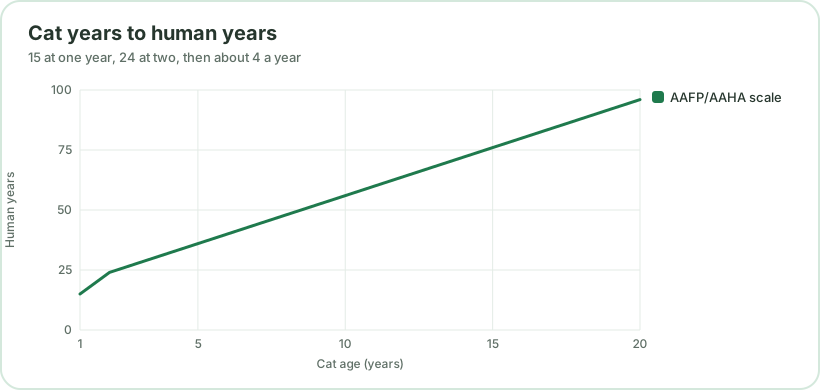
- “One cat year is seven human years.” The AAFP/AAHA scale is quite different: 15 at one year and 24 at two.
- “If it is not limping it is fine.” Cats hide discomfort, so changes in routine, appetite or litter habits matter.
- “Old cats just slow down.” Some slowing is normal, but sudden changes deserve a check-up.
- “An average of 11.7 means mine will die at 11.7.” It does not.
How to read a life table
Life tables look dry, but they are easy to use once you know the columns. Each row is an age. One column shows the share of cats still alive at that age, and another shows how many more years a cat of that age can expect on average. The expectancy at age 5 can be higher than the expectancy at birth minus 5, because the cats that died young have been removed from the group.
That is why you will see older cats described as having “years left” that do not match a simple subtraction. If a source says a 10-year-old cat has on average several more years, that is the table at work, and it is a more useful figure for an owner of an older cat than the figure at birth. When you search for statistics, check whether the number is “at birth” or “at age X”.
Comparing different studies
You may see other numbers online, some higher, some lower. Differences arise because studies use different populations (insured cats, cats seen at one clinic, owner surveys), different methods and different periods. Surveys of owners tend to include healthier, more cared-for cats, while clinic records include cats that were seen when ill. Neither is wrong; they answer slightly different questions.
When you read a number, ask:
- Which cats were included?
- Where and when were they studied?
- Is it an average at birth or at a certain age?
- Was it published in a journal that checks the work?
- Does the source say how sure it is?
A figure with a clear answer to each question is more useful than a round number repeated on many websites with no source.
Making the most of the years you have
Whatever the average, the decisions that fall to you are about day-to-day care. A short list worth discussing with your vet:
- Keep a healthy weight, with measured meals and counted treats.
- Keep up with vaccinations and parasite control as your vet advises.
- Book regular check-ups, and more often in the senior years.
- Provide play, climbing and hiding places, indoors and out as appropriate.
- Keep the litter tray clean and easy to reach.
- Notice and report changes in appetite, drinking, weight or behaviour.
Our guide to when a cat is senior and the cat life stage guide put these into a calendar.
A worked planning example
Imagine two owners, both with a 3-year-old neutered cat of 4 kg. Owner A plans for the average and budgets to age 12; owner B plans to age 16 because the cat is lean, active and from a long-lived line. Both use the same monthly figure of 85 and a one-off cost of 750.
| Owner A | Owner B | |
|---|---|---|
| Planning age | 12 | 16 |
| Years still to budget | 9 | 13 |
| Running costs from now | 9 × 1,020 = 9,180 | 13 × 1,020 = 13,260 |
| Difference | 4,080 |
The difference of 4,080 is what owner A would be short if the cat lives to 16. Neither owner is wrong; the lesson is that a plan built on an average has no margin for the cat that outlives it. A sensible rule is to plan to the age at which many cats are still alive, not the age at which half have died, and to review the plan every few years. The Cost of Owning a Cat Calculator lets you change the years and see the effect straight away.
Quality of life matters as much as length
Owners understandably focus on how many years, but vets also stress how good the years are. A cat that is comfortable, eating well, moving freely and engaged with the household is living well at any age. That is why the senior-care habits in this series, regular weighing, a calm routine and prompt attention to change, are about comfort as much as about length.
If you want a framework for judging how your cat is doing, ask your vet to show you a quality-of-life checklist. Typical ones score pain, appetite, hydration, hygiene, happiness, mobility and the balance of good days to bad. You can run through it once a month alongside the weight check. Having a baseline when your cat is well makes it much easier to see a change later.
What the evidence cannot tell you
Even a large, well-designed study has limits. Life tables describe cats that were seen by vets, so they may under-represent cats that never see one. They cannot say what would have happened to a particular cat under different care. And because they look backwards, they describe the cats of the past, whose food, vaccination, neutering and indoor habits may differ from those of cats today.
For these reasons, trust a range, avoid false precision and talk to your vet about the cat in front of you. The most reliable prediction for any one cat is a good history of regular care, weights and notes, because that is what your vet needs to give tailored advice. Our guide to cat life stages gives the framework for those conversations.
Quick summary
- A large UK study found an average life expectancy at birth of about 11.7 years.
- An average describes a group; individual cats range widely.
- Weight, neutering, lifestyle, preventive care and dental health are linked with lifespan.
- Plan costs over at least a decade, with higher costs in the senior years.
- Ask your vet questions about your cat, not about the statistic.
- Use the Cat Age Calculator to place your cat on the life stage scale.
Frequently asked questions
How long do cats live on average?
A large UK study of primary-care veterinary records found an average life expectancy at birth of about 11.7 years. Averages differ between studies and countries.
Do indoor cats live longer than outdoor cats?
Lifestyle affects risks such as accidents and infectious disease, but studies vary and each cat differs. Ask your vet about the best set-up for your cat.
Do neutered cats live longer?
Some studies link neutering with longer average lifespan, but it is one factor among many. Your vet can advise on timing and on weight control afterwards.
Does weight affect how long a cat lives?
Obesity is linked with several health problems in cats, which is why weight management is a core part of care. See our feeding guides for calorie targets.
What is the oldest age a cat can reach?
Some cats live well into their twenties, but those cases are rare and should not be used as an expectation.
Can I estimate how long my cat will live?
Not reliably. Population averages cannot predict an individual cat. Use them to plan costs and care, not to set expectations.
How should lifespan affect my budget?
Plan for a decade or more of running costs, and allow for higher costs in the senior years.
Sources
- Teng K.T. et al. (2024) Life tables of annual life expectancy and risk factors for mortality in cats in the UK. Journal of Feline Medicine and Surgery 26
- AAFP/AAHA (2021) Feline Life Stage Guidelines. Journal of Feline Medicine and Surgery 23:211-233
Related calculators
- Cat Age CalculatorConvert your cat's age into human years and see its life stage.
- Cost of Owning a Cat CalculatorAdd up the one-off and monthly costs of a cat to see the first-year, yearly and lifetime cost.
- Pet Emergency Fund CalculatorPlan how much to save each month, or how many months it takes, to build a vet-bill safety fund.
Keep reading
- Cat Life Stages: Kitten to Senior ExplainedThe cat life stages from kitten to senior under the AAFP/AAHA guidelines, with age ranges, human-year equivalents, what changes at each stage and how to plan care.
- Cat Years to Human Years: Age ChartA clear cat age chart from kitten to 20 years, how the AAFP/AAHA scale works, the cat life stages and how long cats usually live.
- How Much Does It Cost to Own a Cat?Work out what a cat really costs: one-off items, monthly spending, litter and food, yearly and lifetime totals from your own numbers and ways to plan.
- Cat Age from Birth Date: Exact Years and WeeksHow to find a cat's exact age from its birth date in years, months, weeks and days, then read it on the AAFP/AAHA human-years scale, with three worked cats.