
When you ask how much a cat should eat, the useful first answer is in calories, because calories are what every cat food label and every feeding guideline has in common. This guide shows the formula vets use, gives a cat calorie requirement for every common situation, and shows how to adjust the number for your own cat. If you want the food amounts that follow from the calories, our guide on how much to feed a cat covers wet, dry and mixed feeding.
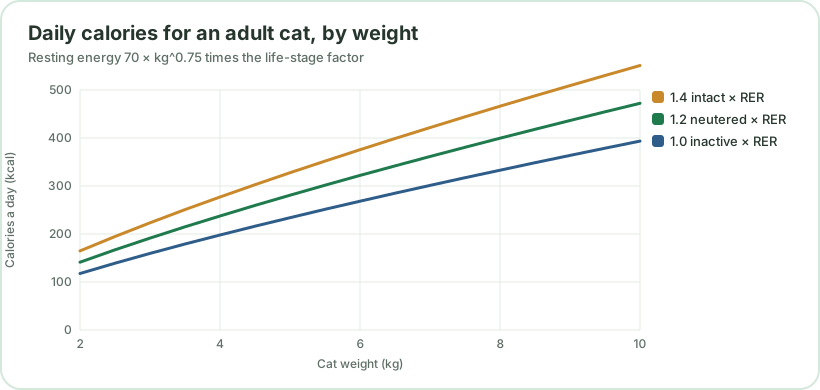
The two-step formula
First the energy a cat needs at rest, then a factor for the life it leads:
RER (kcal/day) = 70 × body weight in kg ^ 0.75 daily energy = RER × life stage factor
The factors come from the NRC, Merck and WSAVA tables used by the Cat Calorie Calculator:
| Cat | Factor × RER |
|---|---|
| Neutered adult | 1.2 |
| Intact adult | 1.4 |
| Inactive or weight-gain-prone adult | 1.0 |
| Weight loss (RER of the ideal weight) | 0.8 |
| Kitten | 2.5 |
Cats have lower factors than dogs because they are lean, efficient animals that are often indoors. The explanation for the weight-loss factor is that the cat is fed for the weight it should be, not the weight it is.
Daily calories by weight
| Cat weight | RER | Neutered (1.2) | Intact (1.4) | Inactive (1.0) | Weight loss (0.8, ideal weight) |
|---|---|---|---|---|---|
| 2 kg (4.4 lb) | 118 | 141 | 165 | 118 | 94 |
| 3 kg (6.6 lb) | 160 | 191 | 223 | 160 | 128 |
| 4 kg (8.8 lb) | 198 | 238 | 277 | 198 | 158 |
| 5 kg (11 lb) | 234 | 281 | 328 | 234 | 187 |
| 6 kg (13 lb) | 268 | 322 | 376 | 268 | 215 |
| 7 kg (15.4 lb) | 301 | 361 | 422 | 301 | 241 |
| 8 kg (17.6 lb) | 333 | 400 | 466 | 333 | 266 |
All values are kcal a day. For the weight-loss column, use the cat’s ideal weight, not its current weight, and only with your vet’s agreement. For the full chart and its uses, see cat calories by weight.
A worked example
Take a neutered adult cat weighing 4 kg.
- 4 ^ 0.75 ≈ 2.83.
- RER = 70 × 2.83 ≈ 198 kcal.
- Daily energy = 1.2 × 198 ≈ 238 kcal.
- Treat allowance at 10% ≈ 24 kcal.
If that cat is fed a dry food of 3,800 kcal per kg, the amount is 238 ÷ 3.8 ≈ 63 g a day. If it is fed a wet food of 1,000 kcal per kg, the amount is 238 g a day. The grams look very different, the calories are the same.
Why cats and dogs differ
A common mistake is to feed a cat as if it were a small dog. A neutered dog uses 1.6 times RER and a neutered cat 1.2, so for the same weight a cat needs about three quarters of the calories of a neutered dog. A 4 kg dog would need about 317 kcal and a 4 kg cat about 238. The difference may look small, but it adds up over a year, and a cat fed a dog’s portion tends to gain weight.
Which factor should I use?
- 1.2 (neutered adult) is the right starting point for most pet cats.
- 1.4 (intact adult) applies to cats that have not been neutered.
- 1.0 (inactive) is for cats that gain weight easily or are very inactive, if your vet agrees.
- 2.5 (kitten) applies to growing kittens; see how much a kitten should eat.
- 0.8 (weight loss) is only for a vet-supervised plan.
Pregnant and nursing queens have different needs, so ask your vet instead of using an adult factor.
Counting everything the cat eats
The daily figure covers all food:
- Main meals, wet and dry.
- Treats and dental chews.
- Food used for medication.
- Scraps and any food from other cats’ bowls.
Treats should be kept to no more than 10% of the day’s calories (WSAVA and AAHA). The Cat Treat Calorie Calculator shows how many treats fit. If a cat eats more treats, reduce the meals to match.
Reading the label
Cat food labels give energy in kcal per kg, kcal per can, kcal per cup or kilojoules. Convert to kcal per gram by dividing kcal per kg by 1,000, or kJ by 4.184. For wet food in cans, divide the daily calories by kcal per can to get cans per day; our Cat Food Calculator does the full calculation with your own foods.
| Food energy | kcal per gram | Grams for 238 kcal |
|---|---|---|
| 900 kcal/kg wet | 0.9 | 264 g |
| 1,000 kcal/kg wet | 1.0 | 238 g |
| 3,500 kcal/kg dry | 3.5 | 68 g |
| 3,800 kcal/kg dry | 3.8 | 63 g |
| 4,200 kcal/kg dry | 4.2 | 57 g |
Adjusting from the cat itself
The calculation is an estimate. Check it against the cat:
- Weigh your cat every month on the same scale.
- Feel the ribs: they should be easy to feel under a thin layer of padding.
- Look from above for a waist, and from the side for a slight tuck.
- If weight is creeping up, reduce daily calories by a small step, such as 10%, and recheck in a few weeks.
- If your cat is losing weight without a diet, call your vet.
Cats that lose weight too fast or stop eating can become seriously ill, so never make a large cut without advice.
Why cats are not “just small dogs” when dieting
Cats cannot go without food for long periods without risk to their health, and drastic cuts can cause serious problems. This is why any weight-loss plan for a cat should be agreed with your vet and based on a goal weight, with regular weigh-ins. Our dog weight loss plan explains the same ideas for dogs, but a cat plan must be written by someone who has examined the cat.
Common mistakes
- Feeding a cat as a small dog.
- Using the current weight of an overweight cat in the weight-loss formula.
- Forgetting treats and scraps.
- Measuring dry food by cup instead of by weight.
- Making a large, sudden cut in calories.
- Ignoring changes in appetite or drinking.
Calories for cats of different lifestyles
The same weight can mean different numbers, depending on the cat’s life. Here are five cats of 4 kg.
| Cat | Situation | Factor | Daily calories | Dry food (3,800 kcal/kg) |
|---|---|---|---|---|
| Mimi | Neutered, indoor, ordinary | 1.2 | 238 | 63 g |
| Felix | Neutered, very inactive, gains weight easily (vet agrees) | 1.0 | 198 | 52 g |
| Tom | Intact male | 1.4 | 277 | 73 g |
| Bella | Neutered, needs to lose weight (ideal weight 4 kg, vet plan) | 0.8 | 158 | 42 g |
| Kit | A 4-month-old kitten at 1.5 kg | 2.5 | 237 | 59 g |
Mimi’s and Kit’s daily calories are almost the same, even though Kit weighs less than half as much. This is the effect of growth. Felix’s number is lower than Mimi’s by 17%, and Bella’s by about 34%, which is why weight plans need a vet.
Setting a calorie target for a multi-cat home
If you have several cats, work out each one’s number and write it down. Then decide how to feed them: separate rooms, scheduled meals, microchip feeders or a mix. Cats do not share fairly, and the heaviest often eats the most. A simple card on the fridge helps everyone:
| Cat | Weight | Daily calories | Food | Grams a day |
|---|---|---|---|---|
Weigh each cat monthly. If one cat is gaining while another is losing, rearrange the feeding.
What to do when a cat is a fussy eater
Fussiness and calories often meet. A cat that refuses its measured meal and then wolfs a plate of treats has not eaten a balanced diet. Offer meals at set times, remove them after a short while, and avoid filling the gap with treats. If a cat refuses food for more than a day, call your vet: cats that do not eat can become ill quickly.
A worked set of cats
| Cat | Weight | RER | Factor | Daily energy |
|---|---|---|---|---|
| Kitten | 2 kg | 118 | 2.5 | 295 |
| Neutered adult | 4 kg | 198 | 1.2 | 238 |
| Intact adult | 4 kg | 198 | 1.4 | 277 |
| Inactive or obese-prone | 5 kg | 234 | 1.0 | 234 |
| Weight loss, goal 4 kg | 5 kg | 198 (of 4 kg) | 0.8 | 158 |
These are the calculator’s factors applied by hand. They are population averages, so your cat may need more or less. Weigh monthly and adjust by about 10% when the trend is wrong, and ask your vet for a plan if a cat needs to lose weight, since fast loss is risky in cats. See cat RER and MER explained for the step-by-step.
Turning calories into a meal
Divide calories by the food’s kcal per gram. A cat needing 238 kcal on a food of 1.0 kcal/g eats 238 g; on a 3.6 kcal/g food, 66 g. Split across two to four meals, and count treats within 10% of the total.
Quick summary
- Cats use RER = 70 × weight in kg ^ 0.75, multiplied by 1.2 for a neutered adult.
- A 4 kg neutered cat needs about 238 kcal a day; an intact adult 277; an inactive cat 198.
- Kittens use 2.5 × RER; weight-loss plans use 0.8 × RER of the ideal weight and need a vet.
- Count treats within 10% of the day’s calories.
- Adjust by about 10% at a time from monthly weight and body condition.
- Use the Cat Calorie Calculator for your cat.
Frequently asked questions
How many calories does a cat need a day?
A neutered adult cat needs about 1.2 × 70 × weight in kg ^ 0.75 kcal. A 4 kg cat needs about 238 kcal, a 5 kg cat about 281 kcal and a 3 kg cat about 191 kcal.
Do intact cats need more calories?
Yes. The adult intact factor is 1.4 times RER, so a 4 kg intact cat needs about 277 kcal against 238 for a neutered cat.
How many calories should an indoor or inactive cat eat?
For an inactive or weight-gain-prone cat, the factor is 1.0 times RER, which is about 198 kcal for a 4 kg cat. Your vet can advise if this suits your cat.
How many calories does a kitten need?
About 2.5 times RER. A 1.5 kg kitten needs about 237 kcal a day, much more per kilogram than an adult cat.
How many calories should an overweight cat eat?
Vets use about 0.8 times the RER of the ideal weight and aim for slow loss. Never start a cat diet without your vet, because cats can become ill if they eat too little.
How many calories are in a can of cat food?
It varies by product, so read the label. A food of 1,000 kcal per kg has 1 kcal per gram, so an 85 g can has about 85 kcal.
How many calories can treats have?
No more than about 10% of the day's calories, which is roughly 24 kcal for a 4 kg neutered cat.
Sources
- NRC (2006) Nutrient Requirements of Dogs and Cats, National Academies Press
- Merck Veterinary Manual — Nutritional Requirements of Small Animals
- AAHA (2014) Weight Management Guidelines for Dogs and Cats
Related calculators
- Cat Calorie CalculatorWork out how many calories your cat needs each day, from its weight and life stage.
- Cat Food CalculatorWork out your cat's daily calories and how to split them between wet and dry food.
- Cat Treat Calorie CalculatorCheck how many treats your cat can have a day without unbalancing its diet: the 10% rule.
Keep reading
- Cat RER and MER ExplainedCat RER and MER explained: how resting energy (70 × kg^0.75) becomes a daily calorie target with life stage factors, worked examples, treats and common mistakes.
- How Much Should I Feed My Cat? Wet and DryHow much to feed a cat by weight: daily calories, grams of wet and dry food, mixed feeding, meals per day, treats and how to avoid overfeeding.
- Senior Cat Care: Food, Vet Visits and HomeA practical senior cat care guide: weighing, food and water, vet check-up rhythm, home changes for stiff joints, a monthly checklist and what to note for your vet.