
When you adopt a cat from a rescue or take in a stray, the first question people ask is “how old is she?”, and the honest answer is often “we do not know”. There is no birth certificate and no sure test. What exists is a set of signs that a vet reads together to arrive at an estimate. This guide explains what those signs are, how far each can be trusted, why estimates widen with age and how to turn an estimate into something practical: a birthday on a calendar and a life stage for planning care.
Why one sign is never enough
Every sign of age can be misleading by itself. Teeth wear with diet and chewing habits, coats change with health and breed, eyes change for many reasons and a thin cat can look older than she is. A vet uses all the signs together and also considers the cat’s medical history, if known. The result is an estimate, usually stated as a range.
What a vet looks at
Teeth
Teeth are the most useful single clue in young cats. In kittens, the milk teeth appear and are replaced by adult teeth in a regular sequence over the first months, so a vet can often estimate age within a small range by seeing which teeth are present. Once all the adult teeth are in place, the clues become softer: wear on the edges, build-up of tartar, gum condition and any missing or damaged teeth. These reflect how a cat has lived as much as how long, so they point to an age band, such as young adult or senior, more than a precise year.
Eyes
Young cats usually have bright, clear eyes. Changes in the lens or iris can appear with age, and some are normal. Others can signal a health problem. If you see cloudiness, a change in colour or discharge, mention it to your vet for a check. Do not try to decide age from eye changes at home.
Coat
A kitten’s coat is soft and fine. Adult cats have a fuller coat, and older cats may groom less, so the coat can become thinner or matted. Some cats develop grey or white hairs with age, though this is not reliable. Coat condition also reflects diet, health and parasites.
Body and muscle
Kittens are lean, growing and active. Adults hold a stable weight. Seniors can lose muscle, particularly over the spine and hips, and may become bonier or, in some cases, heavier. Body condition is a health sign as much as an age sign, so it is best used to inform care. Our dog body condition score chart shows the idea of scoring, and your vet can score a cat with a similar scale.
Behaviour and mobility
Kittens play and sleep in bursts, young adults are active and seniors may sleep more and move more slowly or stiffly. Behaviour alone is a poor guide: a lively 14-year-old and a quiet 4-year-old are both normal. Stiffness, difficulty jumping and changes in litter box habits are reasons to see the vet, whatever the age.
How accurate can it be?
| Age group | How well can a vet estimate? |
|---|---|
| Newborn to about 6 months | Often within weeks, from teeth and size |
| About 6 months to 2 years | Within a few months, as adult teeth are in place |
| Young and mature adults | Within a band of a few years |
| Seniors | A wide band; health matters more than the number |
The older the cat, the wider the range, and the less meaning an exact year has. For planning care, the life stage is what matters.
From an estimate to a birthday
A range is not very useful on a calendar, so choose a date inside it.
- Ask your vet for the range at the first visit and write it down.
- Pick a birth date within it. For a kitten, use the vet’s estimate of weeks. For an adult, choose the middle of the range or a memorable date, such as the day you adopted her.
- Enter it into the Cat Age from Birth Date Calculator to get the age in years and months.
- Use the Pet Birthday Calculator for the next birthday and as a reminder to book a check-up.
- Treat the human-year result as approximate.
Worked example
A rescue cat has a vet estimate of “about 5 to 7 years”.
- The owner chooses 6 years, and sets a birth date accordingly.
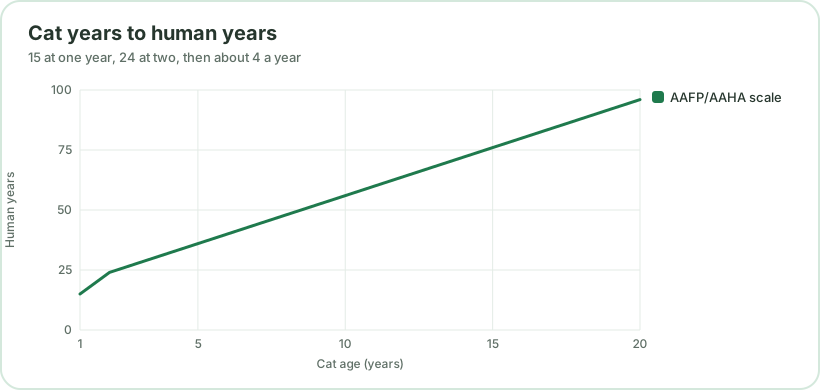
- The human age on the AAFP/AAHA scale is 24 + (6 − 2) × 4 = 40, the end of the young adult stage.
- The range of 5 to 7 years covers 36 to 44 human years, from young to mature adult.
- The owner and vet agree to treat the cat as a mature adult for check-up planning, and to review at each visit.
The exact number matters less than the planning it supports; our guide on how old a cat is in human years shows the scale in full.
Kittens: weight and weeks
A kitten’s age is easier to track by weight and weeks. A healthy kitten gains weight steadily, and your vet and the Puppy & Kitten Age Calculator can help match weight to age. Our kitten feeding chart lists calories by weight, which is useful for kittens of unknown age. If you find a very young kitten, take it to a vet promptly for a feeding plan.
Why bother with age at all?
An estimated age helps you:
- Plan vaccines and neutering for a young cat.
- Choose the right food for the life stage.
- Decide when to start senior check-ups.
- Judge whether weight and behaviour are normal.
- Give the cat a birthday to celebrate and remember.
What not to do
- Do not decide age from a single sign.
- Do not use eye changes to guess, since they can be a health issue.
- Do not assume a thin cat is old, or a plump one young.
- Do not wait to see a vet because “she seems fine”.
- Do not treat an estimate as exact.
Common mistakes
- Using adoption date as the birth date.
- Believing a single chart of teeth.
- Ignoring the kitten weight and growth.
- Never asking the vet for an estimate.
- Forgetting to record the estimate.
Questions to ask your vet
- What age range do you estimate for my cat?
- Which signs did you use?
- Which life stage is she in, and how often should we meet?
- What date should I use as a birthday?
- Are any signs worth watching, such as changes in teeth or eyes?
A checklist to take to the vet
When you bring a cat of unknown age to the vet, a few facts help the estimate:
| Question | Why it matters |
|---|---|
| Where did the cat come from, and what did the finder or rescue say? | Gives a starting range |
| Has she had kittens? | Suggests she is past kittenhood |
| Is she neutered, and when was it done? | The vet may know typical timings |
| What does she eat, and any changes in appetite? | Teeth and weight are linked to diet |
| Any signs of illness or discomfort? | Health affects how a cat looks |
| Does she have a microchip or records? | May carry an age or date |
Ask for the estimate in writing, and ask what range the vet would give. If the cat later becomes unwell, the record helps.
Kitten age by weeks: a guide for rescuers
If you have found a very young kitten, an approximate age can be judged from behaviour and development, and a vet can give a better answer. The aim is to know how much and how often to feed, and when it can eat solid food. Because a kitten under about four weeks needs a vet’s feeding plan, take it to a vet promptly. Use a kitchen scale to weigh daily and write it down. Our kitten feeding chart lists calories by weight for kittens that are old enough.
Common myths about telling cat age
- “Count the rings on a claw.” There is no such method.
- “Whiskers turning white mean old age.” Colour changes in whiskers and fur happen for many reasons.
- “A cat that sleeps all day is old.” Cats of all ages sleep a lot.
- “Weight tells you age.” Adult weight is not a reliable guide, since cats vary by breed and condition.
- “Cloudy eyes are normal in all old cats.” Some changes are age-related and others are signs of disease; mention any to your vet.
What changes at each life stage
| Stage | Typical features a vet may note |
|---|---|
| Kitten | Small, fast-growing, milk teeth changing to adult teeth, playful |
| Young adult | Adult teeth in good condition, lean and fit, active |
| Mature adult | Some wear on teeth, may gain weight, fewer signs of age |
| Senior | More dental wear and tartar, possible muscle loss, slower movement, changes in coat |
These are general patterns. Individual cats can be exceptions, and a vet looks at the whole picture.
What a vet looks at
A vet estimates age from several signs together, because no single sign is exact. Teeth are the usual first clue: kittens have small, sharp milk teeth, adults have larger teeth with progressively more tartar and wear. Coat and eyes, body condition and muscle tone add detail, and blood tests may add context. The estimate is usually a range, such as “about 5 to 7 years”. Write the range on the cat’s records, then use the Cat Age Calculator with a rounded figure and treat the result as an approximation. For the human-years chart see how old is my cat in human years.
Recording the estimate
If you adopt a cat of unknown age, ask the vet for a range, write it on the first page of the cat’s records and set a notional birthday, for example the adoption date. Use the same date every year for check-ups and vaccine reminders, which makes planning simple even if the true age is a guess.
Quick summary
- A vet combines teeth, eyes, coat, body condition, muscle and health to estimate age.
- Kittens can be aged quite closely; adults and seniors only within a range.
- Do not rely on one sign, and mention eye or mobility changes to your vet.
- Choose a birthday inside the vet’s range and record it.
- Use the Cat Age from Birth Date Calculator and the AAFP/AAHA scale for the human-year equivalent.
- Plan care by life stage, not by an exact year.
Frequently asked questions
How can I tell how old my cat is?
A vet looks at teeth, eyes, coat, body condition and overall health together and gives an estimate or a range.
Can teeth show a cat's age?
They give clues. Kittens' teeth erupt in a known order, while in adults, wear and tartar suggest age but vary with diet and care.
Do cloudy eyes mean an old cat?
Not always. Changes in the eyes can happen for different reasons, so mention them to your vet rather than judging age from them.
Can I tell a cat's age by weight?
Weight helps with kittens, who gain steadily, but adult weight says little about age.
How accurate are age estimates?
Fairly good for kittens and young cats, and less precise for adults and seniors, so the estimate is a range.
What birthday should I choose?
A date inside your vet's range. Many rescues pick a date, and you can use it as a consistent birthday for check-ups.
Do I need a vet to estimate age?
A vet gives the most reliable estimate, and a first check-up is a good time to ask.
Sources
- AAFP/AAHA (2021) Feline Life Stage Guidelines. Journal of Feline Medicine and Surgery 23:211-233
- Vogt A.H. et al. (2010) AAFP-AAHA Feline Life Stage Guidelines. Journal of Feline Medicine and Surgery 12:43-54
Related calculators
- Cat Age CalculatorConvert your cat's age into human years and see its life stage.
- Cat Age from Birth Date CalculatorEnter your cat's birth date to see its exact age, its age in human years and its life stage.
- Pet Birthday CalculatorFind your pet's next birthday, how many days away it is and how old it will turn.
Keep reading
- Cat Years to Human Years: Age ChartA clear cat age chart from kitten to 20 years, how the AAFP/AAHA scale works, the cat life stages and how long cats usually live.
- How Much Should a Kitten Eat? By AgeHow much to feed a kitten by weight and age: the 2.5 times RER rule, grams of wet and dry food, meals per day, weaning and when to switch to adult food.
- Cat Age from Birth Date: Exact Years and WeeksHow to find a cat's exact age from its birth date in years, months, weeks and days, then read it on the AAFP/AAHA human-years scale, with three worked cats.
- When Is a Cat Senior? Age, Signs and Next StepsWhen a cat counts as senior: the AAFP/AAHA age bands, what the label does and does not mean, early signs worth noting and how to adjust check-ups, food and the home.