
Most owners start with the table on the back of the bag. It looks authoritative: weights down one side, cups or grams down the other. Yet many owners find that if they follow it to the letter, their dog gains weight. This is not because the table is dishonest; it is because it has to cover every dog that might eat the food, from lazy to athletic, young to old, neutered to intact, and it must err on the side of not underfeeding. This guide explains the reasons why the bag overshoots, shows how to build a better number from calories and gives a method for checking and adjusting. It is general information, and your vet is the right person for your dog’s specific needs.
Why a bag cannot be exact
A feeding guide on a bag faces several limits.
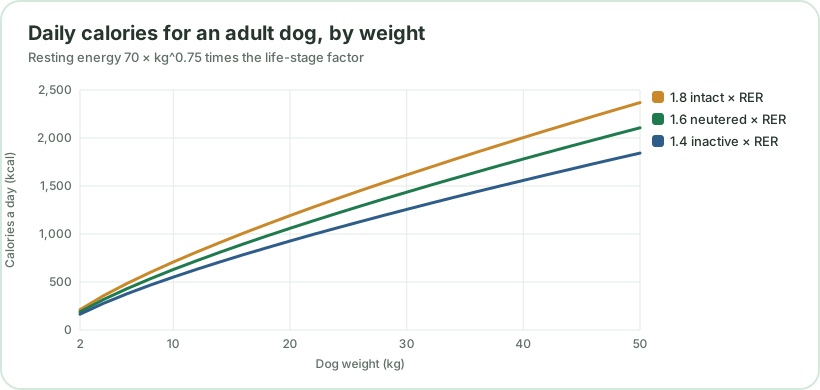
- Wide weight bands. The guide may give one amount for dogs from 10 to 20 kg. A 10 kg dog and a 20 kg dog differ in needs by about 60%, because energy needs grow with weight to the power 0.75, not in a straight line.
- One factor for all. The table typically assumes a typical adult, with no adjustment for neutering, which lowers energy needs, or for inactivity or high activity.
- No treats. The guide covers the food only. Every treat and chew is on top.
- A built-in margin. Manufacturers prefer that a dog is not underfed, so they err generous.
- Cups. Many guides give cups, which vary in weight by scoop and fill.
- Rounding. Amounts are rounded to simple numbers for readability.
None of these is a scandal, but together they mean the guide is a starting point.
A worked comparison
Take a neutered 20 kg adult and a food of 3,600 kcal/kg. The calculation is:
| Step | Working | Result |
|---|---|---|
| Resting energy | 70 × 20 ^ 0.75 | 662 kcal |
| Neutered adult factor | × 1.6 | 1,059 kcal |
| Grams of food | 1,059 ÷ 3.6 | 294 g |
Suppose the bag’s table says “20 kg: 350 g”. That is 350 × 3.6 = 1,260 kcal, which is 19% above the calculated need. A dog fed 19% too much gains weight steadily: 200 kcal a day extra is about 73,000 kcal a year, a large surplus. The point is not that the bag is “wrong”, but that the dog in your kitchen is probably not the average dog the table assumes.
For an inactive dog (factor 1.4), the need is 927 kcal, or 258 g, and the bag’s 350 g is 36% above. For a working dog, the opposite may hold. This is why a calculation based on your own dog is better.
How much can the guide be off by?
The table below shows the calories for the same bag amount across three dogs of the same weight. The bag guide is assumed to be 350 g of a 3,600 kcal/kg food.
| 20 kg dog | Need (kcal) | Bag gives (kcal) | Surplus or shortfall |
|---|---|---|---|
| Inactive (1.4 × RER) | 927 | 1,260 | +36% |
| Neutered adult (1.6 × RER) | 1,059 | 1,260 | +19% |
| Intact adult (1.8 × RER) | 1,192 | 1,260 | +6% |
| Active working dog (2.0 × RER or more) | 1,324 | 1,260 | −5% |
The values for the active dog illustrate that the guide may suit some dogs. The example uses factors from our calculators: 1.4, 1.6 and 1.8 for adult maintenance, and 2.0 as an illustration of higher activity (the calculators’ puppy factor at 2.0; working-dog factors vary and your vet can advise).
Build your own number
- Weigh your dog on a reliable scale, in kg.
- Calculate resting energy: 70 × weight ^ 0.75.
- Choose a factor: 1.6 for a neutered adult, 1.8 intact, 1.4 inactive or prone to weight gain.
- Find the food’s kcal per kg on the label or from the maker. If only cups and kcal per cup are given, convert; use the Dog Food Cups to Grams Calculator. If kcal are missing, the Dog Food kcal Calculator estimates them from the analysis panel.
- Divide: grams per day = calories ÷ (kcal per kg ÷ 1,000).
- Subtract treats: keep treats within 10% and reduce meals.
- Check in two to four weeks: weigh and score body condition.
The Dog Food Calculator does steps 2 to 5. Our guides to how much to feed a dog and the dog feeding chart by weight show the numbers for many weights.
Using the bag as a sense check
Compare your calculated amount with the bag’s. If they are within about 10 to 20%, good. If the calculated amount is much lower, check:
- Is the dog neutered or inactive, which would explain a lower need?
- Is the weight right, and did you convert pounds to kilograms?
- Is the food’s energy as you think?
- Is the dog at an ideal weight? If overweight, the amount should be based on the ideal weight, with a vet’s plan.
If the calculated amount is higher than the bag, the dog may be active, young or lean; check body condition before feeding more, and ask your vet.
Adjusting from real life
A calculated amount is a starting point for an average dog. Every dog differs by perhaps 10 to 20%. The way to find your dog’s real figure is to feed the calculated amount for two to four weeks, weigh weekly and score body condition. If the weight is steady and the ribs are easy to feel, you have found it. If weight rises, reduce by 10%; if it falls and the dog is lean, increase by 10%. Keep a record. The Dog Body Condition Score tool describes the scale.
Wet food and mixed feeding
The same applies to cans and trays, which often list a number of cans by weight band. Calculate from kcal per can instead. A 20 kg neutered dog needing 1,059 kcal would need about 3.2 cans of a 330 kcal can. If you feed wet and dry together, work out the calories for each. The Dog Wet & Dry Food Calculator splits the calories and shows grams for each.
Common mistakes
- Following the bag to the letter.
- Measuring by cup.
- Forgetting treats.
- Using the same amount after neutering.
- Not adjusting after weight changes.
- Comparing to a friend’s dog of a different type.
- Never weighing.
What to do when your calculation is far from the bag
Sometimes the difference is not 10% but 40%. Work through these steps:
- Recheck the weight and units. A dog of 44 lb is 20 kg, not 44.
- Recheck the food’s energy. A food at 3,200 kcal/kg needs 14% more grams than one at 3,700.
- Recheck the factor. 1.4, 1.6 and 1.8 differ by up to 29%.
- Recheck the ideal weight. If the dog is overweight, the calculation should use the goal weight, with your vet.
- Check the dog’s age and health. Puppies, seniors, pregnant or nursing dogs and sick dogs need different numbers.
- Ask your vet to confirm the target.
If the dog is lean, active and your calculation seems low, increase the amount by 10% and recheck in a fortnight. If the dog is gaining on the bag amount, you have your answer.
Multi-dog households and sharing bags
With more than one dog, the bag’s table is even less useful, because each dog needs its own amount. Write a card for each dog with the daily grams, the number of meals and the treat allowance, and put it on the food container. Feed dogs separately if one tends to steal. Weigh each dog monthly. Dogs of different sizes may need different foods, and your vet can advise on whether one food suits all.
When the manufacturer’s guidance is helpful
The bag guide is not always wrong. For some foods, particularly prescription diets and weight-control formulas, the manufacturer’s table is calibrated to the product and your vet’s plan. Follow your vet’s instructions in these cases. For general adult maintenance foods, treat the table as an upper estimate and begin lower, with weekly checks. The aim is a dog at a healthy weight, not a perfect match with a table.
A quick audit of your own bag
Pick up your dog food bag and run through these points.
| Question | Where to find it | Your answer |
|---|---|---|
| Is it complete and balanced for my dog’s stage? | Adequacy statement | |
| What is the energy? | kcal per kg or per cup | |
| What are the grams for my dog’s weight according to the bag? | Feeding table | |
| What are my calculated grams? | Dog Food Calculator | |
| Difference in percent | (bag − calculated) ÷ calculated | |
| Is my dog’s weight stable? | Last three weigh-ins | |
| Are treats counted? | Your log |
If the difference is 10% or less and weight is stable, carry on. If it is larger, start from your calculation and track the weight. Keep the audit sheet with the bag’s label photo.
A conversation with the manufacturer
If the bag’s guide and your calculation disagree, ask the maker. Most have customer services that can tell you the energy value, how the guide was set and whether it is intended for typical or active dogs. Ask for the information in writing. A responsible maker will explain; a vague answer is itself informative. Share the information with your vet if you are unsure.
Quick summary
- Bag guides use wide weight bands, ignore neutering and treats and often err generous.
- Neutered 20 kg adult: 1,059 kcal, or 294 g of a 3,600 kcal/kg food.
- A bag amount of 350 g would be about 19% too much for that dog.
- Build your number: 70 × kg ^ 0.75 × factor ÷ food energy.
- Feed for two to four weeks, weigh, score condition and adjust by about 10%.
- Use the Dog Food Calculator for your dog.
Frequently asked questions
Why does the bag recommend more food than my dog needs?
Bag guides are written to cover many dogs in wide weight bands, and they tend to be generous so that no dog goes underfed. Your dog's own needs depend on neutering, activity and age.
How do I calculate my dog's food from calories?
Resting energy is 70 × weight in kg ^ 0.75. Multiply by 1.6 for a neutered adult, 1.8 for intact, 1.4 for inactive. Divide by the food's kcal per gram.
What if the bag does not list kcal?
Look on the maker's website, contact them, or estimate from the guaranteed analysis with a calculator.
How accurate is a calorie calculation?
It is an estimate for an average dog. Use it as a starting point and adjust by about 10% from weight and body condition.
Should I ignore the bag completely?
Use it as a sense check, not as the answer. If your calculated amount is far from the bag, check your arithmetic and ask your vet.
Do wet foods have the same problem?
Yes. Cans give guidance by weight band and can be generous. Calculate from kcal per can.
Does the guide include treats?
Usually not. Treats should stay within 10% of daily calories, and meals reduced to match.
Sources
- NRC (2006) Nutrient Requirements of Dogs and Cats, National Academies Press
- WSAVA Global Nutrition Guidelines
- AAHA (2014) Weight Management Guidelines for Dogs and Cats
Related calculators
- Dog Food CalculatorTurn your dog's daily calorie need into grams and cups of the food you actually feed, using the energy value printed on the bag.
- Dog Food Cups to Grams CalculatorConvert cups of dog food to grams (and back) using the energy values printed on your bag.
- Dog Food Calorie CalculatorWork out how many calories are in a dog or cat food from the nutrient percentages (guaranteed analysis) on its label, when no kcal figure is printed.
Keep reading
- How Much Should I Feed My Dog? By WeightHow much to feed a dog by weight: a grams and cups chart, how to read the food label, meals per day, adjusting by body condition and common mistakes.
- How Many Cups of Dry Food Should a Dog Eat?How many cups of dry food a dog needs: the calorie method, a cups chart for 300, 360 and 400 kcal per cup, why cups vary and how to measure accurately.
- Dog Feeding Chart by Weight (Printable)A printable dog feeding chart by weight: daily calories for neutered, intact and inactive adults, with grams for 3,400, 3,600 and 3,800 kcal/kg foods.
- Feeding Wet and Dry Dog Food TogetherHow to feed wet and dry dog food together without overfeeding: splitting daily calories, worked grams for a 20 kg dog, topper rules and a mixed-feeding table.