
A new puppy is a small body doing a huge amount of growing, and the question “how much should I feed my puppy?” has no single answer because the right amount changes every few weeks. This guide explains how puppy calories are calculated from weight and age, how to turn calories into grams of food, how many meals a day suit different ages, and when to move on to adult food. It also covers the common mistakes that make puppies too heavy or too light.
Why puppies eat more per kilogram than adults
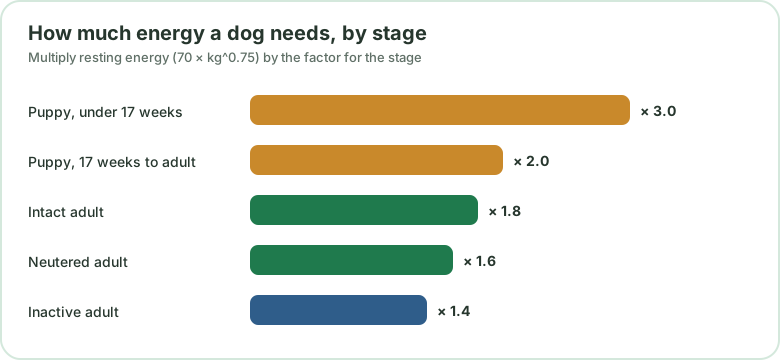
A puppy has to fuel its normal daily activity and also build bone, muscle and organs. That is why the energy factors in the nutrition tables are higher for puppies than for adults. All of them multiply the resting energy requirement (RER), the energy a dog uses at rest:
RER (kcal/day) = 70 × body weight in kg ^ 0.75
| Life stage | Factor × RER |
|---|---|
| Puppy under 4 months | 3.0 |
| Puppy from 4 months to adulthood | 2.0 |
| Neutered adult dog | 1.6 |
These factors come from the Merck Veterinary Manual and WSAVA guidance and are the same as in our Puppy Food Calculator. They describe an average puppy. A very active puppy may need more and a calm one less, which is why the scale and body shape matter more than the arithmetic.
Puppy energy needs by weight
| Puppy weight | Under 4 months (3.0 × RER) | 4 months to adult (2.0 × RER) |
|---|---|---|
| 2 kg (4.4 lb) | 353 kcal | 235 kcal |
| 5 kg (11 lb) | 702 kcal | 468 kcal |
| 10 kg (22 lb) | 1,181 kcal | 787 kcal |
| 15 kg (33 lb) | 1,601 kcal | 1,067 kcal |
| 20 kg (44 lb) | 1,986 kcal | 1,324 kcal |
| 30 kg (66 lb) | 2,692 kcal | 1,795 kcal |
The figures are daily totals, including treats. A puppy that grows from 5 kg to 10 kg changes row, so you need to recalculate as it grows. A good habit is to weigh every week or two and update the plan each time.
From calories to grams
Dog food labels give energy as kcal per kg (or per 100 g, or per cup). The conversion is:
grams per day = calories ÷ (kcal per kg ÷ 1,000)
A puppy food that lists 3,800 kcal/kg contains 3.8 kcal per gram. The same puppy foods give these daily amounts:
| Puppy weight | Under 4 months (3,800 kcal/kg food) | 4 months to adult (3,800 kcal/kg food) |
|---|---|---|
| 2 kg | 93 g | 62 g |
| 5 kg | 185 g | 123 g |
| 10 kg | 311 g | 207 g |
| 15 kg | 421 g | 281 g |
| 20 kg | 523 g | 348 g |
| 30 kg | 708 g | 472 g |
If your food lists kcal per cup instead, the Dog Food Cups to Grams Calculator converts between the two. Different foods have different densities, so do not assume your puppy’s food has the energy value used above; read the label.
A worked example
Take a puppy aged 10 weeks that weighs 5 kg and eats a puppy food of 3,800 kcal/kg.
- RER = 70 × 5 ^ 0.75 ≈ 234 kcal.
- A puppy under 4 months uses factor 3.0, so daily energy = 3.0 × 234 ≈ 702 kcal.
- Daily food = 702 ÷ 3.8 ≈ 185 g.
- At this age the calculator suggests 4 meals, so each meal is about 46 g.
At 4 months, the factor drops to 2.0. If the same puppy then weighs 8 kg, its daily need becomes roughly 2.0 × (70 × 8 ^ 0.75) ≈ 665 kcal, which is a fall in the amount per kilogram even though the puppy is heavier. Recalculate at each stage rather than assuming the amount only goes up.
How many meals a day?
Young puppies have small stomachs and need frequent meals. The Puppy Food Calculator uses this pattern:
| Puppy age | Suggested meals per day |
|---|---|
| Under 13 weeks | 4 |
| 13 to 25 weeks | 3 |
| 26 weeks and older | 2 |
This is a practical default, not a rule. Your vet may prefer a different pattern for toy breeds, which can be prone to low blood sugar if they go too long between meals, or for giant breeds. Ask your vet which schedule suits your puppy. Dividing the daily total into evenly sized meals is the simplest approach, and keeping meal times regular also helps house-training.
Large and giant breed puppies
Large-breed puppies grow for longer and are more sensitive to the way they are fed. Veterinary nutrition guidance (WSAVA, AAHA) points toward steady, even growth rather than the fastest possible growth, and your vet may recommend a diet formulated for large-breed growth. We do not give amounts for that here, because the correct diet and calcium content are for your vet to decide. What you can do is weigh regularly, keep the puppy lean (ribs easily felt, a visible waist) and avoid free-feeding. Our dog body condition score guide shows how to check.
When to switch to adult food
AAHA’s 2019 life stage guidelines describe puppyhood as ending at about 6 to 9 months for many dogs, with large and giant breeds maturing later. A sensible approach is:
- Ask your vet when your puppy’s growth is nearly complete.
- Switch gradually over about a week by mixing a little more of the new food each day.
- Recalculate calories with the adult factor (1.6 × RER for a neutered adult) using the adult weight.
- Watch weight and stools during the change.
The Dog Food Calculator covers adult amounts, and our guide to how much to feed a dog explains the adult factors.
Treats and training
Training a puppy uses many small rewards, and those calories count. WSAVA and AAHA suggest treats make up no more than 10% of the day’s calories. For the 5 kg puppy above, that is about 70 kcal. Practical tips:
- Use part of the day’s kibble as training rewards.
- Choose small, soft treats and break them up.
- Reduce meal portions slightly on heavy training days.
- Use the Dog Treat Calorie Calculator to see how many treats fit.
Signs you are feeding the right amount
- Ribs are easy to feel under a thin layer of padding, but not visible.
- The puppy has a visible waist when seen from above.
- Energy and coat look healthy, and stools are firm.
- Weight rises steadily without jumps.
If the puppy is too thin, too heavy or has loose stools, do not change the food dramatically on your own; speak to your vet.
Common puppy feeding mistakes
- Free-feeding. A bowl that is always full makes it hard to know what the puppy eats and makes house-training harder.
- Using the bag guide only. Bag charts are averages; check against the scale.
- Forgetting to recalculate. A puppy’s needs change quickly as weight and age rise.
- Counting cups instead of grams. A cup of one kibble can weigh far more than a cup of another.
- Too many treats. Treats and chews can quietly push calories well above the target.
- Changing foods suddenly. Switch gradually to avoid stomach upsets.
Questions to ask your vet
- What is my puppy’s expected adult weight?
- Which food and how many calories a day should I aim for now?
- How many meals suit my puppy’s age and breed?
- When should we move to adult food?
- How will we know if growth is too fast or too slow?
Weigh your puppy at home
A weekly weigh-in is the best feedback you have. For small puppies, use kitchen or baby scales. For larger puppies, stand on a bathroom scale holding the puppy, then subtract your own weight. Do it at the same time of day, ideally before a meal. Write down the date and weight; the Puppy & Kitten Age Calculator tells you the age in weeks so that you can match weight to age on your notes.
| Date | Age in weeks | Weight | Daily calories (recalculated) | Notes |
|---|---|---|---|---|
| Starting point | ||||
| Update weekly |
Steady gain is the goal. A puppy that suddenly stops gaining, or gains much faster than before, is worth a call to your vet.
What steady growth looks like
Growth is not a straight line, but it should be smooth. A well-fed puppy has energy, a shiny coat and firm stools. Its ribs can be felt, its waist is visible from above and its tummy tucks up slightly. Many owners find that their puppy’s shape changes noticeably over a week or two, with “leggy” phases and “chubby” phases, which is normal as long as the trend is steady. Puppies that are too round put extra strain on growing joints, which is why vets prefer lean and steady growth to rapid growth.
A feeding routine for the first months
A simple routine makes feeding, toilet breaks and sleep easier:
- Feed at regular times, such as morning, lunch, afternoon and evening for a young puppy.
- Pick up the bowl after about 15 to 20 minutes; do not leave it down all day.
- Offer a toilet break soon after each meal, since young puppies often need one.
- Give a short, calm rest after eating rather than hard play.
- Reduce to three and then two meals as your vet suggests.
A puppy that is resting in a crate between meals needs the right-sized space; our guide to crate sizing shows how to measure, including how a divider helps while your puppy grows.
Several puppies, or a fussy eater
If you are feeding a litter, feed each puppy from a separate bowl and watch that the shy ones get their share. Weigh each puppy individually.
For a fussy eater, rule out the obvious first: is the food fresh, the amount right for the weight, and are treats filling the puppy up? A puppy that skips meals for more than a day, seems lethargic or has other signs of illness needs a vet check. Do not keep changing foods to tempt the puppy, because that tends to make fussiness worse.
Loose stools and tummy upsets
Puppies often get mild stomach upsets when their food changes, when they eat something unusual or when they are stressed by moving house. Changing food gradually helps. Contact your vet promptly if your puppy has diarrhoea or vomiting that lasts more than a day, if it is also lethargic or refuses water, or if the puppy is very small, because young puppies can dehydrate quickly.
Quick summary
- Puppies need about 3.0 × RER under 4 months and 2.0 × RER from 4 months to adulthood.
- A 5 kg puppy under 4 months needs about 702 kcal, roughly 185 g of a 3,800 kcal/kg food, in 4 meals.
- Convert calories to grams with the kcal per kg on the bag and weigh the food.
- Recalculate as the puppy grows and keep treats under 10% of the day.
- Switch to adult food gradually, at a time your vet advises.
- Use the Puppy Food Calculator for your puppy’s numbers.
Frequently asked questions
How much should I feed my puppy?
Work out calories from weight and age, then convert to grams using the kcal per kg on the food bag. A 5 kg puppy under 4 months needs about 702 kcal a day.
How many times a day should a puppy eat?
The CalcuPaw puppy calculator suggests 4 meals under 13 weeks, 3 meals from 13 to 25 weeks and 2 meals after that. Your vet may advise a different pattern for your puppy.
Why does a puppy eat more than an adult dog of the same weight?
Growing puppies use extra energy, so the factor is 3.0 times resting energy under 4 months and 2.0 times after that, compared with 1.6 for a neutered adult.
When should I switch from puppy food to adult food?
It depends on size. AAHA describes puppyhood as lasting to about 6 to 9 months for many dogs, while large breeds often stay on a growth diet longer. Ask your vet before switching.
Is the feeding guide on the bag accurate?
It is a starting point. Bags are written for an average puppy, so use the bag amount and your own weigh-ins together and adjust gradually.
Do treats count in a puppy's daily calories?
Yes. Treats should stay within 10% of daily calories, and training treats add up fast with a small puppy.
Should I use cups or grams for puppy food?
Grams are more accurate. Cups vary with the shape and density of the kibble, so use a kitchen scale if you can and the cup only as a rough check.
Sources
- NRC (2006) Nutrient Requirements of Dogs and Cats, National Academies Press
- Merck Veterinary Manual — Nutritional Requirements of Small Animals
- WSAVA Global Nutrition Guidelines
- AAHA (2019) Canine Life Stage Guidelines. Journal of the American Animal Hospital Association 55:267-290
Related calculators
- Puppy Food CalculatorCalculate how much a growing puppy needs, how many meals a day, and how much per meal.
- Puppy & Kitten Age CalculatorFind your puppy's or kitten's exact age in weeks, months and days from its birth date.
- Dog Treat Calorie CalculatorCheck how many treats your dog can have a day without unbalancing its diet — the 10% rule.
Keep reading
- How Much Should I Feed My Dog? By WeightHow much to feed a dog by weight: a grams and cups chart, how to read the food label, meals per day, adjusting by body condition and common mistakes.
- Dog Years to Human Years: Chart by SizeSee how old your dog is in human years with a size-based chart, the newer epigenetic formula, the dog life stages and why 7 to 1 is wrong.
- What Size Crate Does My Dog Need?Measure your dog's length and height, add 5 to 10 cm (2 to 4 in) and match the result to the crate maker's inside measurements. Includes examples and puppy tips.
- When to Switch Puppy Food to Adult FoodWhen to move a puppy to adult food: AAHA's stage guide, why large breeds switch later, the 20% energy drop to recalculate and a 7-day transition plan.