
The honest answer to “how much should I feed my dog?” is that it depends on weight, life stage, activity and the food itself, and that the number on the bag is only a starting point. This guide shows how to work out a daily food amount in grams and cups, how to read the energy information on the label, how to share the food across meals, and how to tell from your dog’s body whether the plan is working.
Start with calories, not cups
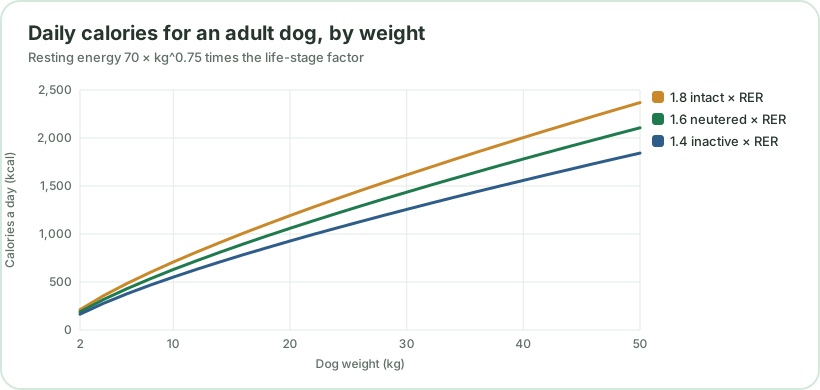
Vets calculate feeding in calories because that is the one unit that is comparable between foods. A cup of one kibble can have far more calories than a cup of another. The starting point is the resting energy requirement (RER):
RER (kcal/day) = 70 × weight in kg ^ 0.75
A dog’s daily maintenance energy (MER) is RER multiplied by a life stage factor from the NRC, Merck and WSAVA references:
| Dog | Factor × RER |
|---|---|
| Neutered adult | 1.6 |
| Intact adult | 1.8 |
| Inactive or weight-gain-prone adult | 1.4 (vets use 1.2 to 1.4) |
| Light work | 2.0 |
| Moderate work | 3.0 |
Our companion guide on how many calories a dog needs explains why the formula uses a power of 0.75 and how the factors are chosen. For feeding, the key point is that the result is a daily total to be converted into food.
Grams and cups by weight
The table shows a neutered adult dog (1.6 × RER), a kibble of 3,600 kcal/kg (3.6 kcal per gram) and a cup that holds 360 kcal. Both are only examples; yours will differ.
| Dog weight | Calories a day | Grams a day (3,600 kcal/kg) | Cups a day (360 kcal per cup) |
|---|---|---|---|
| 2 kg (4.4 lb) | 188 | 52 g | 0.5 |
| 5 kg (11 lb) | 374 | 104 g | 1.0 |
| 10 kg (22 lb) | 630 | 175 g | 1.7 |
| 15 kg (33 lb) | 854 | 237 g | 2.4 |
| 20 kg (44 lb) | 1,059 | 294 g | 2.9 |
| 25 kg (55 lb) | 1,252 | 348 g | 3.5 |
| 30 kg (66 lb) | 1,436 | 399 g | 4.0 |
| 40 kg (88 lb) | 1,781 | 495 g | 4.9 |
| 50 kg (110 lb) | 2,106 | 585 g | 5.8 |
The Dog Food Calculator does this for your own weight, life stage and food energy. Notice that food amount does not rise in step with weight: a 40 kg dog needs less than twice the food of a 20 kg dog.
How to read the energy on the label
Look for metabolisable energy (ME), shown as kcal per kg, kcal per 100 g or kcal per cup. Some labels use kilojoules (kJ) or megajoules (MJ); divide kJ by 4.184 to get kcal. The conversions are:
- kcal per kg ÷ 1,000 = kcal per gram.
- kcal per 100 g × 10 = kcal per kg.
- kcal per cup ÷ kcal per gram = grams in one cup.
If the label shows only nutrient percentages (protein, fat, fibre, moisture, ash), you can estimate energy with the Dog Food Calorie Calculator, which uses the NRC’s modified Atwater factors. The estimate is rougher than a printed ME figure, so use the manufacturer’s value when you can get it. If you need to compare cups and grams, the Dog Food Cups to Grams Calculator converts between them.
A worked example
Take Luna, a neutered adult dog weighing 20 kg, on a kibble of 3,600 kcal/kg.
- RER = 70 × 20 ^ 0.75 ≈ 662 kcal.
- MER = 1.6 × 662 ≈ 1,059 kcal a day.
- Food = 1,059 ÷ 3.6 ≈ 294 g a day.
- Two meals of about 147 g each.
If her food lists 360 kcal per cup instead, the amount is 1,059 ÷ 360 ≈ 2.9 cups a day. If treats supply some of the calories, take them out of the meals so the daily total stays the same.
Meals per day
Most adult dogs do well on two meals a day, roughly twelve hours apart, and the calculator divides the daily amount into two. Some owners prefer three smaller meals for dogs that gulp, and Your vet may recommend splitting meals for breeds prone to bloat. Ask your vet which pattern suits your dog. Whatever you choose, keep the daily total the same and keep meal times regular.
Feeding wet and dry food together
If you mix wet and dry food, divide the day’s calories between them:
- Decide the share, for example 25% wet and 75% dry.
- Calories from wet = share × daily calories; divide by the wet food’s kcal per gram.
- Calories from dry = the rest; divide by the dry food’s kcal per gram.
The Dog Wet and Dry Food Calculator does the arithmetic. This matters because wet food is mostly water: a can that looks large may hold far fewer calories than a scoop of kibble.
Adjusting by body condition
The calculator gives an estimate for an average dog. Individual dogs differ, so the final check is the dog itself. Every few weeks, look and feel:
- Ribs: you should feel them easily under a thin layer of padding.
- Waist: a narrowing behind the ribs when viewed from above.
- Tummy: a slight upward tuck when viewed from the side.
If you cannot feel the ribs, reduce the daily amount by a small step and recheck in two to three weeks. If the ribs are sharply visible, ask your vet before increasing food. Our dog body condition score guide shows the 9-point scale in detail.
Treats and extras
WSAVA and AAHA advise that treats stay under 10% of the day’s calories. For a 20 kg neutered adult that is about 106 kcal. A single large dental chew can use a big share of that. Count every treat, chew and scrap, and use the Dog Treat Calorie Calculator to see how many fit. When you give more treats, give a little less at mealtime.
What does it cost to feed my dog?
Once you know grams a day, you can work out cost: grams a day × price per gram of food. The Dog Food Cost Calculator turns your dog’s calorie need and the bag price into a cost per day, month and year, which helps when comparing foods fairly because it uses calories instead of bag size.
Special cases
- Puppies need a higher factor and more meals; see how much to feed a puppy.
- Overweight dogs are fed for the ideal weight; see our dog weight loss plan.
- Working or very active dogs use higher factors (2.0 to 3.0 × RER), and the right figure depends on the work, so ask your vet.
- Senior dogs often need fewer calories but not always, so adjust by body condition rather than age.
- Pregnant and nursing dogs have different needs; ask your vet instead of using the adult figure.
Common mistakes
- Using a scoop instead of a scale.
- Believing the bag chart is tailored to your dog.
- Forgetting treats, chews and table scraps.
- Not recalculating after a change in weight or food.
- Feeding by weight alone without checking body condition.
- Switching foods suddenly and then wondering why the amount seems wrong.
Hydration goes with feeding
Food is only half of the daily intake. Fresh water should always be available. Merck gives about 50 mL per kg of body weight per day as typical maintenance water (a range of 40 to 60), and over 100 mL per kg per day is considered excessive drinking worth reporting to a vet. Wet food and warm weather change how much a dog drinks, so treat the figures as a guide.
| Dog weight | Typical water (50 mL/kg) | Range (40 to 60 mL/kg) |
|---|---|---|
| 5 kg | 250 mL | 200 to 300 mL |
| 10 kg | 500 mL | 400 to 600 mL |
| 20 kg | 1,000 mL | 800 to 1,200 mL |
| 30 kg | 1,500 mL | 1,200 to 1,800 mL |
| 40 kg | 2,000 mL | 1,600 to 2,400 mL |
If your dog suddenly drinks much more than usual, tell your vet. The Dog Water Intake Calculator compares your dog’s measured intake with these ranges.
Example daily schedules
A written schedule keeps everyone in the household consistent. For the 20 kg neutered dog in our example, who eats about 294 g of a 3,600 kcal/kg food a day:
| Pattern | Meals | Per meal | Notes |
|---|---|---|---|
| Two meals | 8 am and 6 pm | about 147 g | The common default |
| Three meals | 7 am, 1 pm, 7 pm | about 98 g | Useful for dogs that gulp |
| Meals plus training | 2 meals and treats | about 130 g plus treats | Subtract treat calories from meals |
Keep the daily total the same, whatever the pattern. If you use part of the day’s food as training rewards, weigh that portion out of the day’s allowance in the morning so nothing is double counted.
Changing food safely
Changing food abruptly is a common cause of upset stomachs, and it also changes the calories per gram, so the amount you feed should be recalculated. A gentle approach over about a week:
- Days 1 to 2: mostly the old food with a little of the new.
- Days 3 to 4: about half and half.
- Days 5 to 6: mostly the new food.
- Day 7: the new food only, with the amount recalculated from the new label.
If a dog has a health condition or is on a prescription diet, ask your vet before changing anything.
Keeping a record
A short log makes it obvious when something has changed. Write down the food, the daily grams, the dog’s weight each month and the date you last scored body condition. When you see a change in weight, check the log before changing the plan. Our calorie guide shows how to adjust by about 10% at a time.
Quick summary
- Work out calories first: 70 × kg ^ 0.75 × a life stage factor (1.6 for a neutered adult).
- Convert calories to grams or cups with the energy value on your food’s label.
- A 20 kg neutered adult needs about 1,059 kcal, about 294 g of a 3,600 kcal/kg food.
- Weigh food on a scale and keep treats under 10% of the day.
- Judge the result by body condition, not just the bag chart.
- Use the Dog Food Calculator for your own dog.
Frequently asked questions
How much should I feed my dog a day?
Start from calories: 1.6 × 70 × weight in kg ^ 0.75 for a neutered adult, then convert to grams with the kcal per kg on your food. A 20 kg dog needs about 1,059 kcal.
How many cups of food should my dog eat?
Divide the daily calories by the kcal per cup on the label. At 360 kcal per cup, a 20 kg neutered adult needs about 2.9 cups. Cups vary between foods, so check the label.
Is the amount on the dog food bag right for my dog?
It is an average. Use it as a starting point and adjust over several weeks using weight and body condition.
How many meals a day should an adult dog have?
Two meals a day is the usual pattern for adult dogs, but your vet may suggest more for some dogs. The calculator divides daily food into 2 meals by default.
Should an intact dog eat more than a neutered dog?
Intact adult dogs use a higher factor (1.8 times resting energy versus 1.6), so a 20 kg intact adult needs about 1,192 kcal compared with 1,059 for a neutered one.
How do I feed wet and dry food together?
Decide what share of the day's calories each will provide, then divide each share by its own kcal per kg. The wet and dry calculator does the arithmetic.
How do I know if I am overfeeding?
If ribs are hard to feel, the waist has disappeared or weight keeps creeping up, reduce gradually and ask your vet. Body condition score is a more reliable check than the bag chart.
Sources
- NRC (2006) Nutrient Requirements of Dogs and Cats, National Academies Press
- Merck Veterinary Manual — Nutritional Requirements of Small Animals
- WSAVA Global Nutrition Guidelines (incl. 9-point BCS charts)
- AAHA (2014) Weight Management Guidelines for Dogs and Cats
Related calculators
- Dog Food CalculatorTurn your dog's daily calorie need into grams and cups of the food you actually feed, using the energy value printed on the bag.
- Dog Food Cups to Grams CalculatorConvert cups of dog food to grams (and back) using the energy values printed on your bag.
- Dog Wet and Dry Food CalculatorSplit your dog's daily calories between wet and dry food and see the grams of each.
- Dog Food Calorie CalculatorWork out how many calories are in a dog or cat food from the nutrient percentages (guaranteed analysis) on its label, when no kcal figure is printed.
- Dog Treat Calorie CalculatorCheck how many treats your dog can have a day without unbalancing its diet — the 10% rule.
- Dog Food Cost CalculatorSee what it costs per day, month and year to feed your dog, from its calorie need and the price of the bag.
Keep reading
- How Many Calories Does a Dog Need? RER, MERLearn how to calculate a dog's daily calories with RER and MER, see every life stage factor, a calorie table by weight and how to adjust the result.
- Dog Weight Loss Plan: Calories and PaceA practical dog weight loss plan: how to set a goal weight, work out daily calories, choose a safe pace of 1 to 2% a week and track progress.
- How Much Should I Feed My Puppy? By AgeWork out how much to feed a puppy by weight and age: the calorie factors, meals per day, a grams table, a worked example and when to switch foods.
- Feeding Wet and Dry Dog Food TogetherHow to feed wet and dry dog food together without overfeeding: splitting daily calories, worked grams for a 20 kg dog, topper rules and a mixed-feeding table.