
The idea that a dog ages seven years for every calendar year is one of the most repeated and least accurate rules in pet care. A dog is not a small human on a seven-times clock. It grows up in the first two years, then ages at a pace that depends on size. This guide gives you a dog years to human years chart by size, explains the newer epigenetic formula, shows how the two methods differ, and lists the life stages so you can match care to your dog’s age.
The quick chart: dog age in human years
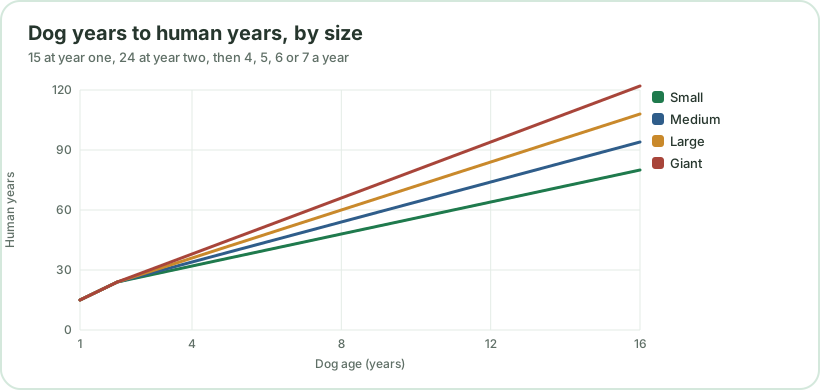
This chart uses the widely published size-based rule: 15 human years at one year, 24 at two years, then a fixed number of human years for every extra dog year, depending on adult size. It is a rule of thumb, not a laboratory measurement.
| Dog’s age | Small (up to 9 kg) | Medium (9 to 23 kg) | Large (23 to 41 kg) | Giant (over 41 kg) |
|---|---|---|---|---|
| 1 year | 15 | 15 | 15 | 15 |
| 2 years | 24 | 24 | 24 | 24 |
| 3 years | 28 | 29 | 30 | 31 |
| 4 years | 32 | 34 | 36 | 38 |
| 5 years | 36 | 39 | 42 | 45 |
| 6 years | 40 | 44 | 48 | 52 |
| 7 years | 44 | 49 | 54 | 59 |
| 8 years | 48 | 54 | 60 | 66 |
| 9 years | 52 | 59 | 66 | 73 |
| 10 years | 56 | 64 | 72 | 80 |
| 12 years | 64 | 74 | 84 | 94 |
| 14 years | 72 | 84 | 96 | 108 |
| 15 years | 76 | 89 | 102 | 115 |
| 16 years | 80 | 94 | 108 | 122 |
To see your own dog’s figure, enter its age and expected adult weight in the Dog Age Calculator. If you only know the birth date, the Dog Age from Birth Date Calculator calculates the exact age first.
Which size group is my dog in?
The calculator groups dogs by expected adult weight:
- Small: up to 9 kg (about 20 lb)
- Medium: more than 9 kg and up to 23 kg (about 51 lb)
- Large: more than 23 kg and up to 41 kg (about 90 lb)
- Giant: more than 41 kg
For a mixed-breed dog, use the weight at full growth rather than the current weight, or the weight your vet estimates. A dog that is still growing should be placed by where it is heading. Dogs close to a boundary can reasonably sit in either group; the result is an estimate.
The newer method: the epigenetic formula
In 2020 a team of researchers (Wang et al., Cell Systems) compared the way DNA methylation changes with age in dogs and in people. Their formula for converting dog age to human age is:
human age ≈ 16 × ln(dog age in years) + 31
Because it uses the natural logarithm, the curve rises steeply in the first years of life and then flattens. A one-year-old dog comes out at 31, a two-year-old at about 42, and a ten-year-old at about 68. The formula was built from a study of Labrador retrievers, so it may suit other breeds less well, and it gives one answer for every size.
| Dog’s age | Epigenetic formula (human years) |
|---|---|
| 1 year | 31 |
| 2 years | 42 |
| 3 years | 49 |
| 5 years | 57 |
| 7 years | 62 |
| 10 years | 68 |
| 12 years | 71 |
| 15 years | 74 |
| 20 years | 79 |
The two methods are answering slightly different questions. The size chart tries to reflect that big dogs generally live shorter lives; the epigenetic formula tries to reflect biological ageing measured in the DNA of a single breed. Neither one predicts how long a particular dog will live.
Comparing the methods for a 10-year-old dog
| Method | Small | Medium | Large | Giant |
|---|---|---|---|---|
| Seven-to-one rule | 70 | 70 | 70 | 70 |
| Size chart | 56 | 64 | 72 | 80 |
| Epigenetic formula | 68 | 68 | 68 | 68 |
The seven-to-one rule lands in the middle of the range, which is why it feels plausible, but it is wrong for young dogs and for any size at the extremes. At one year it gives 7 where the other methods give 15 or 31, and at 20 it gives 140 for every size. Use whichever method you prefer as a guide to life stage, and rely on your vet for decisions about health.
Why the first two years count for so much
Dogs reach sexual and physical maturity quickly. Small and medium dogs are close to adult size within the first year, while large and giant breeds take longer to finish growing. That is why the chart assigns 15 human years to a one-year-old dog and a further 9 to the second year. If you want to follow a young puppy more closely, the Puppy & Kitten Age Calculator shows age in weeks, months and days, and our dog feeding guide explains how food changes as your dog moves from growth to adulthood.
Why large dogs age faster on the chart
A consistent finding in large studies of pet dogs is that bigger breeds tend to have shorter lives. A 2024 study of dog longevity (McMillan et al., Scientific Reports) analysed lifespans across breeds and showed that breed influences how long dogs live. The size chart reflects that pattern with a larger step per year for large and giant dogs. Researchers are still working out why, and individual dogs vary a great deal within every breed.
Dog life stages
Age in human years is a way of picturing a dog’s stage of life. Vets use named stages. AAHA’s 2019 canine life stage guidelines describe these:
- Puppy: from birth to roughly 6 to 9 months, depending on the dog. Growth, vaccination and early socialisation.
- Young adult: from the end of puppyhood to about 3 to 4 years.
- Mature adult: the long middle of life, from young adulthood until the senior stage.
- Senior: roughly the last quarter of the dog’s expected lifespan.
- End of life: care focused on comfort and quality of life.
Because the senior stage is defined by the expected lifespan, it comes earlier for giant dogs than for small ones. A dog the vet expects to live 10 years becomes a senior around 7.5; a dog expected to live 15 years becomes one around 11. The Dog Life Stage Calculator shows the stage from your dog’s age and expected lifespan.
What each stage means for care
| Stage | Care focus | Ask your vet about |
|---|---|---|
| Puppy | Vaccines, growth, training, safe socialising | Feeding for growth, neutering timing, parasite control |
| Young adult | Fitness, weight, dental care, routine | Ideal weight and body condition score, check-up schedule |
| Mature adult | Early signs of age-related change | Whether to begin senior screening |
| Senior | Comfort, mobility, appetite, mental sharpness | Frequency of check-ups, joint comfort, diet |
Worked examples
A 5-year-old terrier mix with an expected weight of 8 kg. The size chart gives 36 human years; the epigenetic formula gives about 57. Both put the dog in the middle of adult life.
A 5-year-old Labrador-sized dog of 30 kg. The size chart gives 42; the epigenetic formula gives about 57. The two methods are closer for medium and large dogs than for small ones at this age.
A 12-year-old great dane of 55 kg. The size chart gives 94 and the epigenetic formula about 71. For giants the chart is much more pessimistic, and the dog is almost certainly in the senior stage regardless of method.
Common mistakes with dog age
- Multiplying by seven. It is simple and misleading.
- Ignoring size. The same age can mean different life stages for a Chihuahua and a Newfoundland.
- Treating the number as a diagnosis. It describes stage of life, not health.
- Using the adoption date as the birthday. Use the birth date or your vet’s estimate.
- Forgetting to adjust care. Age should change the check-up schedule, diet and exercise, not just the birthday card.
Questions to ask your vet
- How old do you think my dog is, and which life stage is it in?
- What is a healthy weight for my dog now, and does that change as it ages?
- Should we start senior health checks, and how often?
- What changes at home would make my dog more comfortable?
- Which signs would you want me to report straight away?
How to estimate age when the birth date is unknown
Many dogs come from rescues or are found as strays, so nobody knows the birthday. A vet can give a sensible estimate by looking at the teeth, the coat, the eyes and the body’s muscle condition. Young adult dogs are easier to place than older ones, and the estimate becomes a range rather than a single number as the dog ages.
A practical way to use an estimate:
- Ask your vet for the most likely age range at your first visit.
- Choose a birth date inside that range and write it in your records.
- Enter it into the Dog Age from Birth Date Calculator and treat the human-year result as approximate.
- Use the Pet Birthday Calculator to find the next birthday, which gives you a regular date to book a check-up.
Using age to plan check-ups
Age does not diagnose anything, but it is a sensible trigger for conversations with your vet. A few moments to raise the topic:
- Around the end of puppyhood: growth is finishing, so food, exercise and neutering plans may change.
- As the senior stage approaches: for a dog expected to live 12 years that is around age 9; for one expected to live 8 years it is around age 6. Ask whether senior check-ups should start.
- Whenever behaviour changes: slowing down, reluctance on stairs, drinking more or changes in appetite deserve a call at any age.
The Dog Life Stage Calculator shows where your dog sits if you enter its age and expected lifespan.
Age and weight go together
An older dog often changes shape: muscle shrinks, and the same body weight can hide more fat. Your dog’s age is a good reason to score body condition every month and weigh it regularly. Our dog body condition score guide shows how, and our weight loss plan explains what to do if the score creeps up.
Quick summary
- A dog is about 15 in human years at one and 24 at two, then the size chart adds 4 (small), 5 (medium), 6 (large) or 7 (giant) years per dog year.
- A 10-year-old dog is about 56, 64, 72 or 80 on the chart, and about 68 on the epigenetic formula.
- The epigenetic formula is 16 × ln(age) + 31 and gives one answer for all breeds.
- Life stage matters more than the number: the senior stage is roughly the last quarter of expected lifespan.
- For a rescue dog, use a vet’s estimated birth date and treat the result as approximate.
- Use the Dog Age Calculator for your dog, and compare with the cat years to human years chart if you have both.
Frequently asked questions
How old is a 10-year-old dog in human years?
On the size chart a small dog is about 56, a medium dog 64, a large dog 72 and a giant dog 80. The epigenetic formula gives about 68 whatever the size.
Is one dog year really seven human years?
No. Dogs mature very quickly in the first two years and then age at a rate that depends on size, so a flat multiplier is wrong at almost every age.
Why do large dogs age faster?
Large and giant dogs tend to have shorter lifespans, so the chart adds more human years for each dog year after age 2. The pattern is well documented, but the reasons are still being researched.
What is the epigenetic dog age formula?
It is human age = 16 × ln(dog age) + 31, from a 2020 study of DNA methylation (Wang et al., Cell Systems). It gives one answer for every breed and size.
When is a dog considered senior?
AAHA's 2019 life stage guidelines describe the senior stage as roughly the last quarter of a dog's expected lifespan, so it starts earlier in giant breeds than in small ones.
How can I find out my dog's size category?
Use the expected adult weight: up to 9 kg is small, over 9 and up to 23 kg medium, over 23 and up to 41 kg large, and over 41 kg giant.
Can I use this for a puppy under one year?
Yes, with caution. The chart treats the first year as 15 human years, but a puppy changes month by month, so ask your vet about development instead of relying on one number.
Sources
- Wang T. et al. (2020) Quantitative translation of dog-to-human aging by conserved remodeling of the DNA methylome. Cell Systems
- AAHA (2019) Canine Life Stage Guidelines. Journal of the American Animal Hospital Association 55:267-290
- McMillan K.M. et al. (2024) Longevity of companion dog breeds: those at risk from early death. Scientific Reports
- Size-based human-year chart: commonly published rule of thumb (an approximation, not taken from the AAHA life-stage guidelines)
Related calculators
- Dog Age CalculatorConvert your dog's age into human years, taking size into account.
- Dog Age from Birth Date CalculatorEnter your dog's birth date and size to see its exact age and its age in human years.
- Dog Life Stage CalculatorFind out which AAHA life stage your dog is in and when it becomes a senior, from its age and estimated lifespan.
- Pet Birthday CalculatorFind your pet's next birthday, how many days away it is and how old it will turn.
Keep reading
- Cat Years to Human Years: Age ChartA clear cat age chart from kitten to 20 years, how the AAFP/AAHA scale works, the cat life stages and how long cats usually live.
- How Much Should I Feed My Dog? By WeightHow much to feed a dog by weight: a grams and cups chart, how to read the food label, meals per day, adjusting by body condition and common mistakes.
- Dog Age From Birth Date: Exact Years and MonthsHow to work out a dog's exact age from its birth date in years, months, weeks and days, then convert it to human years with a size chart and the epigenetic formula.
- Why Do Big Dogs Age Faster Than Small Dogs?Why large dogs tend to have shorter lives than small ones: what research shows, how dog-year charts add more years for big breeds and what it means for care.