
The number on the scale tells you how heavy a dog is. It does not tell you whether that is a good weight for this dog. A lean greyhound and a stocky bulldog can weigh the same and look entirely different. That is why vets use the body condition score (BCS), a quick, repeatable way to judge fat cover by sight and touch. This guide explains the 9-point dog body condition score chart, shows how to score your own dog in a few minutes, and turns the score into an estimate of ideal weight.
What the 9-point scale measures
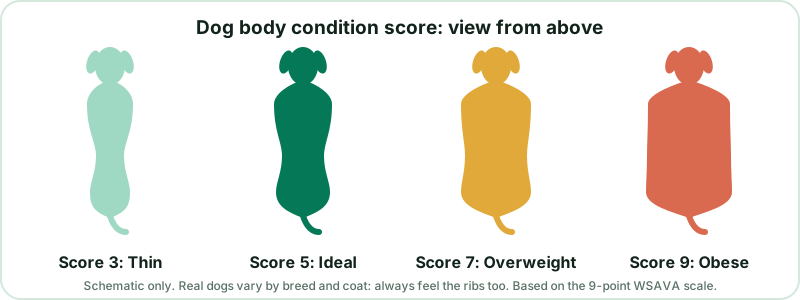
The scale is published in the WSAVA Global Nutrition Guidelines and is based on work by Laflamme (1997). It rates fat cover over the ribs, the waist seen from above and the abdominal tuck seen from the side. The scores group into four bands:
| Score | Band | What it means |
|---|---|---|
| 1 to 3 | Too thin | Ribs, spine and hip bones easy to see; little or no fat cover |
| 4 to 5 | Ideal | Ribs easy to feel with a thin layer of fat; clear waist and tuck |
| 6 to 7 | Overweight | Ribs harder to feel; waist less visible; fat deposits building |
| 8 to 9 | Obese | Ribs hard or impossible to feel; no waist; large fat deposits and a rounded belly |
Four to five is the target for almost every dog. A dog at 5 has the middle of the ideal range; a dog at 4 is slim but healthy. Our Dog Body Condition Score Calculator uses the score and the current weight to estimate the ideal weight.
How to score your dog in three checks
Do the checks with the dog standing on level ground. Good light helps, and a long-haired dog needs a hands-on check because fur hides the shape.
1. The rib check (feel). Run your hands lightly along the ribs. At an ideal score you can feel each rib with light pressure, like the back of your hand with your fingers extended. If you have to press hard to find them, the score is higher. If each rib is sharply visible and feels like a washboard, the score is lower.
2. The waist check (look from above). Stand over the dog and look down. There should be a narrowing behind the ribs. If the body looks like a straight tube or bulges outward, the score is higher.
3. The tummy check (look from the side). From the side, the belly should rise from the chest towards the hind legs. A flat or sagging belly points to a higher score.
Repeat once a month and write down the date, weight and score. A small notebook entry is enough.
Score by score
| BCS | Typical look and feel |
|---|---|
| 1 | Emaciated: ribs, spine and pelvic bones easily visible; no fat; obvious loss of muscle |
| 2 | Very thin: ribs and spine easily visible; minimal fat |
| 3 | Thin: ribs easily felt and may be visible; waist and tuck obvious |
| 4 | Slightly lean: ribs easily felt; visible waist; clear tuck |
| 5 | Ideal: ribs felt without excess fat; waist seen from above; tuck seen from side |
| 6 | Slightly overweight: ribs felt with some excess fat; waist visible but not marked |
| 7 | Overweight: ribs felt with difficulty; waist barely visible; fat at the tail base |
| 8 | Obese: ribs not felt under heavy fat; no waist; belly bulges |
| 9 | Severely obese: massive fat deposits over the chest, spine and tail base; belly distended |
The wording follows the standard charts in spirit; for the official diagrams, see the WSAVA guidelines linked below. Ask your vet to show you what each score looks like on your own dog, because they can calibrate your eye.
From score to ideal weight
Laflamme’s work suggests each score point above 5 is roughly 10% above ideal body weight. To estimate the ideal weight:
ideal weight ≈ current weight ÷ (1 + 0.10 × (score − 5))
| Current weight | Score 6 (≈10% over) | Score 7 (≈20% over) | Score 8 (≈30% over) | Score 9 (≈40% over) |
|---|---|---|---|---|
| 10 kg | 9.1 kg | 8.3 kg | 7.7 kg | 7.1 kg |
| 20 kg | 18.2 kg | 16.7 kg | 15.4 kg | 14.3 kg |
| 30 kg | 27.3 kg | 25.0 kg | 23.1 kg | 21.4 kg |
This is a rule of thumb, and it is why the dog’s goal weight in our dog weight loss plan is a range to discuss with a vet, not a promise. The Dog Overweight Percentage Calculator tells you how far above a known ideal weight your dog is.
A worked example
A dog weighs 33 kg and scores 8 out of 9.
- Score above 5 = 3 points.
- Estimated excess = 3 × 10% = 30%.
- Ideal weight ≈ 33 ÷ 1.30 ≈ 25.4 kg.
- Excess ≈ 33 − 25.4 ≈ 7.6 kg.
If the owner then follows a plan of 1 to 2% weight loss per week, the dog would take a few months to reach the target. Re-score every month to check that the shape, as well as the weight, is changing.
What if the score is 1 to 3?
A score in the thin range is a reason to talk to your vet. The cause may be illness, dental pain, parasites, stress, too little food or food that is not suitable. Do not try to fatten a thin dog quickly by changing the diet at home; get a check first. The calculator does not estimate an ideal weight for scores of 3 or below because the right plan depends on the cause.
Breed and body shape
Breeds differ. A deep-chested sighthound has visible ribs even at a healthy weight, while a short-legged, stocky breed hides its ribs more easily. This is why the score uses feel as much as sight. Compare your dog against the descriptions, not against another dog. Coat type matters too: thick or curly coats make a visual check unreliable. Rely on your hands, and ask your vet to score your dog at its next visit so you have a reference.
Why body condition matters for health
Carrying extra weight puts strain on joints, and the heart and breathing can be affected as well. Even a modest excess matters over a dog’s lifetime. Being too thin has its own risks. The reason to keep a dog at 4 to 5 is not appearance, but comfort and long-term health. You will find the targets for treating excess weight in AAHA’s 2014 guidelines, which also discuss pace: about 1 to 2% of body weight per week.
Using the score to adjust food
Once you have a score, link it to feeding:
- Score 4 to 5: keep the same plan and monitor monthly.
- Score 6 to 7: reduce the daily amount slightly and re-score in a few weeks, or follow a weight loss plan agreed with your vet.
- Score 8 to 9: talk to your vet about a structured plan and a health check.
- Score 1 to 3: see your vet before changing the diet.
Our guide to how much to feed a dog shows how to calculate the daily amount, and the Dog Calorie Calculator provides the energy figure. The Pet Weight Change Calculator measures how fast weight is changing.
Scoring puppies and seniors
Puppies are growing, so their weight rises steadily and the score is more useful than the weight alone. A puppy should have a visible waist and easy-to-feel ribs. Overweight puppies are at risk of problems with growing joints, and veterinary nutrition guidance (WSAVA, AAHA) points toward steady growth, and your vet may prefer slow and steady growth.
Senior dogs may lose muscle as they age, which can hide fat on the body. Use your hands and ask your vet about muscle condition. A senior dog at score 5 with poor muscle may still need a diet plan. Our dog age chart explains the life stages.
Common mistakes with body condition scoring
- Scoring by sight only on a long-haired dog.
- Comparing your dog with another breed’s shape.
- Ignoring the tummy tuck and looking only at the ribs.
- Not recording the score, so changes go unnoticed.
- Treating a high score as a character flaw rather than a feeding and exercise issue.
- Putting a thin dog on a rich diet without a vet check.
Keep a body condition log
Scoring once is useful, but scoring regularly is what spots trends. A simple log needs only a few columns:
| Date | Weight | Score (1 to 9) | Rib feel | Waist from above | Tummy from side |
|---|---|---|---|---|---|
Take a photo from above and from the side each month in the same spot with the dog standing. Comparing photos is often easier than comparing numbers, because gradual changes are hard to notice day to day. Share the log with your vet at check-ups.
Muscle condition is a separate check
Body condition measures fat. WSAVA also publishes a muscle condition score that looks at muscle over the spine, skull, shoulders and hips. A dog can have a body condition of 5 and still have lost muscle, which is common in older dogs and in dogs with certain illnesses. If you notice the spine or shoulder blades becoming more prominent while the belly stays rounded, mention it to your vet.
What your vet looks at
At a check-up your vet will usually weigh your dog, score body condition and feel the ribs, spine and belly. They will compare today’s weight with earlier records, and they may ask about food, treats, exercise and recent changes. Bringing your log makes the discussion more concrete, and it is a good moment to agree on an ideal weight and score for your dog.
Using the score with the calculators
The score becomes more useful when connected to other numbers:
- Score the dog and estimate the ideal weight.
- If the dog is above its ideal weight, enter both weights into the Dog Weight Loss Calculator for calories and a timeline.
- Use the Pet Weight Change Calculator to see how fast weight is changing from week to week.
- Recheck the score each month.
Quick summary
- The 9-point score rates dogs from 1 (emaciated) to 9 (obese); 4 to 5 is ideal.
- Check three things: feel the ribs, look at the waist from above and the tuck from the side.
- Each point above 5 is about 10% over ideal weight, so ideal ≈ current ÷ (1 + 0.10 × (score − 5)).
- A 30 kg dog scoring 7 has an ideal weight near 25 kg.
- Scores 1 to 3 need a vet check before any diet change.
- Use the Dog Body Condition Score Calculator and re-score monthly.
Frequently asked questions
What is a body condition score?
It is a 1 to 9 rating of how lean or heavy a dog is, based on seeing and feeling the ribs, waist and belly. WSAVA publishes standard charts, and 4 to 5 is ideal.
How do I check my dog's body condition at home?
Feel the ribs, look at the waist from above and look at the belly from the side. You should feel the ribs easily under a thin layer of fat, see a waist and a slight tuck.
What does a score of 7 mean?
A score of 7 means overweight: ribs are hard to feel under thick fat, the waist is barely visible and fat is building at the tail base. It suggests about 20% over ideal weight.
How do I work out my dog's ideal weight from the score?
Divide the current weight by 1 plus 0.10 for every point above 5. A 30 kg dog scoring 7 gives 30 ÷ 1.20 = 25 kg. It is an estimate for your vet to confirm.
Is a thin dog the same as a healthy dog?
No. Scores of 1 to 3 mean too thin and need a vet check, because weight loss can be a sign of illness or a feeding problem.
Do all breeds look the same at score 5?
No. Deep-chested breeds and very lean breeds look different from stocky ones at the same score, so rely on feel and your vet's opinion rather than comparing with another dog.
How often should I score my dog?
Every month is a good habit, and more often during weight loss. Scoring regularly picks up gradual changes that are easy to miss day to day.
Sources
- WSAVA Global Nutrition Guidelines (incl. 9-point BCS charts)
- Laflamme D. (1997) Development and validation of a body condition score system for dogs. Canine Practice
- AAHA (2014) Weight Management Guidelines for Dogs and Cats
Related calculators
- Dog Body Condition Score & Ideal Weight CalculatorScore your dog's body condition on the 9-point scale and estimate its ideal weight.
- Dog Overweight Percentage CalculatorSee how far above its ideal weight your dog is, in percent and in kilograms.
- Dog Weight Loss CalculatorPlan a safe weight-loss target: daily calories and how many weeks it should take.
- Pet Weight Change CalculatorTrack a weight change over time: percent change, percent per week and whether the pace is inside 1–2% a week.
Keep reading
- Dog Weight Loss Plan: Calories and PaceA practical dog weight loss plan: how to set a goal weight, work out daily calories, choose a safe pace of 1 to 2% a week and track progress.
- How Much Should I Feed My Dog? By WeightHow much to feed a dog by weight: a grams and cups chart, how to read the food label, meals per day, adjusting by body condition and common mistakes.
- Dog Years to Human Years: Chart by SizeSee how old your dog is in human years with a size-based chart, the newer epigenetic formula, the dog life stages and why 7 to 1 is wrong.
- Senior Dog Care Checklist: Vet, Diet, ExerciseA senior dog care checklist for every month and every visit: weighing, body condition, food and water, gentle exercise, home comfort, vet questions and budgeting.