
A crate works best when it is the right size: big enough for your dog to stand up, turn round and lie down comfortably, but not so big that it stops being a cosy den. This guide answers the question behind searches like “what size crate does my dog need”, “dog crate size chart” and “puppy crate size” with a method that works for any breed, because it uses your dog’s own measurements rather than weight or a size label.
How to measure your dog
You need a soft tape measure or a piece of string and a ruler. Your dog should stand on level ground, relaxed and looking forward. A treat helps a wriggly puppy stay still.
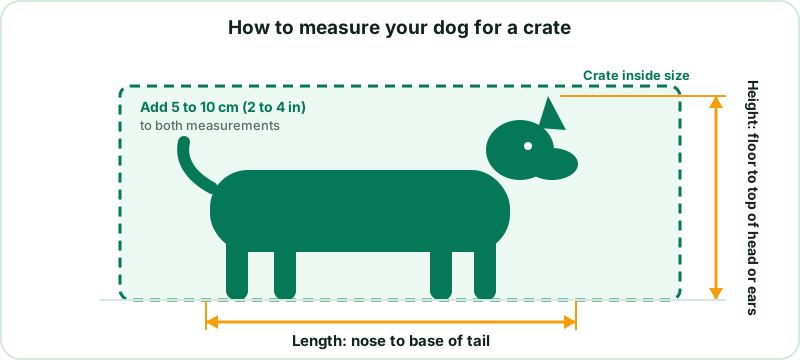
- Length: measure from the tip of the nose to the base of the tail (where the tail meets the body). Do not include the tail itself.
- Height: measure from the floor to the top of the head or the tips of the ears, whichever is higher, with your dog standing.
- Write both numbers down in centimetres or inches. If you need to convert, the Pet Measurement Converter does it exactly (1 inch is 2.54 cm).
Measure twice. Dogs tend to move, and a few centimetres make the difference between a good fit and a crate that feels cramped.
The sizing rule
Add 5 to 10 cm (2 to 4 inches) to both numbers. The result is the minimum inside length and height of the crate. This is a rule of thumb from owner guidance and manufacturers, not a legal standard, so treat it as a starting point.
| Your dog (length × height) | Minimum inside size (adding 10 cm) |
|---|---|
| 60 × 45 cm | 70 × 55 cm |
| 80 × 60 cm | 90 × 70 cm |
| 100 × 70 cm | 110 × 80 cm |
The Dog Crate Size Calculator does the sum for your own numbers and shows the result in centimetres and inches.
Use the same sum in inches
If you shop in inches, the rule is the same: add 2 to 4 inches to each measurement.
| Dog length × height | Add 4 in | Minimum inside size |
|---|---|---|
| 24 × 18 in | +4 in | 28 × 22 in |
| 32 × 24 in | +4 in | 36 × 28 in |
| 40 × 28 in | +4 in | 44 × 32 in |
A dog who falls exactly between two measurements should be sized up to the larger crate, because a slightly roomy crate with a divider is easier to fix than a crate that is too small.
Which end of the range to use: 5 cm or 10 cm?
The rule gives a range, not a single number. Here is a practical way to choose:
| Situation | Use |
|---|---|
| A calm dog who uses the crate to sleep | Closer to +5 cm |
| A dog who stretches out fully or is still growing | Closer to +10 cm |
| A thick-coated dog | Closer to +10 cm |
| A puppy in a crate with a divider | Size for the adult, then adjust the divider |
When two crates both fit, the smaller one that still passes the checks below is usually better, because a snug crate feels more like a den.
Match it to the crate, not the label
Crate sizes are not standard. A “medium” crate from one brand can be a different size from another brand’s medium. Compare your minimum inside length and height with the inside measurements listed by the maker, and choose a crate that is at least that size in both directions. If your dog falls between two sizes, the larger one is usually the better choice, using a divider if the crate is too roomy.
Look out for these details when you read a product page:
- Inside or outside size? Outside dimensions can be larger than the inside, especially on plastic and soft crates.
- Door position. A door at one end can affect how easily a large dog gets in and out.
- Roof height. Some crates slope or curve at the top, which can cut into head room.
- Tray and bedding. A thick tray or bed reduces usable height.
Puppy crate size
A growing puppy will need a bigger crate soon. Rather than buying several, buy a crate for the expected adult size and use a divider to shrink the space while your puppy is small. As the puppy grows, move the divider back. If you do not know the adult size, ask your vet or breeder for an estimate, and use the Puppy Age Calculator to keep track of your puppy’s age in weeks.
A simple routine for a divider crate:
- Measure your puppy’s length and height every couple of weeks.
- Move the divider so the usable space still passes the checks in this guide.
- Remove the divider when your dog reaches the adult measurements.
Do not leave a young puppy in a crate for long periods. Puppies need regular toilet breaks, company and play, and your vet or a qualified trainer can tell you what is realistic for your puppy’s age.
Types of crate and how size works
| Crate type | Good for | Sizing note |
|---|---|---|
| Wire (folding) | Home use, puppies with a divider | Usually comes with a divider; check inside size |
| Plastic (travel style) | Car travel, den-like feel | The shell reduces inside size; check manufacturer specs |
| Soft-sided | Calm dogs, light use | Less strong; check that your dog cannot chew or push through |
| Heavy-duty or furniture style | Escape-prone dogs, home décor | Check inside size; the frame can be thick |
The measuring method is the same for every type. What changes is how much the frame or shell takes from the inside space.
Why not just buy a bigger crate?
A crate that is much too big can make house-training harder, because a puppy may use one end as a toilet and sleep in the other. It also loses the secure, den-like feel that helps many dogs settle. Choose the smallest crate that fits comfortably and use a divider while your puppy grows.
Air travel is different
Airlines set their own rules for travel containers, and they follow the IATA container requirements with a different formula from everyday crate sizing. Check the airline’s own instructions and measure your dog the way they ask. The home crate rule above is not designed for flights.
Car travel
If the crate will travel in the car, measure the boot or back seat as well as the dog. Plastic travel crates are often easier to secure, but whichever type you choose, make sure it cannot slide or tip. Ask the crate maker whether the model is designed for use in vehicles.
Checking the fit
A good fit means your dog can:
- stand up without hitting the top,
- turn around in a full circle,
- lie down stretched out or curled up,
- and still feel enclosed rather than lost in a large space.
If your dog is cramped, rubs against the sides or cannot stand, the crate is too small. If there is a lot of unused space, it is too big or needs a divider. Try the crate with the bed inside, because bedding takes up room.
Worked examples
- A small dog, 60 cm long and 45 cm tall. Add 10 cm to each: at least 70 cm long and 55 cm high inside. Look for a crate whose inside measurements are at least that large.
- A medium dog, 80 cm long and 60 cm tall. The minimum is 90 cm by 70 cm. If a crate is only listed by its outside size, ask the maker for the inside measurements.
- A large dog, 100 cm long and 70 cm tall. The minimum is 110 cm by 80 cm. Very large dogs may need an extra-large or giant-breed crate, because many standard crates stop before this size.
In every case, check both length and height. A crate can be long enough but too low for a tall dog.
Making the crate comfortable
A well-sized crate is only part of the picture. Place it somewhere quiet but not isolated, add a bed or blanket that fits without crowding the space, and introduce it gradually so your dog sees it as a safe place. Ask your vet or a qualified trainer for advice on crate training, particularly for puppies and nervous dogs.
Think about where the crate will live. A corner of a living room often works better than a spare room, because the dog can see and hear the family. Keep it away from direct sun, radiators and draughts.
Crates, heat and pregnancy
Life events change what a dog needs from a resting place. A dog in season may want a washable, secure bed; see our guide to how long a dog stays in heat for the timeline. A pregnant dog needs a larger, quiet whelping area rather than a standard crate, so ask your vet what to prepare; our guide to how long dogs are pregnant lists the key dates.
Common mistakes
- Choosing by weight or breed label instead of measuring.
- Measuring a sitting dog’s height instead of standing.
- Ignoring the crate’s inside measurements.
- Buying a very large crate for a small puppy with no divider.
- Forgetting that fleece, beds and bowls take up space.
- Using a crate as punishment, which makes it a place your dog avoids.
- Forgetting to re-measure a growing puppy.
Also measure for a harness
If you are buying gear for a walk or a car trip, the Dog Harness Size Calculator shows how to measure chest girth and neck. Sizes vary between brands, so always check the maker’s chart.
A step-by-step buying checklist
Use this checklist when you are ready to buy, and keep the numbers in your phone.
- Measure your dog’s length and standing height, twice.
- Add 5 to 10 cm (2 to 4 in) to each using the guidance above.
- Write down the minimum inside length and height.
- Read each product page for the inside measurements, not the outside ones.
- Compare both dimensions; a crate must pass on length and on height.
- Check for a divider if you have a puppy.
- Test the crate with your dog’s bed and bowl inside.
- Return window: buy from a shop that accepts returns, because the real fit is clearer once the dog is inside.
Special cases
Some dogs do not fit the standard rule neatly.
- Long-bodied, short-legged dogs. Length drives the size, and height may be much smaller than the crate offers. Choose by length and accept extra head room.
- Tall, narrow dogs. Height drives the size. Check that the roof does not slope down.
- Thick-coated dogs. A heavy coat adds bulk, so lean towards the upper end of the range.
- Older dogs with stiff joints. A low entrance and a flat, padded floor make the crate easier to use; ask your vet about comfort.
- Dogs who dislike crates. A bigger crate is not the answer. Ask your vet or a qualified trainer for a gentle introduction plan.
How often to re-measure
An adult dog should only need one measurement, unless she gains or loses a lot of weight or you change the bedding. A growing puppy needs re-measuring every couple of weeks, which is easiest if you keep a small log of the date, length and height. Adding the puppy’s age in weeks from the Puppy Age Calculator shows how fast growth is going and when the divider should move.
Quick summary
- Measure length (nose to base of tail) and height (floor to top of head or ears).
- Add 5 to 10 cm (2 to 4 in) to each.
- Compare with the crate’s inside measurements, not the size label.
- Use a divider for puppies and size for the adult.
- Choose the smallest crate that fits comfortably, and check the fit with bedding inside.
- Use the Dog Crate Size Calculator for your own numbers.
Frequently asked questions
What size crate does my dog need?
Add 5 to 10 cm (2 to 4 in) to your dog's length and standing height to get the minimum inside size.
What size crate for a puppy?
Buy for the expected adult size and use a divider while the puppy is small.
Is this the same for air travel?
No. Airlines follow IATA container rules with their own formula, so check the airline's requirements.
Should the crate be much bigger than the minimum?
No. Extra space can make house-training harder, so choose the smallest size that fits comfortably.
Do crate sizes match between brands?
No. Sizes vary by brand, so compare your minimum inside length and height with each maker's inside measurements, not the name of the size.
Why measure height standing and not sitting?
The crate must allow your dog to stand up and turn around. Measure from the floor to the top of the head or ears while your dog stands.
Do I measure the tail?
No. Measure from the nose to the base of the tail, where it meets the body. The small amount you add covers the tail and room to move.
Sources
- AKC expert advice (owner guidance; practical rule of thumb)
- Manufacturer sizing guidance (general industry convention; brands differ)
Related calculators
- Dog Crate Size CalculatorFind the minimum crate size for your dog from two simple measurements.
- Dog Harness Size CalculatorMeasure your dog correctly and read any brand's harness size chart with confidence.
- Pet Measurement ConverterConvert crate, collar, harness and coat measurements between centimetres and inches.
Keep reading
- How Long Does a Dog Stay in Heat? StagesA dog's heat usually lasts about 2 to 3 weeks and comes around every 7 months on average. Learn the four stages, how often it happens and when to call the vet.
- How Long Are Dogs Pregnant? Due Date GuideDog pregnancy lasts about 63 days from ovulation and 58 to 68 days from mating. Learn how to count, what is normal and when to call the vet.
- Wire vs Plastic vs Soft Crates: Which to BuyWire, plastic and soft-sided dog crates compared on ventilation, travel, durability, dividers and cleaning, with a decision table and a sizing check before you buy.
- Where to Put a Dog Crate at Home: A ChecklistWhere to place a dog crate: best rooms, spots to avoid, a comfort and safety checklist, how placement changes with age and a quick floor-plan method.