
Walk through a park and you will meet dogs of every size, and if you ask their owners about age, a pattern emerges. The owner of a Great Dane at 7 may be talking about retirement and joints. The owner of a Jack Russell at 7 may be planning a long run of years. The pattern is real, and it is part of why veterinary guidelines and age charts treat dogs of different sizes differently. This guide explains what we know, what we do not and how the size chart for dog years is built.
What the evidence shows
Across companion dogs, size and lifespan are linked: larger dogs tend to have shorter lives. A 2024 study of companion dog breeds (McMillan and colleagues, Scientific Reports) analysed lifespans across breeds and showed that breed has a clear effect on longevity, with some breeds at higher risk of early death. This runs against the pattern between species, where bigger animals usually live longer, which is one reason the topic interests researchers.
It is important to be precise about what the finding means. It describes groups of dogs. It does not mean a given large dog will die early, and plenty of large dogs live long lives. It does mean that planning for a large breed should include an earlier senior stage and a closer eye on joints, weight and routine check-ups.
What science does not yet know
Several explanations have been proposed, and none is settled. They include faster growth in large puppies, differences in cell turnover linked to body size, breed-specific inherited conditions and the effects of selective breeding. Researchers are still testing these ideas. If someone gives a confident single reason, treat it with caution.
What can be said with confidence is practical: because the pattern is established, vets use size when judging life stage, and so do the charts you meet in our calculators.
How the size chart works
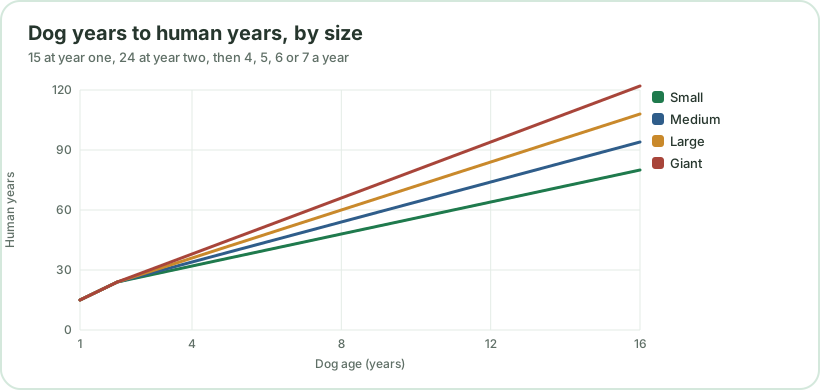
The dog-years chart used by the Dog Age Calculator gives 15 human years for the first dog year and 24 for the second, then adds a fixed number of human years for each later dog year depending on size.
| Size | Human years added per dog year after year 2 |
|---|---|
| Small | 4 |
| Medium | 5 |
| Large | 6 |
| Giant | 7 |
The chart is widely attributed to veterinary sources and is an approximation. Here is what it gives for a 10-year-old dog of each size.
| Size | Calculation | Human-year equivalent |
|---|---|---|
| Small | 24 + 8 × 4 | 56 |
| Medium | 24 + 8 × 5 | 64 |
| Large | 24 + 8 × 6 | 72 |
| Giant | 24 + 8 × 7 | 80 |
So the same ten years of life count as 56 for a small dog and 80 for a giant one. Our full dog years to human years chart lists every age from 1 to 20 for each size.
A different view: the epigenetic formula
In 2020, researchers (Wang and colleagues, Cell Systems) compared patterns of DNA methylation in dogs and humans and proposed a formula: human age = 16 × ln(dog age) + 31. It does not take size into account, since it was based on one breed. For a 10-year-old dog it gives 16 × 2.303 + 31 = about 68, between the medium and large figures on the chart. The two methods agree roughly in mid-life and differ at the extremes, which shows that all conversions are approximations. Our guide to how old a dog is in human years compares them side by side.
Senior age by size
The practical consequence is that the senior stage begins at a different age for each size. AAHA defines senior as roughly the last quarter of expected lifespan. The table gives illustrations.
| Example expected lifespan | Senior from | Size group |
|---|---|---|
| 8 years | 6 years | Giant |
| 10 years | 7.5 years | Large |
| 12 years | 9 years | Medium |
| 14 years | 10.5 years | Small |
Because the numbers are illustrative, ask your vet for a range suited to your dog. The Dog Life Stage Calculator applies the rule, and our guide on when a dog is senior explains it.
What this means for owners of large and giant dogs
- Start senior-style habits earlier. Monthly weighing, joint checks and a twice-yearly vet visit can begin before the dog looks old.
- Watch weight closely. Extra weight loads joints, and large dogs have more to carry. A 40 kg dog with 4 kg extra is 10% over.
- Protect growth. Large-breed puppies need a diet and pace of growth that suit their size; ask your vet. See the puppy feeding chart.
- Plan costs. Larger dogs eat more and treatments are often priced by weight, so monthly costs are higher.
- Make the home easy. Non-slip floors, ramps and orthopaedic beds help as the dog ages.
- Enjoy the time. A shorter average does not make the years you have any less good.
What this means for owners of small dogs
Small dogs tend to live longer, so their owners should plan for a long run of care: dental health matters, and weight is easy to gain, since 50 kcal is a larger share of a small dog’s day. A 5 kg neutered dog needs about 374 kcal, so a 50 kcal treat is 13% of the day.
Common mistakes
- Using one age chart for every dog.
- Assuming a large dog’s slowing is “normal” without a check.
- Waiting for obvious signs before senior care.
- Overfeeding large puppies in the name of growth.
- Using the seven-to-one rule.
- Treating averages as predictions.
Questions to ask your vet
- Which size group is my dog in for age purposes?
- When should I begin senior-style check-ups?
- What are the common problems in my breed?
- Is my dog’s weight right?
- How can I protect my dog’s joints?
Growth and size: what is being investigated
Scientists studying why size and lifespan are linked in dogs have looked at several directions, and it is worth knowing them as questions rather than answers. One is growth: large breeds grow much faster as puppies, putting on many kilograms in a few months, and some researchers ask whether rapid growth has long-term costs. Another is cell biology: bigger bodies have more cells that divide, which may raise the chance of errors over time. A third is breed history: some large breeds were developed from small founder populations and carry inherited conditions. None of these is settled. They are active areas of research, and findings may change.
For owners the practical message is more modest and more useful. Feed large-breed puppies a diet suited to growth and keep them lean, since extra weight in growth loads developing joints. Ask your vet about the pace of growth, and weigh regularly. The Puppy Food Calculator gives a calorie target at each age, and our guide to how much to feed a puppy explains how the amounts change.
What you can still influence
The size pattern is about averages, and individual dogs sit at different points within a breed. Several factors that you control are linked with how well dogs age:
| Factor | Why it matters |
|---|---|
| Healthy body weight | Reduces load on joints and is linked with fewer health problems |
| Regular exercise | Keeps muscles strong and joints moving |
| Preventive care | Vaccines, parasite control and dental care |
| Early detection | Regular check-ups find change early |
| Good nutrition | A complete and balanced diet suited to life stage |
None of these cancels out the effect of size, but they improve the odds for the individual dog. The Dog Body Condition Score tool helps you keep condition on target.
Explaining it to children
Children often ask why their large dog is “old” when the neighbour’s small dog is the same age. A simple explanation: dogs of different sizes grow and age at different speeds, a bit like some plants that grow quickly and live shorter lives. It is not that the large dog is less loved or less healthy, only that its stages come sooner. This opens a useful conversation about care, how to be gentle with a stiff dog and why we have regular vet visits.
What the chart cannot capture
Size-based charts are simple on purpose. Within each size group, breeds and individuals differ widely, and the chart cannot capture them. A 30 kg dog from a long-lived line may age more slowly than the chart implies, while a 30 kg dog from a breed with known heart conditions may age faster. The categories also blur: where does a “medium” dog end and a “large” one begin? Veterinary practices often use weight bands, such as small under about 10 kg, medium to about 25, large to about 45 and giant above that, but different sources draw the lines in different places. When your dog sits near a boundary, calculate both options and note the range.
For a 24 kg dog aged 9, the medium chart gives 24 + 7 × 5 = 59 and the large chart gives 24 + 7 × 6 = 66. The difference of 7 is useful to know, but both place the dog in the same life stage, which is what really matters for planning.
Practical differences owners notice
Owners of large and giant dogs often notice stiffness earlier, slower recovery after exercise and a need for non-slip floors and ramps. Owners of small dogs more often notice dental problems and weight gain. These are patterns, not rules, but they suggest where to look first. The senior dog care checklist includes a monthly check that covers both. Keep a record of weight, and ask your vet what to watch for in your dog’s breed.
Talking to your vet about a large dog’s care plan
Ask your vet to build a plan around your dog’s size. Questions to raise include: when to start senior-style checks, what screening to consider, how to protect joints, what weight range is ideal, which exercise suits and how to manage costs. Your vet may offer plans that combine regular visits, vaccination and preventive care for a monthly fee; compare these with paying per visit. Keep a record of weights and notes, and review the plan every year.
A word on myths
You may hear that small dogs live longer because they are less stressed, or that big dogs are simply less healthy. These explanations sound plausible but are not established. Researchers are still working out the biology, so be wary of simple stories. The practical lesson, to begin careful monitoring earlier in large breeds, stands whatever the explanation.
Quick summary
- Large and giant dogs tend to live shorter lives; the reasons are still being studied.
- After year two, the chart adds 4, 5, 6 or 7 human years per dog year by size.
- A 10-year-old dog is 56, 64, 72 or 80 on the chart depending on size.
- The senior stage starts earlier in big dogs; begin senior habits sooner.
- Control weight and plan costs with size in mind.
- Use the Dog Age Calculator with your dog’s size.
Frequently asked questions
Do big dogs really age faster?
On average, large and giant breeds have shorter lives than small breeds, which is why charts treat them as ageing faster. Individual dogs vary.
Why do large dogs have shorter lives?
Researchers are still working it out. Growth rate, body size and breed-linked health risks are all under study, so no single explanation is settled.
How many human years is a large dog year?
On the size chart, 6 human years for each dog year after the second (7 for giant, 5 medium and 4 small).
When is a giant dog senior?
Often around 6 years, because the senior stage is roughly the last quarter of expected lifespan and giant breeds have short expectations.
Does this mean my large dog will die young?
No. It is a pattern across groups, not a prediction for an individual. Good care helps.
Should I feed a large dog differently?
Large breeds need food suited to their size and growth, especially as puppies. Ask your vet about food and exercise.
Is the size chart accurate?
It is an approximation. The epigenetic formula gives another view. Both are guides, not measurements of health.
Sources
- McMillan K.M. et al. (2024) Longevity of companion dog breeds: those at risk from early death. Scientific Reports
- Wang T. et al. (2020) Quantitative translation of dog-to-human aging by conserved remodeling of the DNA methylome. Cell Systems
- AAHA (2019) Canine Life Stage Guidelines. Journal of the American Animal Hospital Association 55:267-290
Related calculators
- Dog Age CalculatorConvert your dog's age into human years, taking size into account.
- Dog Life Stage CalculatorFind out which AAHA life stage your dog is in and when it becomes a senior, from its age and estimated lifespan.
- Dog Age from Birth Date CalculatorEnter your dog's birth date and size to see its exact age and its age in human years.
Keep reading
- Dog Years to Human Years: Chart by SizeSee how old your dog is in human years with a size-based chart, the newer epigenetic formula, the dog life stages and why 7 to 1 is wrong.
- How Long Do Dogs Live? Size, Breed and CareHow long dogs live and why it depends on size and breed: how to read lifespan studies, factors you can influence and how lifespan shapes budgets and care.
- When Is a Dog Senior? It Depends on SizeWhen a dog counts as senior: AAHA's last-25%-of-lifespan rule, a table of senior start ages by expected lifespan, early signs to notice and how to adapt care.
- Dog Age From Birth Date: Exact Years and MonthsHow to work out a dog's exact age from its birth date in years, months, weeks and days, then convert it to human years with a size chart and the epigenetic formula.