
Few questions are asked as often about dogs, or answered as unhelpfully, as “how long do dogs live?” A single number is easy to quote but hides the main fact: dogs differ enormously. A toy breed and a giant breed live under very different expectations, and within each breed the range is wide. This guide explains how to read lifespan statistics, which patterns are well established, which factors you can influence and how to turn a range into a plan for care and money.
Why there is no single answer
Dogs are the most varied mammal species in size, from a couple of kilograms to well over seventy. Body size is one of the strongest predictors of lifespan, and a 2024 study of companion dog breeds (McMillan and colleagues, Scientific Reports) analysed longevity across breeds and showed that breed influences how long dogs live, with some breeds at higher risk of early death. A mean across all dogs blends these together and tells you little about any one of them.
A better question is “how long do dogs like mine live, and what shortens or lengthens that?” Your vet can answer for your dog’s breed or size and health, and the answer is a range rather than a date.
The size pattern
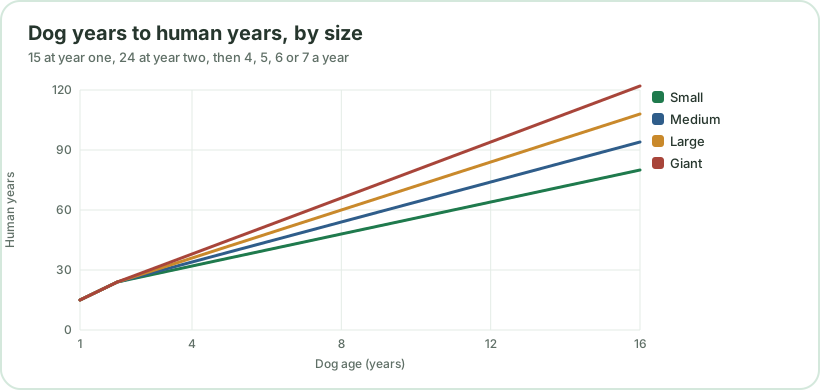
Across dogs, the general pattern is that larger dogs tend to live shorter lives than smaller dogs, the opposite of the pattern seen between species. Researchers are still investigating why. This is also why the chart that converts dog years to human years adds more human years per dog year for large and giant dogs. See why big dogs age faster for what is known so far.
| Size group | Typical pattern | What it means for planning |
|---|---|---|
| Small | Longer lifespans on average | Plan for a long run of costs; senior stage starts later |
| Medium | In between | Use a vet’s estimate |
| Large | Shorter than small dogs | Senior stage earlier; plan for joint care |
| Giant | Shortest on average | Senior stage may begin around 6 |
The table gives direction, not numbers. For numbers, ask a vet who knows your dog’s breed, or look up breed-specific research from a reputable source.
How to read a lifespan figure
Whenever you see a number for lifespan, ask five questions:
- Which dogs? Insured dogs, clinic patients, owner surveys and kennel club data give different results.
- Which breed or size? A figure for all dogs hides the size effect.
- Which measure? An average at birth, a median or the average age at death are all different.
- How recent? Veterinary care and nutrition change over time.
- Which country? Lifestyle, climate and health care differ.
An average age at death includes dogs that died young from accidents or illness, so it can understate how long a healthy dog lives. A life expectancy at age 5 or 8 is often more relevant to an adult dog’s owner.
Factors you can influence
Some of the factors linked with how long dogs live are outside your control, such as breed and genetics. Others are within it.
| Factor | What is generally observed | What you can do |
|---|---|---|
| Body weight | Overweight is linked with more disease | Measure food; weigh monthly; see how much to feed a dog |
| Exercise | Regular activity supports health | Daily walks suited to age and breed |
| Dental health | Dental disease affects the whole body | Ask your vet about dental care |
| Preventive care | Vaccines and parasite control reduce risk | Follow your vet’s schedule |
| Early detection | Problems found early have more options | Regular check-ups |
| Neutering | Research is mixed and varies with breed | Discuss with your vet |
Weight is the factor owners control most directly. A healthy weight is easier to keep than to regain, and the Dog Calorie Calculator gives a daily target. If your dog is already overweight, our dog weight loss plan explains a safe pace.
Lifespan, life stage and the senior years
Life stage and lifespan are linked: AAHA defines the senior stage as roughly the last 25% of expected lifespan, so a shorter expected life means an earlier senior stage. A dog expected to live 10 years is senior from 7.5; one expected to live 14, from 10.5. Our guides to dog life stages and when a dog is senior work through the arithmetic. Check-ups, weight and mobility become more important as the senior stage approaches.
Lifespan and your budget
The longer the life, the more years of running costs. With a one-off cost of 1,000 and monthly costs of 150, each year adds 1,800. Over 10 years the total is 1,000 + 18,000 = 19,000 and over 14 years 1,000 + 25,200 = 26,200. A longer-lived small dog therefore has a higher lifetime cost at the same monthly figure, but a large dog’s monthly costs are usually higher because it eats more and needs parasite treatments priced by weight band. The honest approach is to calculate with your own numbers.
| Years | Total at 150 a month | Total at 200 a month |
|---|---|---|
| 8 | 15,400 | 20,200 |
| 10 | 19,000 | 25,000 |
| 12 | 22,600 | 29,800 |
| 14 | 26,200 | 34,600 |
(These use a one-off cost of 1,000 and are illustrations.) The Cost of Owning a Dog Calculator will give your lifetime figure, and how much it costs to own a dog lists the cost groups.
How to talk to your vet about lifespan
You will get a more useful answer to a specific question. Try:
- What range of lifespan is typical for dogs like mine?
- Which health issues are most common in this breed or size?
- What can I do from now to lower the risk?
- When should I start senior-style check-ups?
- Are there screening tests that make sense for my dog?
Myths
- “One dog year is seven human years.” Dogs age faster early on and at a size-dependent pace later; see is one dog year seven human years.
- “Mixed breeds always live longer.” Results vary, and size matters.
- “Old dogs cannot learn.” Many enjoy short training and scent games.
- “Slowing down is just age.” It may be, but it may also be treatable.
A worked comparison of two dogs
To make the planning concrete, compare two families with different dogs, using the same monthly cost for simplicity and the dog’s expected lifespan as the only difference.
| Family A: giant breed | Family B: small breed | |
|---|---|---|
| Example expected lifespan | 8 years | 14 years |
| Senior stage begins (75%) | 6 years | 10.5 years |
| Years of senior-stage costs | 2 | 3.5 |
| Total years of running costs | 8 | 14 |
| At 150 a month plus 1,000 one-off | 15,400 | 26,200 |
Family B pays more in total over the life, even though family A’s dog eats more each month. If family A’s dog costs 220 a month, the total is 1,000 + 8 × 2,640 = 22,120, which is still below family B’s 26,200 at the lower monthly cost. The example shows why lifespan belongs in any honest estimate, and why you should avoid comparing breeds on monthly figures alone. Use your own numbers in the Cost of Owning a Dog Calculator.
Preparing for the later years
Whatever the length of life, owners do well to prepare early.
- Keep records of weight, vaccinations, treatments and notes on behaviour.
- Build a fund for the later years with a regular transfer.
- Learn the signs of the common problems in your dog’s breed.
- Keep the home safe for an older dog, with steps and grip.
- Stay in touch with your vet about changes in the plan.
- Think about the end of life before you are in a crisis, and ask your vet about quality-of-life assessment.
These steps do not shorten or lengthen life directly, but they let you act quickly when something changes, which is the most reliable way to give a dog the best outcome.
The role of breed and mixed breeds
Pedigree breeds are often discussed in terms of average lifespan, and the 2024 study by McMillan and colleagues is one of several that shows differences between breeds. Some breeds have inherited conditions that shorten life or reduce its quality, which is why responsible breeders health-test parents. Mixed-breed dogs are sometimes said to live longer because of “hybrid vigour”, but studies are mixed, and size remains a strong influence. If you are choosing a puppy, ask the breeder or rescue about the health and age at death of relatives, and ask your vet which conditions to watch for.
What lifespan means for the senior years
The longer the lifespan, the longer a dog spends as a mature adult and senior. A small dog may spend three or four years in the senior stage, with time to adapt the home and the routine, while a giant breed may spend only a couple. The right response is the same: begin senior-style habits early, keep weight lean and see your vet regularly. The Dog Life Stage Calculator shows where your dog is now and when the senior stage begins.
Reading headlines about the oldest dogs
News stories about dogs that lived into their twenties make good reading, but they are the extreme end of a distribution, not a norm. Records are also hard to verify, since birth dates are often unrecorded. Enjoy the stories, but plan on the basis of your own dog’s breed and size, not on exceptions. A better aim is to give your dog as many good years as you can, whatever their number.
Questions to ask when choosing a puppy or adopting a dog
If you are still choosing a dog, lifespan and health are fair questions for a breeder or rescue. Ask how long the parents and relatives lived, which conditions are common in the line, what health tests have been done and what size the dog is expected to be. Ask your vet which breed-linked conditions to watch for and what the typical senior start age would be. A sensible answer includes uncertainty, so be wary of anyone who promises a long life. Then plan your budget with the whole range in mind, using the Cost of Owning a Dog Calculator, and enjoy the time you have with your dog.
Quick summary
- Lifespan varies with size and breed; larger dogs tend to live shorter lives.
- A 2024 study confirmed that breed influences longevity.
- Read any lifespan figure by asking which dogs, which measure and where.
- Weight, exercise, dental care, preventive care and check-ups are within your control.
- Plan budgets over the whole life and expect higher senior costs.
- Use the Dog Life Stage Calculator to place your dog.
Frequently asked questions
How long do dogs live on average?
It depends on breed and size. Studies report different averages for different populations, so use a breed-specific range from your vet rather than a single number.
Do small dogs live longer than large dogs?
As a general pattern, yes. Large and giant breeds tend to have shorter lives. Individual dogs vary a lot within every breed.
Do mixed-breed dogs live longer?
Results differ between studies. Size matters more than whether a dog is purebred, so ask your vet about your dog.
What can I do to help my dog live longer?
Keep weight healthy, keep up vaccinations and parasite control as your vet advises, provide exercise and dental care and attend regular check-ups.
Does neutering affect lifespan?
Research is mixed and depends on breed, sex and timing. Talk to your vet about the choice for your dog.
How should lifespan affect my budget?
Plan for the whole life and allow for higher costs in the senior years. Use a lifetime calculator with your own numbers.
What is the oldest a dog can live?
A few dogs live remarkably long lives, but those are exceptions and not a guide to expectations.
Sources
- McMillan K.M. et al. (2024) Longevity of companion dog breeds: those at risk from early death. Scientific Reports
- AAHA (2019) Canine Life Stage Guidelines. Journal of the American Animal Hospital Association 55:267-290
- Wang T. et al. (2020) Quantitative translation of dog-to-human aging by conserved remodeling of the DNA methylome. Cell Systems
Related calculators
- Dog Life Stage CalculatorFind out which AAHA life stage your dog is in and when it becomes a senior, from its age and estimated lifespan.
- Dog Age CalculatorConvert your dog's age into human years, taking size into account.
- Cost of Owning a Dog CalculatorAdd up the one-off and monthly costs of a dog to see the first-year, yearly and lifetime cost.
Keep reading
- Dog Life Stages: Puppy to Senior (AAHA)The AAHA dog life stages from puppy to senior, how size shifts each boundary, a worked table by expected lifespan and what to adjust in food, check-ups and exercise.
- Why Do Big Dogs Age Faster Than Small Dogs?Why large dogs tend to have shorter lives than small ones: what research shows, how dog-year charts add more years for big breeds and what it means for care.
- How Much Does It Cost to Own a Dog?Work out the real cost of owning a dog with your own numbers: one-off costs, monthly costs, first-year and lifetime totals, hidden extras and ways to plan.
- Dog Age From Birth Date: Exact Years and MonthsHow to work out a dog's exact age from its birth date in years, months, weeks and days, then convert it to human years with a size chart and the epigenetic formula.