
“Senior” is one of those words that sounds precise and is not. For people it is often a fixed number, but for dogs it depends on how long that particular dog is expected to live, and that varies a great deal with size and breed. A Great Dane at 6 is already nearing the senior stage, while a Chihuahua at 6 may be in its prime. This guide explains the rule used by veterinary guidelines, shows the arithmetic for different dogs and describes what to do when your dog enters the stage.
The rule: the last quarter of life
AAHA’s 2019 Canine Life Stage Guidelines describe the senior stage as roughly the last 25% of a dog’s expected lifespan. That means the start of senior is 75% of the expected lifespan:
senior from = expected lifespan × 0.75
A 12-year expected lifespan gives 12 × 0.75 = 9 years. An 8-year expectation gives 6, and a 16-year expectation gives 12. The rule reflects an important fact: dogs of different sizes age at different speeds, and large and giant breeds tend to have shorter lives. A study of dog longevity published in 2024 (McMillan and colleagues, Scientific Reports) analysed lifespans across breeds and found that breed matters for how long dogs live.
A table you can use
| Expected lifespan | Senior from (×0.75) | Example type of dog |
|---|---|---|
| 7 years | 5.25 years | Some giant breeds |
| 8 years | 6 years | Giant breeds |
| 10 years | 7.5 years | Large breeds |
| 12 years | 9 years | Medium dogs |
| 14 years | 10.5 years | Small dogs |
| 16 years | 12 years | Some very small dogs |
The “example type” column is a rough illustration. Actual expectations vary by breed, individual health and lifestyle, so ask your vet for a figure for your dog. For a mixed-breed dog, a vet may estimate from size and appearance. The Dog Life Stage Calculator applies the rule with your dog’s age and size.
Does the human-year conversion help?
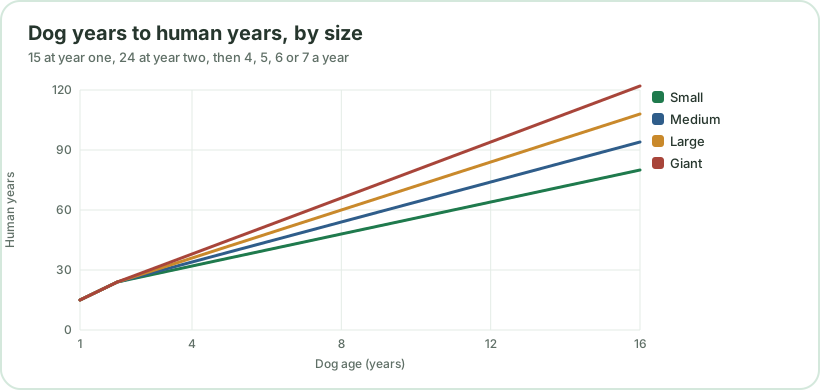
Charts that convert dog years to human years can give a feel for life stage. For example, on the size chart a 9-year-old medium dog is about 15 + 9 + 7 × 5 = 59 human years, and a 9-year-old giant dog is about 15 + 9 + 7 × 7 = 73. The same age corresponds to a different human age because larger dogs are assumed to age faster. See our dog years to human years chart for the full table. Treat these numbers as a way to think about life stage rather than as a measurement of health.
Signs your dog is entering the senior stage
Many dogs show gradual changes. Common signs include:
- Slowing on walks or tiring sooner.
- Stiffness when getting up after rest.
- Reluctance to jump into the car or onto furniture.
- Sleeping more, or sleeping more deeply.
- Greying around the muzzle (which can also be early in some dogs).
- Changes in hearing or sight.
- Changes in weight or appetite.
- Drinking more, which is worth measuring (see how much water a dog should drink).
- Changes in toileting habits.
Any one of these can have causes that a vet can address, so note the date and mention it at your next visit.
What changes when a dog becomes senior
The senior stage is not a crisis; it is a change of emphasis.
- More frequent check-ups. Your vet may suggest about two a year, and may propose routine screening tests.
- Weight and body condition. Weigh monthly, and score condition with the Dog Body Condition Score tool. Both being overweight and losing weight deserve attention.
- Exercise. Shorter, more regular walks often suit better than long outings, and gentle activity keeps muscles working.
- Home comfort. Non-slip floors, ramps for the car, orthopaedic bedding and warmth.
- Food. Keep to a calorie target, and ask your vet before any change.
- Mind. Short training games and scent games keep the brain active.
Our senior dog care checklist turns these into a monthly routine.
A worked example: energy and weight
A 25 kg neutered dog has a resting energy of 70 × 25 ^ 0.75 = 783 kcal, so at the neutered adult factor of 1.6 it needs about 1,252 kcal. If the same dog becomes less active, the inactive factor of 1.4 gives about 1,096 kcal, a difference of 156 kcal or 12%. In practice your dog’s vet sets any reduction, because health matters as well as activity. The routine is the same: keep weight steady, check monthly and adjust by about 10% when the trend is wrong. Use the Dog Calorie Calculator for the starting figure.
Note that not all senior dogs need fewer calories. Some lose muscle or have conditions that raise needs, which is another reason to involve your vet.
Planning costs
Senior years often bring higher vet costs. Review your budget, and consider insurance or a savings pot. Our pet insurance vs savings fund guide compares the two, and the Pet Emergency Fund Calculator helps with a target. If you have insurance, check how it treats ongoing conditions.
Common mistakes
- Using a single age for all dogs.
- Assuming slowing is only age.
- Skipping check-ups because the dog “seems fine”.
- Changing food on the birthday, not on advice.
- Over-resting a dog that would benefit from gentle activity.
- Forgetting to weigh.
Questions to ask your vet
- What lifespan do you expect for my dog, and when does senior begin?
- How often should we meet from now on?
- Would screening tests help?
- Is my dog’s weight right?
- What exercise is best for my dog now?
Three example dogs in detail
Numbers become clearer with named examples. These are illustrations that apply the 25% rule to dogs of different sizes.
| Poppy, a toy dog | Max, a medium mixed breed | Duke, a giant breed | |
|---|---|---|---|
| Example expected lifespan | 15 years | 12 years | 8 years |
| Senior from (×0.75) | 11.25 years | 9 years | 6 years |
| Human years at that age (size chart) | 24 + 9.25 × 4 = 61 | 24 + 7 × 5 = 59 | 24 + 4 × 7 = 52 |
| Checks to begin | From about 10 | From about 8 | From about 5 |
Notice how little the human-year figures differ: all three dogs reach the senior stage at about 52 to 61 on the chart. That is the logic of the chart, which stretches the dog-years for big dogs so that life stages line up with human equivalents. It also shows that “senior” in human terms means roughly the same stage of life whatever the dog’s size.
The conversation with your vet about timing
Because the start of senior depends on the expected lifespan, the most useful step is to ask your vet for their estimate and write it down. Vets consider breed, size, current health and family history if known. They may also suggest starting preventive steps before the nominal start of the stage, such as a baseline blood test or a joint check, so that later changes can be compared. Keep the estimate in the dog’s records, and revisit it every year or two.
Keeping a senior dog engaged
Engagement helps dogs of any age. Offer variety: new routes for walks, new scents on the lawn, simple puzzle feeders and short training games. Social contact with people and, if your dog enjoys it, with calm dogs is good for mood. Let the dog opt out of activities it finds tiring. A senior dog who is mentally and physically engaged often seems younger than one that is left to doze, though some rest is healthy and normal.
Senior dogs and training
A common worry is that an older dog cannot learn. It can, within its limits, and training is good for mind and mood. Keep sessions short, reward generously and choose tasks that do not strain joints: a settle on a mat, a hand target, finding hidden treats, learning the names of toys. If your dog’s hearing is failing, add hand signals to the voice cue, and if its sight is failing, use scent and touch. Any food rewards count in the daily calories, within the 10% allowance.
When health problems appear
Many senior dogs live with one or more long-term health conditions, such as joint disease, heart or kidney changes or dental problems. A diagnosis does not end quality of life, and many conditions can be managed with treatment, diet and adjustments at home. The key is to follow your vet’s plan, give medicines as directed, keep appointments and record how your dog is doing. If you have an insured dog, keep the paperwork organised and check what the policy covers for long-term conditions. Our guide to how pet insurance works explains excess, reimbursement and limits.
Planning for the final stage
It helps to think ahead about the end of life, before a crisis forces quick decisions. Ask your vet how to assess quality of life, using a checklist that covers hurt, hunger, hydration, hygiene, happiness, mobility and more good days than bad. Think about what matters to your dog: favourite walks, food, company. Having these conversations early, with your vet and your family, allows decisions that are calmer and more considered.
A senior-readiness checklist
Use this list in the year before your dog reaches its estimated senior age.
- Ask your vet for the expected lifespan and the senior start date.
- Record a baseline: weight, body condition score and photographs.
- Ask about a baseline health check, with the tests your vet recommends.
- Review the home: floors, steps, beds, car access.
- Review food and treats: calories, weight trend.
- Set up a monthly check and a diary.
- Plan the budget: vet costs, insurance or savings.
- Agree who in the family does what.
Doing the checklist before the senior stage means you start with a baseline, which makes later changes much easier to interpret.
How owners can spot early change
Compare today’s walks with those of six months ago: how far, how fast, how long the dog rests afterwards. Look at jumping and stairs: does the dog hesitate or choose another route? Look at sleep: is it deeper and longer? Check eating: is it slower, or is the dog dropping food? Check drinking and toileting. Change that builds over months is easiest to see with notes and photos. Show them to your vet.
Mixed-breed dogs
For mixed breeds, estimating adult size and lifespan is harder. Ask your vet to estimate from size, build and any known parentage, and revisit it when the dog is fully grown. Some owners use a DNA test for breed information; ask your vet what the results mean for health and life stage. Treat the senior start as a range rather than a date.
Quick summary
- Senior begins at about 75% of the expected lifespan.
- Giant breeds are senior around 6; small dogs often 10 or later.
- Watch for slowing, stiffness, weight change and drinking change.
- Shift to more frequent check-ups, gentle exercise and home comfort.
- Keep weight steady with a calorie target agreed with your vet.
- Use the Dog Life Stage Calculator to place your dog.
Frequently asked questions
At what age is a dog considered senior?
It depends on size. AAHA defines senior as roughly the last 25% of expected lifespan, so about 6 for a giant breed and 10 or more for a small one.
How do I work out when my dog is senior?
Multiply your dog's expected lifespan by 0.75. For a 12-year expectation that gives 9. Your vet can help estimate the expectation.
Is a 7-year-old dog senior?
For many large and giant breeds, yes or nearly. For small breeds it is usually a mature adult. Size and health matter.
Do senior dogs need different food?
Not automatically. Ask your vet to review weight, health and the current food before changing.
How often should a senior dog see the vet?
Your vet may suggest about twice a year, but your vet will set the schedule for your dog.
What are early signs of getting older?
Slower on walks, stiffness after rest, sleeping more, weight change, changes in drinking or appetite and sight or hearing changes. Tell your vet.
Can I use a calculator to find the life stage?
Yes. The Dog Life Stage Calculator gives the stage from age and expected size.
Sources
- AAHA (2019) Canine Life Stage Guidelines. Journal of the American Animal Hospital Association 55:267-290
- McMillan K.M. et al. (2024) Longevity of companion dog breeds: those at risk from early death. Scientific Reports
Related calculators
- Dog Life Stage CalculatorFind out which AAHA life stage your dog is in and when it becomes a senior, from its age and estimated lifespan.
- Dog Age CalculatorConvert your dog's age into human years, taking size into account.
- Dog Age from Birth Date CalculatorEnter your dog's birth date and size to see its exact age and its age in human years.
Keep reading
- Dog Life Stages: Puppy to Senior (AAHA)The AAHA dog life stages from puppy to senior, how size shifts each boundary, a worked table by expected lifespan and what to adjust in food, check-ups and exercise.
- Senior Dog Care Checklist: Vet, Diet, ExerciseA senior dog care checklist for every month and every visit: weighing, body condition, food and water, gentle exercise, home comfort, vet questions and budgeting.
- Why Do Big Dogs Age Faster Than Small Dogs?Why large dogs tend to have shorter lives than small ones: what research shows, how dog-year charts add more years for big breeds and what it means for care.
- Dog Age From Birth Date: Exact Years and MonthsHow to work out a dog's exact age from its birth date in years, months, weeks and days, then convert it to human years with a size chart and the epigenetic formula.