
RER is a short abbreviation that sits behind almost every dog feeding plan. If you have read a vet’s handout, a food label’s feeding guide or a calorie calculator, you have met it, even if the letters were hidden. This guide explains what the resting energy requirement is, where the formula comes from, how to work it out without special software and how it connects to the amount you feed.
What RER means
RER stands for resting energy requirement. It is the energy a dog needs to run its body at rest in a day: breathing, circulation, digestion, keeping warm and maintaining tissues. It does not include the energy used in exercise, growth, pregnancy or recovering from illness. Because those extras vary so much, nutrition guidelines start with RER and then multiply it by a factor that reflects the dog’s life stage and lifestyle.
RER (kcal per day) = 70 × body weight in kg ^ 0.75
The 70 and the 0.75 are the figures used by the National Research Council (NRC 2006) and by WSAVA for dogs and cats.
How to calculate it by hand
The “^ 0.75” means “to the power three quarters”. On a phone calculator in scientific mode:
- Enter the weight in kilograms (for example 20).
- Press the power key (x^y) and enter 0.75.
- Multiply the result by 70.
For 20 kg: 20 ^ 0.75 = 9.457, and 70 × 9.457 = 662 kcal. If you do not have a power key, take the square root of the weight twice, which gives the quarter power, and multiply it by the square root of the weight: for 20 kg, √20 = 4.472, √4.472 = 2.115, and 4.472 × 2.115 = 9.457. If you have the weight in pounds, divide by 2.20462 first, or use the Pet Weight Converter.
RER by weight
| Dog weight | RER (kcal/day) | RER per kg |
|---|---|---|
| 1 kg (2.2 lb) | 70 | 70 |
| 2 kg (4.4 lb) | 118 | 59 |
| 5 kg (11 lb) | 234 | 47 |
| 10 kg (22 lb) | 394 | 39 |
| 15 kg (33 lb) | 534 | 36 |
| 20 kg (44 lb) | 662 | 33 |
| 25 kg (55 lb) | 783 | 31 |
| 30 kg (66 lb) | 897 | 30 |
| 40 kg (88 lb) | 1,113 | 28 |
| 50 kg (110 lb) | 1,316 | 26 |
| 60 kg (132 lb) | 1,509 | 25 |
Notice the last column: the calories per kilogram fall as the dog gets bigger. That is the 0.75 exponent at work. Our dog calorie chart shows the same effect for the daily feeding amounts.
The shortcut and how good it is
Some clinical handouts give a linear shortcut for animals between roughly 2 and 45 kg:
RER ≈ 30 × body weight in kg + 70
It is easy to do in your head, and it is reasonably close in the middle of the range but not at the ends. Compared with the exponent formula:
| Weight | Exponent formula | Shortcut | Difference |
|---|---|---|---|
| 2 kg | 118 | 130 | about 10% higher |
| 5 kg | 234 | 220 | about 6% lower |
| 10 kg | 394 | 370 | about 6% lower |
| 20 kg | 662 | 670 | about 1% higher |
| 30 kg | 897 | 970 | about 8% higher |
| 40 kg | 1,113 | 1,270 | about 14% higher |
For very small and large dogs, the shortcut over- or under-states the energy. Because of that, the CalcuPaw calculators use the exponent formula everywhere.
From RER to a feeding amount
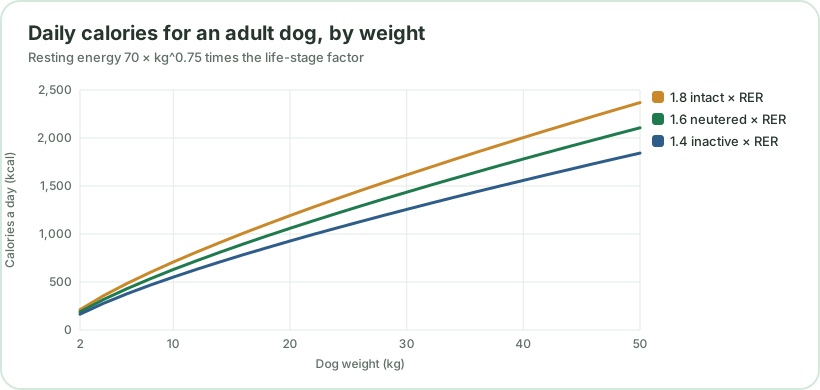
RER on its own is rarely what you feed. A neutered adult dog lives a more active life than “at rest”, so the guideline multiplies RER by 1.6. In full, using the factors on our dog calorie calculator:
| Dog | Factor | Example (20 kg) |
|---|---|---|
| Neutered adult | 1.6 | 1,059 kcal |
| Intact adult | 1.8 | 1,192 kcal |
| Inactive or weight-gain-prone | 1.4 | 927 kcal |
| Light work | 2.0 | 1,324 kcal |
| Moderate work | 3.0 | 1,986 kcal |
| Weight loss | 1.0 × RER of the ideal weight | depends on the goal |
| Puppy under 4 months | 3.0 | 1,986 kcal |
| Puppy 4 months to adult | 2.0 | 1,324 kcal |
The daily amount of food is then calories ÷ (kcal per kg ÷ 1,000). Our guide to how many calories a dog needs and the dog feeding chart show how to complete the steps.
A worked example
A neutered adult dog weighs 12 kg.
- 12 ^ 0.75 = 6.44.
- RER = 70 × 6.44 = 451 kcal.
- Daily energy = 1.6 × 451 = 722 kcal.
- On a 3,600 kcal/kg food, that is 722 ÷ 3.6 ≈ 201 g a day.
If you used the shortcut for RER (30 × 12 + 70 = 430), you would be 5% lower. The error is small here, but the exponent formula avoids having to guess when it matters.
Where the formula comes from, in plain terms
Across the animal kingdom, metabolic rate rises with body mass but more slowly than mass itself, which is why a mouse burns more energy per gram than an elephant. The exponent 0.75 is a widely used summary of that pattern, and the NRC adopted it for dogs and cats. It does not describe any one dog perfectly, which is why the result is an estimate and the factors are applied on top. Individual dogs vary by 20 or 30% in real energy needs, and the scale and body condition are the final judges.
When to use current weight and when to use ideal weight
- Normal dogs: use the current weight.
- Overweight dogs on a weight loss plan: use the ideal (goal) weight with a factor of 1.0, as in our calorie guide for weight loss.
- Underweight dogs: ask your vet before deciding the amount, since the cause matters.
- Growing puppies: use the current weight with the puppy factors.
Common mistakes
- Treating RER as the daily feeding amount.
- Using pounds in the formula without converting.
- Applying the exponent to the wrong number (for example, using 0.75 as a multiplier).
- Using the shortcut for a toy or giant dog.
- Forgetting to recalculate after weight changes.
- Ignoring treats when comparing with RER.
Beyond dogs: the same idea for cats and others
RER is not just a dog formula. The same 70 × weight ^ 0.75 is used for cats and several other animals, with different factors on top. For cats the common factors are 1.2 for a neutered adult and 2.5 for a kitten; see cat RER and MER explained. The shared formula makes comparison easy: a 5 kg cat and a 5 kg dog have the same RER of 234 kcal, but the cat’s daily needs are lower (281 against 374 kcal for a neutered adult) because the factors differ.
Worked examples at different weights
| Dog | Weight | RER | Factor | Daily energy |
|---|---|---|---|---|
| Toy, neutered | 2 kg | 118 | 1.6 | 188 |
| Small, neutered | 8 kg | 333 | 1.6 | 533 |
| Medium, intact | 15 kg | 534 | 1.8 | 960 |
| Large, neutered | 30 kg | 897 | 1.6 | 1,436 |
| Large, overweight, goal 25 kg | 30 kg | 783 (of 25 kg) | 1.0 | 783 |
| Giant, inactive | 50 kg | 1,316 | 1.4 | 1,843 |
Running the numbers for a few dogs gives you a feel for how big or small the results are, and it makes unusual answers stand out. If a calculation gives 3,000 kcal for a 10 kg dog, something is wrong.
Checking your own calculation
A short checklist:
- Did you convert pounds to kilograms? A 44 lb dog is 20 kg, not 44.
- Did you apply the exponent to the weight, not to the 70?
- Did you multiply by the right factor?
- Is the answer in a sensible range? RER is about 30 to 60 kcal per kg for most dogs.
- Does it match the Dog Calorie Calculator?
If the answers disagree, check step 1 and step 2 first; they cause most errors.
When RER is used as a clinical tool
Vets use RER in other settings, too. For example, a hospitalised animal may be fed a fraction of RER at first and increased over days, as part of a plan set by the veterinary team. That is a medical use, and it is not something to do at home. If your vet gives you a feeding plan in terms of RER, follow it, and ask them to explain the numbers.
Rounding and precision
RER is an estimate, so do not read too much into decimals. A calculated 897 kcal and a rounded 900 kcal are the same for practical purposes. What matters is the trend of body weight and condition over weeks. If the weight moves the wrong way, change the daily amount by about 10% and check again in two to four weeks.
Where to go next
Once you have RER, the next step is the factor for your dog, covered in how many calories a dog needs. Then convert calories to grams of your food with the Dog Calorie Calculator, weigh monthly and adjust. RER is the foundation, but your dog’s own weight trend is the final judge.
A note on units
RER uses kilograms. If your dog’s weight is in pounds, divide by 2.205 first: 44 lb is 20 kg. The result is in kilocalories, the same unit as on most pet food labels, and one kilocalorie is the same as a “Calorie” with a capital C. If your label uses kilojoules, divide by 4.184 to get kilocalories. Doing the unit conversion first avoids the most common error in these calculations.
Quick summary
- RER = 70 × body weight in kg ^ 0.75: the energy at rest, in kcal per day.
- A 20 kg dog has RER 662 kcal; a 5 kg dog 234 kcal.
- The shortcut 30 × kg + 70 is close at 20 kg but off by up to 14% at 40 kg.
- Daily feeding = RER × a life stage factor (1.6 for a neutered adult).
- Use ideal weight only for weight loss plans.
- Use the Dog Calorie Calculator to skip the arithmetic.
Frequently asked questions
What is RER in dogs?
Resting energy requirement: the calories a dog uses at rest in a day, calculated as 70 × body weight in kg ^ 0.75.
How do I calculate RER on a calculator?
Raise the weight in kilograms to the power 0.75 (or take the square root of the weight, then the square root of that, and multiply the two), then multiply by 70. For 20 kg the result is 662 kcal.
What is the shortcut formula?
30 × body weight in kg + 70. It is sometimes used for dogs of about 2 to 45 kg, but it can be several percent off, so the exponent formula is preferred.
Is RER the number I should feed?
Usually not. Most dogs are fed RER multiplied by a life stage factor, such as 1.6 for a neutered adult.
Is RER the same as BMR?
Related, but not identical. RER is defined for an animal at rest in a comfortable environment after eating; the NRC and clinical guidelines use RER as the starting point for feeding plans.
Why is the exponent 0.75?
Energy use does not rise in step with weight. The 0.75 power describes how energy needs scale across body sizes.
Do I use current or ideal weight for RER?
For a normal dog, current weight. For weight loss, use the ideal weight.
Sources
- NRC (2006) Nutrient Requirements of Dogs and Cats, National Academies Press
- WSAVA Global Nutrition Guidelines
- Merck Veterinary Manual — Nutritional Requirements of Small Animals
Related calculators
- Dog Calorie CalculatorSee how many calories your dog needs a day: its resting energy requirement (RER) and daily maintenance energy (MER) for its life stage.
- Pet Weight ConverterConvert your pet's weight between kilograms, pounds, ounces and grams.
- Dog Food CalculatorTurn your dog's daily calorie need into grams and cups of the food you actually feed, using the energy value printed on the bag.
Keep reading
- How Many Calories Does a Dog Need? RER, MERLearn how to calculate a dog's daily calories with RER and MER, see every life stage factor, a calorie table by weight and how to adjust the result.
- How Much Should I Feed My Dog? By WeightHow much to feed a dog by weight: a grams and cups chart, how to read the food label, meals per day, adjusting by body condition and common mistakes.
- Weight Gain After Neutering: Adjust the FoodWhy dogs and cats gain weight after neutering and how to prevent it: the lower energy factors, calorie examples, a weigh-in plan and questions for your vet.