
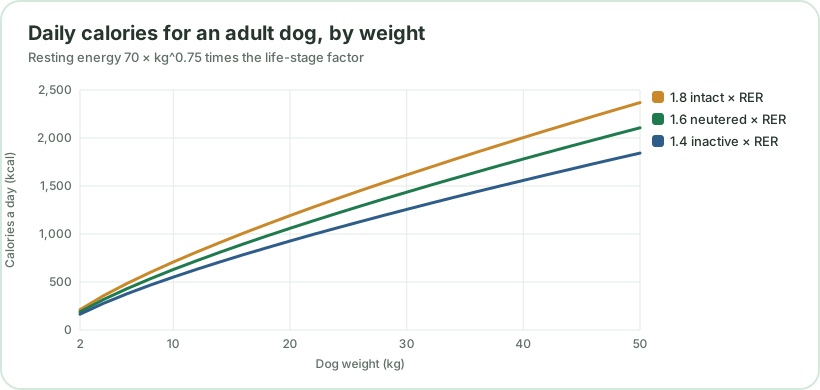
A feeding chart on the fridge saves a lot of arithmetic. The one below shows the daily calories and grams of food for adult dogs by weight, for three common situations, and three food energy values, so that you can find a row that is close to your dog and your bag. It is built from the same formulas as the Dog Food Calculator, and it prints cleanly on one page.
How to use the chart
- Weigh your dog, in kilograms or pounds.
- Find the nearest row.
- Choose the column for your dog’s situation: neutered adult, intact adult or inactive adult.
- Read the grams for the food energy closest to your bag (3,400, 3,600 or 3,800 kcal per kg).
- Weigh the food out each day, and adjust in small steps by body condition.
If the food on your bag is much richer or leaner than these, divide the calories by your own kcal per gram.
Daily calories for adult dogs
| Weight | Neutered adult (1.6 × RER) | Intact adult (1.8 × RER) | Inactive adult (1.4 × RER) |
|---|---|---|---|
| 2 kg (4.4 lb) | 188 | 212 | 165 |
| 4 kg (8.8 lb) | 317 | 356 | 277 |
| 6 kg (13.2 lb) | 429 | 483 | 376 |
| 8 kg (17.6 lb) | 533 | 599 | 466 |
| 10 kg (22 lb) | 630 | 709 | 551 |
| 12 kg (26.5 lb) | 722 | 812 | 632 |
| 15 kg (33 lb) | 854 | 960 | 747 |
| 18 kg (39.7 lb) | 979 | 1,101 | 856 |
| 20 kg (44 lb) | 1,059 | 1,192 | 927 |
| 25 kg (55 lb) | 1,252 | 1,409 | 1,096 |
| 30 kg (66 lb) | 1,436 | 1,615 | 1,256 |
| 35 kg (77 lb) | 1,612 | 1,813 | 1,410 |
| 40 kg (88 lb) | 1,781 | 2,004 | 1,559 |
| 50 kg (110 lb) | 2,106 | 2,369 | 1,843 |
All values are kcal a day. The inactive factor shown is 1.4, the top of the range vets use (1.2 to 1.4) for dogs that gain weight easily.
Grams a day for a neutered adult
| Weight | 3,400 kcal/kg | 3,600 kcal/kg | 3,800 kcal/kg |
|---|---|---|---|
| 2 kg | 55 g | 52 g | 50 g |
| 4 kg | 93 g | 88 g | 83 g |
| 6 kg | 126 g | 119 g | 113 g |
| 8 kg | 157 g | 148 g | 140 g |
| 10 kg | 185 g | 175 g | 166 g |
| 12 kg | 212 g | 201 g | 190 g |
| 15 kg | 251 g | 237 g | 225 g |
| 18 kg | 288 g | 272 g | 258 g |
| 20 kg | 312 g | 294 g | 279 g |
| 25 kg | 368 g | 348 g | 330 g |
| 30 kg | 422 g | 399 g | 378 g |
| 35 kg | 474 g | 448 g | 424 g |
| 40 kg | 524 g | 495 g | 469 g |
| 50 kg | 619 g | 585 g | 554 g |
For an intact adult, multiply the grams by 1.125 (1.8 ÷ 1.6). For an inactive adult, multiply by 0.875 (1.4 ÷ 1.6). For example, an inactive 20 kg dog on a 3,600 kcal/kg food gets 294 × 0.875 ≈ 257 g.
Splitting the day into meals
Most adult dogs eat two meals a day. Half the daily grams goes in each: 147 g for the 20 kg dog on 3,600 kcal/kg food. Weigh both portions, and use the same method every day. The Pet Meal Size Calculator divides any amount into any number of meals if you prefer three.
A worked example
Bella is a 15 kg spayed dog on a food of 3,400 kcal/kg.
- Row: 15 kg, neutered column: 854 kcal a day.
- Grams column for 3,400 kcal/kg: 251 g a day.
- Two meals: about 125 g each.
- Treat allowance: about 85 kcal, so reduce meals if she has chews.
- Weigh Bella every two weeks and check body condition.
If Bella gains weight, take about 10% off (to about 226 g) and recheck in two to three weeks.
What the chart does not cover
- Puppies and kittens. Use the puppy feeding chart.
- Working dogs. Factors of 2.0 to 3.0 times RER apply, and the right figure depends on the work, so ask your vet.
- Overweight dogs. Feed for the goal weight; see the dog weight loss plan.
- Pregnant or nursing dogs. Their needs differ; ask your vet.
- Dogs with health conditions. Follow your vet’s plan.
Printing the chart
Use your browser’s print command (Ctrl+P or Cmd+P), choose A4 or Letter and select “Save as PDF” if you want a file. The tables use plain text so they print clearly in black and white. Keep the printed page near the food bin, and write your dog’s row on it with a pen.
Cups, cans and other measures
If you feed by cups, find your food’s kcal per cup on the label and divide the calories by it, or use the Dog Food Cups to Grams Calculator to convert between cups and grams. Our guide to how many cups of dry food a dog should eat shows a chart in cups. If you convert weights between pounds and kilograms, the Pet Weight Converter does it exactly.
Common mistakes
- Using the chart for a puppy.
- Choosing a row by guesswork instead of weighing the dog.
- Reading grams from a food energy that is not yours.
- Forgetting to count treats.
- Never adjusting after the first weeks.
- Copying the chart onto the fridge and forgetting to update it when the dog’s weight changes.
How the grams change with the food you buy
The same dog needs very different weights of food depending on how many calories each gram holds. For a neutered 20 kg dog that needs 1,059 kcal:
| Food energy | kcal per gram | Grams a day | Two meals of |
|---|---|---|---|
| 3,000 kcal/kg | 3.0 | 353 g | 177 g |
| 3,200 kcal/kg | 3.2 | 331 g | 165 g |
| 3,400 kcal/kg | 3.4 | 311 g | 156 g |
| 3,600 kcal/kg | 3.6 | 294 g | 147 g |
| 3,800 kcal/kg | 3.8 | 279 g | 139 g |
| 4,000 kcal/kg | 4.0 | 265 g | 132 g |
| 4,200 kcal/kg | 4.2 | 252 g | 126 g |
The gap between the leanest and richest food here is 101 g a day, about 29% of the leanest food’s portion. That is why feeding by the bag’s picture or by habit goes wrong when you change brands.
Two meals or three?
Most adult dogs eat two meals a day, and some owners prefer three. The daily total stays the same.
| Dog weight | Daily grams (3,600 kcal/kg) | Two meals | Three meals |
|---|---|---|---|
| 5 kg | 104 g | 52 g | 35 g |
| 10 kg | 175 g | 88 g | 58 g |
| 20 kg | 294 g | 147 g | 98 g |
| 30 kg | 399 g | 200 g | 133 g |
| 40 kg | 495 g | 248 g | 165 g |
Some owners of deep-chested dogs prefer smaller, more frequent meals, and your vet can advise. Whichever you choose, use the same pattern every day.
Adding wet food to the chart
If part of the day’s calories comes from wet food, reduce the dry food to match. For the 20 kg dog on 1,059 kcal, suppose a quarter of the calories come from a wet food of 1,000 kcal/kg and the rest from a dry food of 3,600 kcal/kg.
- Wet: 25% of 1,059 = 265 kcal, which is 265 g.
- Dry: 75% of 1,059 = 794 kcal, which is 221 g.
- Total food by weight: 486 g, against 294 g of dry food alone.
The dog eats 65% more food by weight, but the same number of calories. The Dog Wet and Dry Food Calculator does the sum for your own foods.
A one-week feeding log
| Day | Morning (g) | Evening (g) | Treats (kcal) | Weight check | Notes |
|---|---|---|---|---|---|
| Mon | |||||
| Tue | |||||
| Wed | |||||
| Thu | |||||
| Fri | |||||
| Sat | |||||
| Sun |
A week of notes shows whether the chart’s amount is what you really feed. Many owners find that the grams drift upwards over a few weeks, or that treats make a noticeable difference.
Reconciling the chart with the bag
Every bag has its own feeding guide, and it will rarely match the chart exactly. That does not mean either is wrong. Compare them step by step:
- Find your dog’s weight on the bag’s guide and note the grams or cups.
- Convert to calories: grams × kcal per gram, or cups × kcal per cup.
- Compare with the chart’s calories for your dog’s weight and column.
- If the bag gives more, it may be allowing for an active dog, a range of ages or generosity. If it gives less, check you are using the right energy value.
- Start with the lower number, weigh the dog every two weeks and adjust.
For example, a bag says 300 to 350 g a day for a 20 kg dog and the food is 3,600 kcal/kg. That is 1,080 to 1,260 kcal. The chart says 1,059 for a neutered adult, so the bag’s lower figure is close, and the upper figure is 19% higher, which would suit a more active or intact dog. A neutered house dog that is gaining weight should start at the lower end or below.
Exercise, season and the number on the chart
The chart is for an average day. Real days vary:
- A very active day, such as a long hike, can raise a dog’s energy use well above the usual. You may add a small extra portion, but count it.
- A quiet week, such as recovery from a minor injury, lowers it. Reduce the amount a little if your vet agrees and the dog is gaining.
- Cold weather may raise the needs of dogs that live outdoors, and hot weather may lower appetite.
Rather than adjusting the chart daily, look at the monthly trend in weight and body condition and move the amount by about 10% when it is consistently off.
Quick summary
- Daily calories = 70 × kg ^ 0.75 × a factor (1.6 neutered, 1.8 intact, 1.4 inactive).
- A neutered 20 kg dog needs about 1,059 kcal: 294 g of a 3,600 kcal/kg food.
- Grams = calories ÷ (kcal per kg ÷ 1,000); read your own label.
- Weigh food, count treats and adjust by 10% steps from body condition.
- Print the page and keep it by the food bin.
- Use the Dog Food Calculator for exact numbers.
Frequently asked questions
How much should a 10 kg dog eat a day?
A neutered adult needs about 630 kcal, which is about 175 g of a 3,600 kcal/kg food. An intact adult needs about 709 kcal.
How much should a 20 kg dog eat a day?
About 1,059 kcal for a neutered adult, which is roughly 294 g of a 3,600 kcal/kg food.
How much should a 30 kg dog eat a day?
About 1,436 kcal for a neutered adult, roughly 399 g of a 3,600 kcal/kg food.
Which column of the chart should I use?
Neutered for most pet dogs, intact for dogs that are not neutered and inactive for dogs that gain weight easily if your vet agrees.
Does the chart include treats?
The chart gives the whole day's calories. Treats should stay within 10% and reduce the meals by the same amount.
Can I print this chart?
Yes. Use your browser's print command and choose A4 or Letter.
Is the chart suitable for puppies?
No. Puppies use higher factors, so use the puppy feeding chart.
Sources
- NRC (2006) Nutrient Requirements of Dogs and Cats, National Academies Press
- Merck Veterinary Manual — Nutritional Requirements of Small Animals
- WSAVA Global Nutrition Guidelines
Related calculators
- Dog Food CalculatorTurn your dog's daily calorie need into grams and cups of the food you actually feed, using the energy value printed on the bag.
- Dog Food Cups to Grams CalculatorConvert cups of dog food to grams (and back) using the energy values printed on your bag.
- Pet Weight ConverterConvert your pet's weight between kilograms, pounds, ounces and grams.
Keep reading
- How Much Should I Feed My Dog? By WeightHow much to feed a dog by weight: a grams and cups chart, how to read the food label, meals per day, adjusting by body condition and common mistakes.
- How Many Cups of Dry Food Should a Dog Eat?How many cups of dry food a dog needs: the calorie method, a cups chart for 300, 360 and 400 kcal per cup, why cups vary and how to measure accurately.
- How Many Calories Does a Dog Need? RER, MERLearn how to calculate a dog's daily calories with RER and MER, see every life stage factor, a calorie table by weight and how to adjust the result.
- Feeding Wet and Dry Dog Food TogetherHow to feed wet and dry dog food together without overfeeding: splitting daily calories, worked grams for a 20 kg dog, topper rules and a mixed-feeding table.