
Almost every feeding plan starts from the same two ideas: how much energy a dog needs just to stay alive at rest, and how much more it needs for the life it actually leads. Vets call these the resting energy requirement (RER) and the maintenance energy requirement (MER). This guide explains both in plain terms, shows a dog calorie chart by weight, lists the life stage factors and explains why the numbers you calculate may differ from what the bag says.
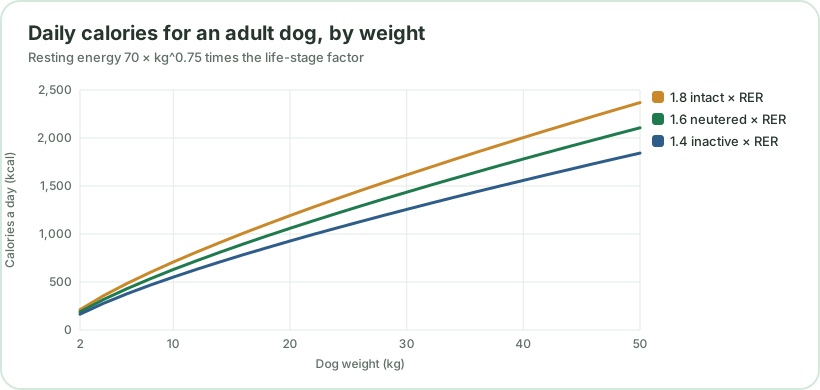
RER: the energy a dog needs at rest
The standard formula in the NRC’s Nutrient Requirements of Dogs and Cats is:
RER (kcal per day) = 70 × body weight in kg ^ 0.75
The “^ 0.75” means weight raised to the power of three-quarters. You can calculate it on any scientific calculator: take the weight in kilograms, raise it to 0.75, then multiply by 70. For a 20 kg dog, 20 ^ 0.75 is about 9.46, so RER ≈ 662 kcal. For 30 kg it is about 897 kcal, and for 5 kg about 234 kcal.
Why the power of 0.75?
If energy rose in a straight line with weight, a 40 kg dog would need twice the calories of a 20 kg dog. In practice larger animals use less energy per kilogram, because body surface area and metabolic rate do not scale in step with weight. The 0.75 exponent captures that pattern, so a 40 kg dog needs about 68% more energy than a 20 kg dog, not 100% more. Small dogs therefore eat more per kilogram than big ones.
| Dog weight | RER (kcal/day) | RER per kg |
|---|---|---|
| 2 kg | 118 | 59 |
| 5 kg | 234 | 47 |
| 10 kg | 394 | 39 |
| 20 kg | 662 | 33 |
| 30 kg | 897 | 30 |
| 50 kg | 1,316 | 26 |
MER: turning resting energy into a daily figure
RER is a baseline, not a feeding target. To find what a dog needs on a normal day, multiply by a life stage factor. The NRC, Merck and WSAVA values used by the Dog Calorie Calculator are:
| Situation | Factor × RER |
|---|---|
| Neutered adult | 1.6 |
| Intact adult | 1.8 |
| Inactive or weight-gain-prone adult | 1.4 (the Merck range is 1.2 to 1.4) |
| Weight loss | 1.0 (of the ideal weight) |
| Light work | 2.0 |
| Moderate work | 3.0 |
| Puppy under 4 months | 3.0 |
| Puppy from 4 months to adulthood | 2.0 |
The range of real dogs is wider than any table, which is why these factors are starting points. Always check the result against body condition and weight over several weeks.
Dog calories by weight and life stage
| Dog weight | Neutered adult (1.6) | Intact adult (1.8) | Inactive (1.4) | Light work (2.0) | Moderate work (3.0) |
|---|---|---|---|---|---|
| 5 kg | 374 | 421 | 328 | 468 | 702 |
| 10 kg | 630 | 709 | 551 | 787 | 1,181 |
| 20 kg | 1,059 | 1,192 | 927 | 1,324 | 1,986 |
| 30 kg | 1,436 | 1,615 | 1,256 | 1,795 | 2,692 |
| 40 kg | 1,781 | 2,004 | 1,559 | 2,227 | 3,340 |
| 50 kg | 2,106 | 2,369 | 1,843 | 2,632 | 3,949 |
All values are kcal a day, rounded. For the grams of food that these calories correspond to, use the Dog Food Calculator or read our guide to how much to feed a dog.
A worked example
A neutered adult dog weighing 30 kg:
- 30 ^ 0.75 ≈ 12.82.
- RER = 70 × 12.82 ≈ 897 kcal.
- MER = 1.6 × 897 ≈ 1,436 kcal a day.
The same dog with a goal weight of 25 kg would be fed 1.0 × RER of 25 kg, about 783 kcal, which is 55% of 1,436. That drop is why vets like to see weight-loss plans written down; our dog weight loss plan walks through it.
Why your result may not match the bag
Pet food bags give an amount “for an average dog of this weight”, often as a range, and they are written by the manufacturer. Differences arise because:
- Bags assume a typical activity level; your dog may be more or less active.
- The calorie content differs between foods, so the same grams give different calories.
- Neutered, intact, young and senior dogs differ, but the bag often does not separate them.
- Manufacturers tend to give generous amounts so that most dogs do not go hungry.
Use the calculator to set a starting point, then use weight and body condition to decide whether to move up or down. The Dog Food Calorie Calculator estimates a food’s energy from its label percentages when no kcal figure is printed.
Energy units: kcal, kJ and MJ
Dog food labels show energy as kilocalories (kcal), kilojoules (kJ) or megajoules (MJ). The conversions are:
- 1 kcal = 4.184 kJ.
- 1 MJ = 1,000 kJ = about 239 kcal.
- “Calories” on a pet food label usually means kilocalories.
The Pet Food Energy Converter switches between kcal per kg, per 100 g, per pound and per ounce so you can compare labels from different countries.
What counts toward the total
The daily figure covers everything the dog eats:
- Main meals, wet and dry.
- Treats and chews. Keep treats below 10% of daily calories (WSAVA and AAHA).
- Food used in training, in puzzle toys or to hide tablets.
- Table scraps and licked-out dishes.
If you give more of any of these, reduce the meals by the same number of calories. The Dog Treat Calorie Calculator shows the allowance for any treat size.
How to adjust the number
- Start with the calculated MER and feed it accurately for two to four weeks.
- Weigh the dog on the same scale every one to two weeks.
- If weight is steady and body condition is ideal, you have found the dog’s maintenance level.
- If weight rises or falls when it should not, change the daily amount by a small step (about 10%) and wait again.
- If you are unsure, ask your vet.
Small, regular adjustments work better than large swings.
Which factor should I use?
Most pet dogs are neutered adults living ordinary lives, so 1.6 is the usual starting point. Use 1.4 only if your dog is inactive or gains weight easily and your vet agrees. Use 1.8 for an intact adult. The working-dog factors of 2.0 and 3.0 apply to dogs doing real work, not to a pet that goes on a long weekend walk. For dogs that need to lose weight, use the weight-loss factor with the ideal weight, as above.
Common mistakes
- Mixing up RER and MER. RER alone is not a feeding target for most dogs.
- Choosing a working-dog factor for an ordinary pet.
- Using the weight-loss option with current weight instead of ideal weight.
- Forgetting treats and chews.
- Assuming a calculator replaces a vet check.
- Not recalculating when the dog’s weight changes.
Two dogs, same weight, different needs
Two 20 kg dogs can need different amounts of food. Take a neutered house dog and an intact dog that does regular light work:
| Dog | Factor | Daily calories |
|---|---|---|
| Neutered adult, ordinary routine | 1.6 | 1,059 kcal |
| Inactive, gains weight easily | 1.4 | 927 kcal |
| Intact adult | 1.8 | 1,192 kcal |
| Light work | 2.0 | 1,324 kcal |
The spread from 927 to 1,324 kcal is about 43%, which is why the factor matters as much as the weight. If a dog is on the higher side of its range and gaining weight, the reasoning is not that the formula is wrong; it is that this dog’s real needs are towards the lower end of the range.
The 10% adjustment rule
When body condition or weight is not where you want it, adjust in steps of about 10%. For a neutered 20 kg dog on 1,059 kcal:
| Change | New daily calories |
|---|---|
| 10% less | about 953 kcal |
| Maintenance | 1,059 kcal |
| 10% more | about 1,165 kcal |
Hold each step for two to four weeks before judging the result. Big swings make it hard to see what is working.
Calories and food labels in practice
Energy can be listed in several ways. Learn to read the one on your bag:
| Label says | How to use it |
|---|---|
| 3,600 kcal/kg | 3.6 kcal per gram; divide the day’s calories by 3.6 for grams |
| 360 kcal per 100 g | The same as 3,600 kcal/kg |
| 360 kcal per cup | Divide the day’s calories by 360 for cups |
| 15 MJ/kg | 15,000 kJ/kg, about 3,585 kcal/kg |
Because cups vary with the shape and density of the kibble, a scale is more accurate. The Dog Food Cups to Grams Calculator converts between them when both numbers are printed.
Small, medium and giant dogs
Energy per kilogram falls as dogs get bigger, so small dogs need more calories per kilogram than large ones. At the neutered adult factor a 5 kg dog needs about 75 kcal per kg, a 20 kg dog about 53, and a 50 kg dog about 42. This is why a small dog fed “by the bag chart for its size” can easily end up overweight on a few extra treats: a 10% treat allowance for a 5 kg dog is only about 37 kcal.
Seasonal and activity changes
Activity changes across a year. A dog that does long hikes in summer and short walks in winter does not need the same amount in both. Rather than changing the formula, change the amount in small steps and watch weight. If your dog’s work becomes regular and demanding, ask your vet whether a working factor now applies, because the right factor depends on the type and length of the work.
Quick summary
- RER = 70 × weight in kg ^ 0.75; it is the energy needed at rest.
- MER = RER × a life stage factor; 1.6 for a neutered adult dog.
- A 20 kg neutered adult: RER 662 kcal, MER about 1,059 kcal a day.
- Weight-loss plans use 1.0 × RER of the ideal weight.
- Count everything the dog eats, and keep treats below 10% of calories.
- Adjust in small steps from weight and body condition; use the Dog Calorie Calculator for your dog.
Frequently asked questions
How many calories does a dog need a day?
Use 70 × weight in kg ^ 0.75 for the resting energy requirement, then multiply by a factor. A 20 kg neutered adult needs about 1,059 kcal a day (1.6 × RER).
What is the difference between RER and MER?
RER is the energy a dog needs at rest. MER is the maintenance energy for a normal day, calculated as RER times a life stage factor.
Why is the formula not just calories per kilogram?
Energy needs rise more slowly than body weight, which is why the formula uses a power of 0.75. A 40 kg dog needs well under twice the energy of a 20 kg dog.
How many calories should an overweight dog eat?
Vets feed 1.0 times the RER of the ideal weight. For a 30 kg dog with a goal of 25 kg that is about 783 kcal a day, and a vet should confirm the plan.
Do puppies need more calories than adults?
Yes. The factor is 3.0 times RER under 4 months and 2.0 times from 4 months to adulthood, compared with 1.6 for a neutered adult.
Do working or very active dogs need more?
Yes. Light work uses a factor of 2.0 and moderate work 3.0, but the right figure depends on the work, so ask your vet.
Why do the calories on my dog food bag differ from the calculator?
Bags give an average for the food. The calculator uses your dog's weight and life stage, so use it as a starting point and adjust by body condition.
Sources
- NRC (2006) Nutrient Requirements of Dogs and Cats, National Academies Press
- Merck Veterinary Manual — Nutritional Requirements of Small Animals (incl. maintenance energy table)
- WSAVA Global Nutrition Guidelines (incl. 9-point BCS charts)
- AAHA (2014) Weight Management Guidelines for Dogs and Cats
Related calculators
- Dog Calorie CalculatorSee how many calories your dog needs a day: its resting energy requirement (RER) and daily maintenance energy (MER) for its life stage.
- Dog Food CalculatorTurn your dog's daily calorie need into grams and cups of the food you actually feed, using the energy value printed on the bag.
- Dog Food Calorie CalculatorWork out how many calories are in a dog or cat food from the nutrient percentages (guaranteed analysis) on its label, when no kcal figure is printed.
- Dog Treat Calorie CalculatorCheck how many treats your dog can have a day without unbalancing its diet — the 10% rule.
- Pet Food Energy ConverterConvert pet food energy between kcal per kg, per 100 g, per pound and per ounce.
Keep reading
- How Much Should I Feed My Dog? By WeightHow much to feed a dog by weight: a grams and cups chart, how to read the food label, meals per day, adjusting by body condition and common mistakes.
- Dog Weight Loss Plan: Calories and PaceA practical dog weight loss plan: how to set a goal weight, work out daily calories, choose a safe pace of 1 to 2% a week and track progress.
- How Much Should I Feed My Puppy? By AgeWork out how much to feed a puppy by weight and age: the calorie factors, meals per day, a grams table, a worked example and when to switch foods.
- Weight Gain After Neutering: Adjust the FoodWhy dogs and cats gain weight after neutering and how to prevent it: the lower energy factors, calorie examples, a weigh-in plan and questions for your vet.