
RER and MER are two small acronyms that explain almost everything about how much a cat should eat. Vets and nutritionists use them because they turn the question “how much?” into arithmetic. This guide explains both in plain terms, shows how they connect, goes through worked examples for different cats and covers the mistakes that creep in when people treat the two as the same thing.
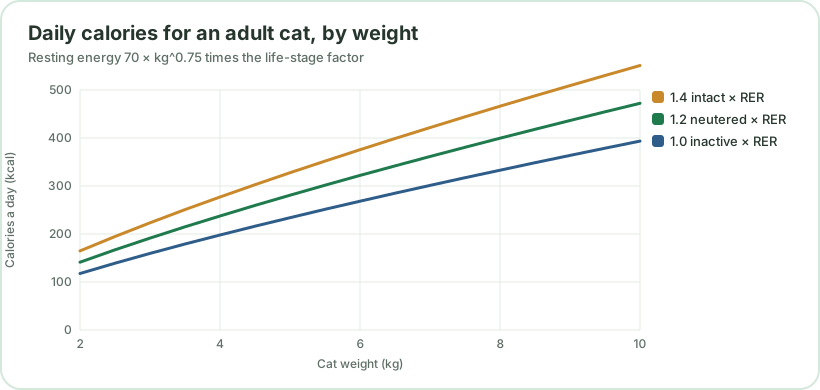
RER: resting energy requirement
RER is the energy a cat needs to keep its body working at rest: heart beating, lungs breathing, organs running, body warm. The formula from the NRC and WSAVA is:
RER (kcal per day) = 70 × body weight in kg ^ 0.75
A 4 kg cat has an RER of 70 × 4 ^ 0.75 = 70 × 2.83 ≈ 198 kcal. A 5 kg cat has 234 kcal and a 3 kg cat 160 kcal. The 0.75 exponent means energy rises more slowly than weight, so a cat twice as heavy needs about 68% more resting energy, not 100% more.
MER: maintenance energy requirement
A cat does not live “at rest”. It moves, plays, eats, grows or has a litter, and its body has different needs at different life stages. MER takes this into account by multiplying RER by a factor:
MER = RER × life stage factor
The factors used in the Cat Calorie Calculator come from Merck, NRC and WSAVA tables:
| Cat | Factor |
|---|---|
| Neutered adult | 1.2 |
| Intact adult | 1.4 |
| Inactive or weight-gain-prone adult | 1.0 |
| Weight loss (RER of the ideal weight) | 0.8 |
| Kitten | 2.5 |
So the 4 kg neutered cat has an MER of 1.2 × 198 ≈ 238 kcal, the intact cat 277 and the inactive cat 198.
Why the two are not the same
It is tempting to feed RER, because it is smaller and simpler. For most cats that would be too little, because RER leaves out activity. The reverse mistake, treating MER for an intact cat as if it applied to a neutered one, would overfeed by about 17%. The terms exist to remind you of the difference: RER is a baseline; MER is the plan.
Worked examples
| Cat | Weight | RER | Factor | MER |
|---|---|---|---|---|
| Neutered adult | 4 kg | 198 | 1.2 | 238 |
| Intact adult | 4 kg | 198 | 1.4 | 277 |
| Inactive adult | 5 kg | 234 | 1.0 | 234 |
| Kitten | 1.5 kg | 95 | 2.5 | 237 |
| Overweight cat, ideal weight 4.5 kg | 4.5 kg | 216 | 0.8 | 173 |
The kitten at 1.5 kg needs about the same calories as a 4 kg neutered adult, which is the effect of the kitten factor of 2.5. The overweight cat is fed at 173 kcal, which is much lower than a normal neutered cat of the same ideal weight (260 kcal), and that is why weight-loss plans need a vet.
Step by step for your own cat
- Weigh the cat in kilograms. For pounds, divide by 2.20462.
- Calculate RER: 70 × weight ^ 0.75.
- Pick the factor for your cat’s situation.
- Multiply to get MER.
- Convert to food: grams = MER ÷ (kcal per kg ÷ 1,000).
- Count treats within 10% of MER.
- Check monthly and adjust.
The Cat Food Calculator follows the same steps and splits calories between wet and dry food.
Choosing the factor
Most pet cats are neutered, and the usual choice is 1.2. The inactive factor of 1.0 suits cats that spend most of the day sleeping or gain weight easily, but should be agreed with your vet. The intact factor of 1.4 applies to cats that have not been neutered. The kitten factor of 2.5 is for growing cats, and our kitten feeding chart shows how it plays out by weight. If your cat is pregnant or nursing, or has a health condition, ask your vet for a plan.
How MER compares across cats of the same weight
At 4 kg the amount ranges from 158 to 495 kcal depending on stage:
| 4 kg cat | Factor | kcal a day | Compared with neutered adult |
|---|---|---|---|
| Weight loss (4 kg ideal) | 0.8 | 158 | 34% lower |
| Inactive | 1.0 | 198 | 17% lower |
| Neutered | 1.2 | 238 | baseline |
| Intact | 1.4 | 277 | 17% higher |
| Kitten (hypothetical 4 kg) | 2.5 | 495 | 108% higher |
The spread explains why a “one size fits all” feeding guide on a bag can be wrong for an individual cat, and why your cat’s own numbers are worth working out.
The “so what” for feeding
Once you have MER, you can:
- Work out grams of dry food, wet food or a mix.
- Check what a bag’s feeding guide implies in calories.
- Plan treats, which should stay within 10%.
- Monitor weight with a target in mind.
Our guide to how many calories a cat needs shows these steps for different foods, and the cat calorie chart lists values by weight.
Where the numbers come from, and what they cannot do
The RER formula and the factors come from reference tables in the NRC and in veterinary nutrition guidelines. They describe averages across many cats. An individual cat may need 20% more or less, depending on muscle, age, activity, temperature and health. That is why the monthly weigh-in matters: it tells you if the plan is working for this cat.
Common mistakes
- Feeding RER instead of MER.
- Using the dog factor for a cat.
- Using the intact factor for a neutered cat.
- Applying the kitten factor to an adult.
- Using current weight in a weight-loss plan.
- Forgetting treats and shared food.
A second look at why the exponent is 0.75
The odd-looking power in the RER formula describes how energy use scales with body size. If energy rose in direct proportion to weight, a cat twice as heavy would need twice the energy. It does not: it needs about 68% more, because 2 ^ 0.75 ≈ 1.68. The table shows the effect for cats.
| Cat weight | RER | RER per kg | If energy were proportional to weight (from 4 kg) |
|---|---|---|---|
| 2 kg | 118 | 59 | 99 |
| 3 kg | 160 | 53 | 149 |
| 4 kg | 198 | 50 | 198 |
| 5 kg | 234 | 47 | 248 |
| 6 kg | 268 | 45 | 297 |
| 8 kg | 333 | 42 | 396 |
For a small cat the proportional rule would underestimate, and for a big cat it would overestimate, by 11% at 6 kg and 19% at 8 kg. That is why a calorie chart cannot be built by simply multiplying a per-kilogram number by weight.
How the two numbers appear on a pet food bag
The feeding guide on a bag usually gives amounts by weight band. Behind it there is usually an MER calculation for a typical cat of that weight, and a food energy value. You can check it:
- Take the weight band, for example 4 kg.
- Compute the MER for a neutered cat: 238 kcal.
- Divide by the food’s kcal per gram.
- Compare with the grams on the bag.
If the bag suggests much more than your sum, it may be allowing for a very active or intact cat, or it may be generous. If it suggests much less, check that you are using the right energy value. A difference of 10 to 15% is normal; a difference of 30% or more is worth looking at.
Worked example: checking a bag
A bag lists a dry food of 3,800 kcal per kg and says to feed 70 to 85 g a day for a 4 to 5 kg cat.
- A neutered 4 kg cat needs 238 kcal, which is 63 g.
- A neutered 5 kg cat needs 281 kcal, which is 74 g.
- The bag’s 70 to 85 g range is similar for the 5 kg cat and generous for the 4 kg cat.
- If the 4 kg cat is neutered and indoor, 63 g is a better starting point than 85 g.
- The owner weighs the cat monthly and adjusts.
Bags are written for the average cat, and your cat may not be average.
RER, MER and a vet’s plan
A vet may recommend a calorie target for your cat that differs from the formula, for good reason: a cat with a medical condition, a cat recovering from illness or a cat on a prescription diet can need a specific amount. In those cases, follow your vet’s plan. The formulas here describe healthy cats, and they are a way of understanding and checking, not of overriding professional advice. If you want to see the numbers in a different format, our cat calorie chart by weight lays them out for common weights.
A quick self-test
If you can answer these, you have understood the two ideas:
- What is the RER of a 3 kg cat? (70 × 3 ^ 0.75 ≈ 160 kcal.)
- What is the MER of that cat if it is neutered? (1.2 × 160 ≈ 191 kcal.)
- What is it if the cat is intact? (1.4 × 160 ≈ 223 kcal.)
- If the same cat were a 3 kg kitten? (2.5 × 160 ≈ 399 kcal.)
- How much of that may come from treats? (No more than 10%, about 19 kcal for the neutered adult.)
The four answers differ by a factor of two, which is the lesson of the page: the same weight can mean very different feeding amounts depending on stage, and the formula is the way to see it.
Quick summary
- RER = 70 × body weight in kg ^ 0.75, the energy at rest.
- MER = RER × factor: 1.2 neutered, 1.4 intact, 1.0 inactive, 2.5 kitten, 0.8 weight loss (ideal weight).
- A 4 kg neutered cat: RER 198 kcal, MER about 238 kcal.
- Feed MER, not RER, and count treats within 10%.
- Check weight monthly and adjust by about 10%.
- Use the Cat Calorie Calculator to skip the arithmetic.
Frequently asked questions
What is RER in cats?
Resting energy requirement: the calories a cat uses at rest in a day, calculated as 70 × weight in kg ^ 0.75.
What is MER in cats?
Maintenance energy requirement: the calories needed on a normal day, equal to RER times a life stage factor.
What factor should I use for a neutered cat?
1.2 times RER is the usual factor for a neutered adult cat.
Is RER the number I should feed?
No. Most cats are fed MER, which is higher than RER.
Why are cat factors lower than dog factors?
Cats are lean and often indoors, and the reference tables give lower multipliers: 1.2 for a neutered cat against 1.6 for a neutered dog.
Do I use current weight or ideal weight?
Current weight for a healthy cat. For a vet-supervised weight-loss plan, use the ideal weight with the weight-loss factor.
How do I check that MER is right?
Weigh the cat monthly and check body condition. Adjust by about 10% if weight drifts.
Sources
- NRC (2006) Nutrient Requirements of Dogs and Cats, National Academies Press
- Merck Veterinary Manual — Nutritional Requirements of Small Animals
- WSAVA Global Nutrition Guidelines
Related calculators
- Cat Calorie CalculatorWork out how many calories your cat needs each day, from its weight and life stage.
- Cat Food CalculatorWork out your cat's daily calories and how to split them between wet and dry food.
- Pet Weight ConverterConvert your pet's weight between kilograms, pounds, ounces and grams.
Keep reading
- How Many Calories Does a Cat Need a Day?How many calories a cat needs: the RER formula, factors for neutered, intact, inactive and kitten cats, a calorie table by weight and how to adjust.
- Resting Energy Requirement (RER) for DogsResting energy requirement (RER) for dogs explained: the 70 × kg^0.75 formula, how to calculate it by hand or on a phone, a quick linear shortcut and its error.
- Indoor Cat Calorie NeedsHow many calories an indoor cat needs: RER × 1.0 if inactive versus 1.2 if neutered, a 3 to 6 kg table in kcal and grams, and how to adjust by weight trend.
- Senior Cat Care: Food, Vet Visits and HomeA practical senior cat care guide: weighing, food and water, vet check-up rhythm, home changes for stiff joints, a monthly checklist and what to note for your vet.