
Ask a vet about common weight problems and neutering comes up quickly. The surgery itself is not the culprit; it changes the equation. Hormones influence energy use, activity and appetite, and the resting energy of a neutered pet is typically lower than that of an intact pet of the same weight, while appetite does not always fall to match. If the food bowl is filled as before, the surplus builds up gradually, and a lean young pet becomes an overweight one within months. The good news is that this is one of the most preventable causes of weight gain. This guide shows the numbers, a plan for the weeks after surgery and the questions to ask your vet.
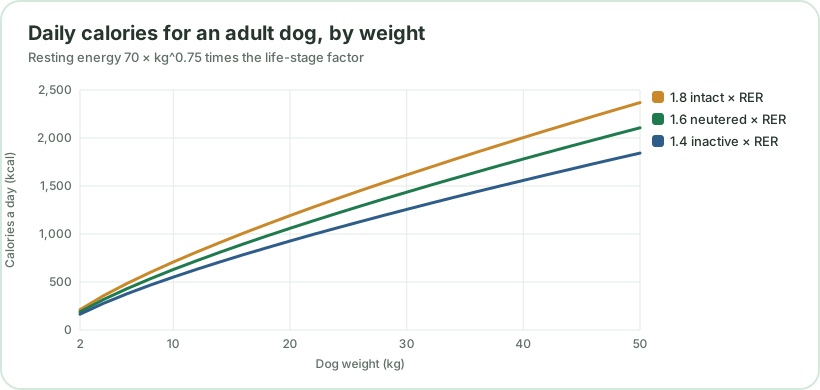
The energy factors
Our calculators work from resting energy (RER = 70 × weight in kg ^ 0.75), multiplied by a factor for life stage and status.
| Pet | Intact adult | Neutered adult | Reduction |
|---|---|---|---|
| Dog | 1.8 | 1.6 | about 11% |
| Cat | 1.4 | 1.2 | about 14% |
The factors come from the nutrition literature that vets use. Individual pets differ, so treat them as starting points; the principle is that a neutered pet needs less.
A dog example
A 20 kg dog has a resting energy of 70 × 20 ^ 0.75 = 662 kcal.
| Factor | Daily calories | Grams at 3,600 kcal/kg | |
|---|---|---|---|
| Intact | 1.8 | 1,192 | 331 g |
| Neutered | 1.6 | 1,059 | 294 g |
| Difference | −133 | −37 g |
If the owner keeps feeding 331 g after neutering, the dog receives 133 kcal a day above its need, about 12.6% more. That is 48,545 kcal a year. The surplus is modest on any single day but steady, and weight rises slowly, so the problem often shows up months later. Use the Dog Calorie Calculator for your dog’s numbers.
A cat example
A 4 kg cat has a resting energy of 198 kcal.
| Factor | Daily calories | Grams at 3,800 kcal/kg | |
|---|---|---|---|
| Intact | 1.4 | 277 | 73 g |
| Neutered | 1.2 | 238 | 63 g |
| Difference | −39 | −10 g |
A 10 g difference in dry food looks tiny in the bowl but is 16% of the neutered cat’s portion. Cats are small, so errors are large in proportion. The Cat Calorie Calculator and our guide to how many calories a cat needs explain the factors.
Why weight creeps up
Several things combine:
- Lower energy needs. The factor falls as above.
- Appetite. Some pets are hungrier after neutering.
- Activity. Some are calmer, and some roam less.
- Timing. Neutering often happens at the point when a young pet’s growth is slowing and its energy needs are changing anyway.
- Habit. The bowl is filled as before.
Understanding the combination helps: you cannot rely on a hungry-looking pet as a guide to what it needs.
A plan for the first weeks
- Ask your vet at the time of surgery what food and amount to use afterwards, and whether the current food suits.
- Recalculate the daily calories with the neutered factor, and the grams for your food’s energy.
- Weigh your pet on the day, then weekly or fortnightly.
- Score body condition, using the Dog Body Condition Score tool for dogs or ask your vet for the cat scale.
- Adjust by about 10% if the weight rises or falls faster than your vet wants.
- Count treats and keep them within 10% of the daily calories.
- Keep a log and share it with your vet.
The weeks after surgery also require following the vet’s wound-care and exercise instructions; follow them carefully and ask about feeding if appetite changes.
Young pets
Pets neutered while still growing have both growth and neutering effects on energy. A puppy under about 17 weeks uses 3.0 times resting energy, and then 2.0 until adulthood; a kitten uses 2.5. After neutering, your vet may adjust. Do not switch to adult food earlier than your vet advises; see when to switch puppy food to adult food. Weigh frequently, because the young pet’s weight is changing for two reasons.
Spotting a gain early
Weight is the best early warning. Gaining 5% of body weight in a month is a lot: for a 20 kg dog that is 1 kg, and for a 4 kg cat 200 g. The Pet Weight Change Calculator shows the percentage and the weekly pace between two weights. Body condition helps too: ribs that were easy to feel and are becoming harder to find, and a waist that is fading. Photograph your pet from above and the side once a month.
If weight has already crept up
Do not panic or cut food dramatically. See your vet, who can confirm the goal weight and a safe plan. For dogs the usual pace is 1 to 2% of body weight a week; for cats, weight loss should be gradual and supervised, since fast loss can be harmful. Our guides on how fast a dog should lose weight and how long it will take set out the arithmetic for dogs.
Managing the hungry pet
A pet that seems always hungry is common after neutering. Ideas that stay within the calorie target:
- Split the daily food into more meals.
- Use puzzle feeders or scatter feeding.
- Make meals last longer with a slow-feeder bowl.
- Keep up play and walks.
- Ask your vet about a food designed for neutered pets or weight control.
- Do not respond to begging with extras.
Common mistakes
- Continuing the same amount after surgery.
- Assuming a hungry pet is underfed.
- Waiting for visible weight gain before acting.
- Not weighing.
- Forgetting treats.
- Switching foods without advice.
- Cutting food drastically when weight has risen.
Questions to ask your vet
- Should I change the food or the amount after neutering?
- How often should I weigh my pet?
- What is my pet’s ideal weight?
- What should I do if my pet seems hungrier?
- When should we recheck?
Month-by-month monitoring plan
A schedule keeps the early months on track. The table is a template, and your vet will adjust it.
| When | Weigh | Check body condition | Food action |
|---|---|---|---|
| Day of surgery | Yes, record the weight | Photograph from above and the side | Ask the vet about the new daily amount |
| Week 1 | Yes | Yes | Feed the recalculated amount; no extras |
| Week 2 | Yes | Yes | Adjust by about 10% only if the trend demands |
| Week 4 | Yes | Yes | Review the log with the vet if there is any change |
| Months 2 to 3 | Every two weeks | Monthly | Keep treats within 10% |
| Month 4 onward | Monthly | Every two months | Maintain; revisit if weight drifts |
If you spot a gain of more than about 5% in a month, act at once: check measuring, treats and activity, and call your vet. The earlier you intervene, the smaller the correction needed. A 20 kg dog that has gained 1 kg needs a modest trim; one that has gained 5 kg needs a proper weight-loss plan.
Special points for cats
Cats are small, so the grams are small and errors are proportionally large. A 4 kg neutered cat needing 238 kcal eats 63 g of a 3,800 kcal/kg dry food, and a 5 g scoop error is 8%. Cats are also more sensitive to rapid weight loss, so prevention matters more than cure. Weigh on a kitchen or baby scale, in a box, so you can see a change of 50 to 100 g. Indoor cats may be less active after neutering, and play sessions with a wand toy help. Puzzle feeders slow eating and add activity, and the Cat Calorie Calculator helps with the daily target. If your cat is already overweight, speak to your vet before changing anything; gradual, supervised loss is the rule.
What about the surgery itself?
Surgery and recovery have their own instructions, and your vet will tell you about food on the day, wound care and exercise restrictions. Follow them closely. Some pets are off their food for a day or so afterwards, and then their appetite returns, sometimes with a vengeance. The calorie target is the same whatever the appetite, and you should resist making up for a missed meal. Ask your vet when to resume the usual routine and how to adjust exercise during recovery, because limited exercise for a couple of weeks makes calorie control even more important.
Frequently asked questions from owners
Will my pet’s personality change? Behaviour can change for many reasons; ask your vet what to expect.
Is a “neutered” or “light” food necessary? Not by itself. A food that suits your pet’s life stage and a measured amount matter most.
Should I wait until my pet is older to neuter? Timing is a veterinary decision that depends on species, breed, size and health.
How will I know the amount is right? Stable weight, ribs you can feel under a thin layer of padding and a visible waist.
A calculation you can copy
Here is a full worked example for a female dog, 12 kg, neutered, on a dry food of 3,500 kcal/kg.
| Step | Intact (before) | Neutered (after) |
|---|---|---|
| Resting energy: 70 × 12 ^ 0.75 | 451 kcal | 451 kcal |
| Factor | 1.8 | 1.6 |
| Daily calories | 812 | 722 |
| Grams a day | 232 | 206 |
| Treat allowance (10%) | 81 | 72 |
| Meals after treats (if 72 kcal treats) | 740 kcal = 211 g | 650 kcal = 186 g |
If the owner keeps feeding 232 g of food and the usual treats, the dog gets 812 + 72 = 884 kcal against a need of 722: an excess of 162 kcal, or 22%. The correct plan is 186 g of food plus up to 72 kcal of treats. Do the same sum with the Dog Calorie Calculator and write the new grams on the food container so everyone in the household uses it.
The vet’s role
Your vet knows your pet’s breed, age, health and body condition, and can set a starting point that fits better than a general formula. Questions worth asking at the pre-operative visit include the target weight, the new daily amount, how soon to start it, whether to change the food and when to recheck. Many practices offer a free weigh-in service, and nurse clinics help owners who want support. Use them. A five-minute weigh-in every month or two for the first year is one of the cheapest forms of prevention available.
Common myths
- “Neutering makes pets fat.” It lowers energy needs; food in excess of those needs makes pets fat.
- “A hungry pet needs more food.” Appetite and need are not the same, particularly after surgery.
- “I should feed less for life.” You should feed to the target that keeps weight steady, which may change with age.
- “Special food is required.” Not necessarily; calories matter most.
- “I can tell by looking.” Weight and body condition scoring are more reliable than a glance, especially in fluffy pets.
Quick summary
- Neutered pets need fewer calories: dog 1.6 vs 1.8 times RER (about 11% less), cat 1.2 vs 1.4 (about 14% less).
- A 20 kg dog drops from 1,192 to 1,059 kcal; a 4 kg cat from 277 to 238 kcal.
- Recalculate food at surgery, weigh weekly and adjust by about 10%.
- Count treats, split meals and use puzzle feeders for hunger.
- See your vet if weight has already crept up.
- Use the Dog Calorie Calculator or Cat Calorie Calculator.
Frequently asked questions
Do dogs and cats gain weight after neutering?
Many do, because energy needs fall while appetite can stay the same or rise. Adjusting food and weighing regularly prevents most of the gain.
How much less should I feed after neutering?
The calculators' factors imply about 11% fewer calories for a dog (1.6 against 1.8) and about 14% fewer for a cat (1.2 against 1.4). Ask your vet for your pet.
When should I reduce the food?
Ask your vet at the time of surgery. Many recommend recalculating straight after and weighing weekly for the first weeks.
Is neutering the cause of obesity?
It lowers energy needs, but weight depends on how much a pet eats and moves. Food control prevents the gain.
What if my pet is a growing puppy or kitten when neutered?
Growth still needs a growth diet. Your vet will advise on the right food and amounts.
How often should I weigh after neutering?
Weekly or fortnightly for the first couple of months, then monthly.
What if my pet is hungrier after neutering?
Appetite can rise. Keep to the calorie target, use measured meals and puzzle feeders, and talk to your vet.
Sources
- NRC (2006) Nutrient Requirements of Dogs and Cats, National Academies Press
- AAHA (2014) Weight Management Guidelines for Dogs and Cats
- WSAVA Global Nutrition Guidelines
Related calculators
- Dog Calorie CalculatorSee how many calories your dog needs a day: its resting energy requirement (RER) and daily maintenance energy (MER) for its life stage.
- Cat Calorie CalculatorWork out how many calories your cat needs each day, from its weight and life stage.
- Pet Weight Change CalculatorTrack a weight change over time: percent change, percent per week and whether the pace is inside 1–2% a week.
Keep reading
- How Much Should I Feed My Dog? By WeightHow much to feed a dog by weight: a grams and cups chart, how to read the food label, meals per day, adjusting by body condition and common mistakes.
- How Many Calories Does a Cat Need a Day?How many calories a cat needs: the RER formula, factors for neutered, intact, inactive and kitten cats, a calorie table by weight and how to adjust.
- When to Switch Puppy Food to Adult FoodWhen to move a puppy to adult food: AAHA's stage guide, why large breeds switch later, the 20% energy drop to recalculate and a 7-day transition plan.
- Resting Energy Requirement (RER) for DogsResting energy requirement (RER) for dogs explained: the 70 × kg^0.75 formula, how to calculate it by hand or on a phone, a quick linear shortcut and its error.