
When you adopt a rescue dog or find a stray, the first question is often the hardest to answer: how old is it? There may be no paperwork, no birth date and no breeder to ask. Vets handle this every day by combining several signs into an estimate. This guide explains what they look at, why the answer is always a range, how to record the estimate and how to turn it into a life stage and a human-year equivalent that you can use for planning.
Why every estimate is a range
Age signs accumulate with time but also with life. Teeth wear faster in a dog that chews stones or bones, tartar builds faster in some dogs than others, a hard life shows in the body, and genetics decide when grey hair arrives. As a result, age can be estimated closely in the first year or two, when changes follow a steady timetable, and only roughly in adults and seniors. A vet might say “about 6 months”, “2 to 3 years” or “8 to 10 years”, and the older the dog, the wider the range.
Accepting this saves frustration. The point of an age estimate is to plan: which life stage the dog is in, how much to feed, how often to see the vet and what to watch for. A range is enough for all of that.
What vets look at
| Sign | What it tells a vet | How reliable |
|---|---|---|
| Teeth in a puppy | Eruption and replacement of baby teeth follow a rough timetable | Fairly good |
| Teeth in an adult | Wear, tartar and gum change with time | Rough, varies with diet and chewing |
| Coat and muzzle | Greying, coat texture | Poor on its own |
| Eyes | A cloudy or bluish look in the lens can occur with age | Rough; some changes are not age |
| Muscle and body | Muscle tone, posture, body condition | Rough |
| Joints and movement | Stiffness, ease of movement | Rough |
| Growth plates (x-ray) | Used for young dogs in some cases | Good for young dogs |
| Hearing and sight | Often decline with age | Rough |
No single sign is conclusive. A vet combines them with the dog’s history, if known, and with the dog’s breed and size, since a giant breed ages differently from a toy.
Puppies and young dogs
In puppies the milk teeth appear in the first weeks and are replaced by adult teeth over the first months; the timing gives a vet a good idea of age within a few weeks or months. Body proportions, paws that look too large for the body, and play behaviour add to it. After the adult teeth are in, estimates become broader: “about a year” or “one to two years”.
For a puppy, age in weeks matters for food and vaccines, so use the Puppy & Kitten Age Calculator once you have a date. Our puppy feeding chart shows how the amount of food changes with age and weight.
Adult dogs
In adults, a vet looks at teeth for wear on the surfaces and tips, tartar and gum health, but teeth tell as much about the dog’s diet and dental care as about its age. A dog that has chewed hard objects can have worn teeth at four, and a dog with careful dental care can have clean teeth at ten. Coat and muzzle can help, but greying is unreliable. The vet may also assess body condition, muscle tone and the way the dog moves.
Senior dogs
In seniors, signs such as cloudy eyes, hearing loss, stiff joints and muscle loss become more common, but they vary a lot. A vet may say “senior, at least 8 or more”, which is useful for care even if the number is vague. For a senior, the actual number matters less than the care that follows. See our senior dog care checklist.
Other tools
Some companies sell DNA tests that estimate age from molecular markers. Research on DNA methylation, such as the work by Wang and colleagues in Cell Systems (2020), shows that changes in methylation patterns track age in dogs, which is the basis for some of these tests. Accuracy, cost and availability vary, so if you are considering one, ask your vet what it adds. For most owners a vet’s estimate from an examination is sufficient.
Recording the estimate
Once you have the vet’s range, make it useful.
- Write the range in the dog’s records, with the date of the estimate.
- Choose a notional birthday, such as the adoption date, so you have a date for yearly reminders. The Dog Age from Birth Date Calculator then tracks age automatically.
- Note the size group for age conversion, which the vet can help with.
- Revisit the estimate at later check-ups. As the dog ages, the vet may narrow or shift it.
Converting to human years
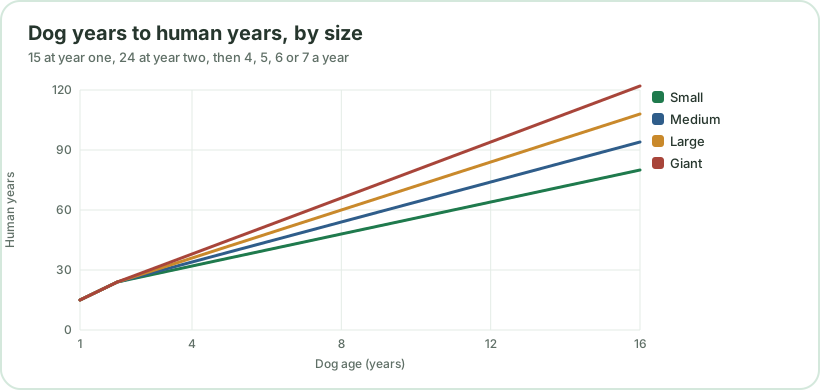
Use the Dog Age Calculator with the estimated age and size. If the vet gives a range, calculate both ends. For example, a medium dog estimated at 4 to 6 years is about 15 + 9 + 2 × 5 = 34 to 15 + 9 + 4 × 5 = 44 human years on the size chart. The range is more honest than one number, and it is enough to place the dog in a life stage. Our dog years to human years chart lists the full table.
| Estimated age | Small | Medium | Large | Giant |
|---|---|---|---|---|
| 3 years | 28 | 29 | 30 | 31 |
| 5 years | 36 | 39 | 42 | 45 |
| 8 years | 48 | 54 | 60 | 66 |
| 10 years | 56 | 64 | 72 | 80 |
These values use 24 for age two and add the size step for each later year.
Why age matters for care
Knowing the approximate age helps with:
- Food. Puppies need growth diets, adults maintenance and seniors whatever your vet advises. See how much to feed a dog.
- Vet plan. Vaccines, parasite control and screening depend on age.
- Exercise. A young dog needs different activity from a senior.
- Budget. Costs change with age; see how much it costs to own a dog.
- Expectations. Life stage helps you understand behaviour.
Common mistakes
- Treating the estimate as exact.
- Relying on grey fur alone.
- Assuming clean teeth mean a young dog.
- Forgetting to record the estimate.
- Using the seven-to-one rule.
- Using the wrong size group.
Questions to ask your vet
- How old do you think my dog is, and how wide is the range?
- What signs did you use?
- Which life stage does that put my dog in?
- Which size group should I use for the age chart?
- When should we revisit the estimate?
A worked example: estimating and planning
A rescue organisation brings in a medium-sized dog of unknown age. The vet examines the dog and estimates 4 to 6 years, mostly from moderate tooth wear, a slight greying of the muzzle and good muscle tone. Here is how the owner uses the estimate.
| Step | Action | Result |
|---|---|---|
| 1 | Record the vet’s range and date | 4 to 6 years, estimated 18 October |
| 2 | Choose a notional birthday | The adoption date |
| 3 | Pick the size group | Medium |
| 4 | Convert both ends | 34 to 44 human years |
| 5 | Place in a life stage | Mature adult territory |
| 6 | Plan | Yearly check-ups, weigh monthly, review at each visit |
The owner has not discovered the dog’s true age, and does not need to. The estimate puts the dog in a life stage, supports food and vet decisions and can be revised as the vet learns more. If the vet later narrows the range, the owner updates the records.
What to avoid
A few popular claims about ageing dogs are not reliable. Counting the number of grey hairs does not give an age. A cloudy look to the eyes can be normal ageing in some dogs, but cloudiness can also be a sign of a health problem, so a vet should check it. Tooth colour and wear reflect diet and habits as much as age. And a dog’s energy level is no guide: some old dogs are lively and some young dogs are calm.
If you are given an age with no source, such as from a website or a seller, treat it as a rough claim and ask your vet to examine the dog. For dogs bought from a breeder or adopted from a rescue with paperwork, use the documented birth date and the Dog Age from Birth Date Calculator.
The puppy timetable in more detail
For puppies, the order of events helps a vet. Milk teeth appear in the first weeks of life and are replaced by adult teeth over several months, and the sequence and rough timing are well known to vets. An owner can use this to cross-check an estimate: a puppy that is still teething on adult teeth is clearly young, while one with a full set of clean adult teeth is probably past the first year. Beyond the teeth, vets also look at how the puppy moves, how it plays and its body proportions.
If you have a puppy of unknown age, ask your vet what the teeth show and write down the estimate with the date. The Puppy & Kitten Age Calculator will track age in weeks from a notional birth date, and our guide to how many times a day a puppy should eat links meals to age.
Why some dogs look older or younger
Genetics, diet, exercise, weight, sun exposure, previous illness and stress all affect how a dog looks. A lean, active dog may look years younger than a heavy, inactive dog of the same age. Some breeds go grey early, and some dogs have white patches from puppyhood. Dark-coated dogs show grey more clearly. This is why the vet combines signs, and why a casual guess based on looks can be off by years.
A summary for adopters
If you are adopting an adult dog, ask the rescue what they know, ask your vet for an estimate, record the range and pick a birthday. Use the range for planning, not as a fixed fact. Revisit it at check-ups. The number matters less than the care that follows: good food, exercise, preventive care and attention to change.
Quick summary
- A vet estimates age from teeth, coat, eyes, muscle and movement.
- Estimates are ranges, narrow in puppies and wide in seniors.
- Record the range, pick a notional birthday and note the size group.
- Convert both ends of the range to human years with the calculator.
- Use the age to plan food, vet visits, exercise and budget.
- Try the Dog Age Calculator with your dog’s details.
Frequently asked questions
How can I tell how old my dog is?
Ask your vet to estimate from teeth, coat, eyes, muscle tone and joints. They will usually give a range such as 3 to 5 years.
Are teeth reliable for ageing a dog?
In puppies, tooth eruption is a good guide. In adults, wear and tartar give only a rough idea, because diet, chewing habits and dental care vary.
Does grey fur mean my dog is old?
Not reliably. Some dogs go grey early, and some stay dark until late in life.
Can a DNA test tell my dog's age?
Some tests estimate age from DNA markers. Ask your vet about accuracy and cost, and treat any result as an estimate.
What birthday should I use for a rescue dog?
Pick a notional date, such as the adoption date or the middle of the estimated range, and use it every year.
How do I convert an estimated age to human years?
Use the dog age calculator with the age and size. For a range, calculate both ends.
How accurate is a vet's estimate?
It is best for puppies and young adults and less precise in older dogs, where individual variation is larger.
Sources
- AAHA (2019) Canine Life Stage Guidelines. Journal of the American Animal Hospital Association 55:267-290
- Wang T. et al. (2020) Quantitative translation of dog-to-human aging by conserved remodeling of the DNA methylome. Cell Systems
Related calculators
- Dog Age CalculatorConvert your dog's age into human years, taking size into account.
- Dog Age from Birth Date CalculatorEnter your dog's birth date and size to see its exact age and its age in human years.
- Dog Life Stage CalculatorFind out which AAHA life stage your dog is in and when it becomes a senior, from its age and estimated lifespan.
Keep reading
- Dog Life Stages: Puppy to Senior (AAHA)The AAHA dog life stages from puppy to senior, how size shifts each boundary, a worked table by expected lifespan and what to adjust in food, check-ups and exercise.
- Dog Years to Human Years: Chart by SizeSee how old your dog is in human years with a size-based chart, the newer epigenetic formula, the dog life stages and why 7 to 1 is wrong.
- Dog Age From Birth Date: Exact Years and MonthsHow to work out a dog's exact age from its birth date in years, months, weeks and days, then convert it to human years with a size chart and the epigenetic formula.
- Why Do Big Dogs Age Faster Than Small Dogs?Why large dogs tend to have shorter lives than small ones: what research shows, how dog-year charts add more years for big breeds and what it means for care.