
“Should I feed my dog once or twice a day?” is a favourite question at dog parks, and every answer comes with confidence. The truth is that the total amount a dog eats in a day matters much more than how many meals it is divided into, but the pattern still affects hunger, routine, digestion and house-training. This guide sets out typical meal patterns by life stage, shows how to divide the daily total, explains timing around exercise and gives a checklist for deciding what works for your dog. It is general information; your vet knows your dog’s health and breed and should have the final say.
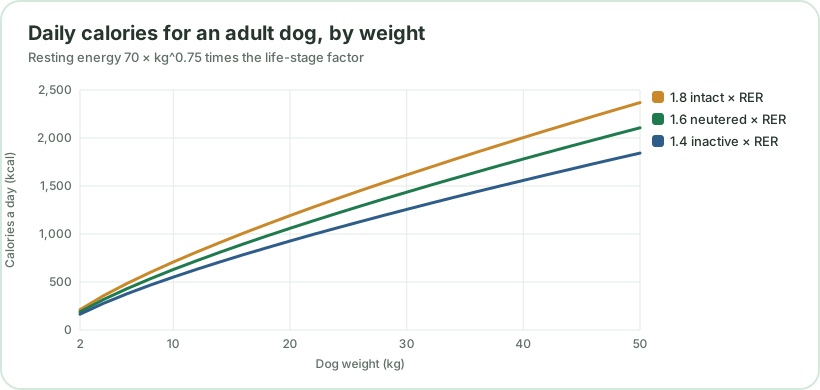
First, the daily total
Before deciding how often to feed, decide how much. For a neutered adult, daily energy is 1.6 × 70 × weight ^ 0.75: about 1,059 kcal for a 20 kg dog. On a 3,800 kcal/kg food that is 279 g a day. The Dog Food Calculator gives the number for your dog, and our guide to how much to feed a dog explains the factors. Once you have the total, the number of meals is a question of how to divide it.
Typical patterns by life stage
| Life stage | Common pattern | Why |
|---|---|---|
| Young puppy (under about 13 weeks) | 4 small meals | Small stomach, high energy needs |
| Puppy (about 13 to 25 weeks) | 3 meals | Needs still high, stomach larger |
| Puppy (about 26 weeks and older) | 2 meals | Moving toward adult pattern |
| Adult | 2 meals | Steady energy; routine |
| Some adults | 1 meal | Works for some dogs; may increase hunger or bile vomiting in others |
| Senior | 2 or more smaller meals | Easier digestion, steadier appetite; ask your vet |
The patterns for puppies match our puppy feeding chart and the guide on how many times a day a puppy should eat. Your vet may suggest something different for toy breeds, giant breeds or dogs with health conditions.
Dividing the daily grams
Divide the daily total equally unless your vet advises otherwise.
| Daily food | 1 meal | 2 meals | 3 meals | 4 meals |
|---|---|---|---|---|
| 150 g | 150 g | 75 g | 50 g | 38 g |
| 200 g | 200 g | 100 g | 67 g | 50 g |
| 279 g | 279 g | 140 g | 93 g | 70 g |
| 350 g | 350 g | 175 g | 117 g | 88 g |
| 450 g | 450 g | 225 g | 150 g | 113 g |
| 600 g | 600 g | 300 g | 200 g | 150 g |
If you give treats, subtract their calories from the meals. The Pet Meal Size Calculator splits a daily amount into meals for you.
Spacing the meals
For two meals, a gap of about 8 to 12 hours is common, such as 7 am and 6 pm. A consistent schedule helps the dog know when to expect food, and helps toileting routines. A dog’s body gets used to the pattern, and big changes in timing can lead to restlessness or an upset stomach. If your working day changes, adjust gradually.
For three or four meals, spread them across the waking day with a last meal in the evening. Younger puppies need a toilet trip soon after eating.
One meal or two?
Some adult dogs eat once a day without problems, and others get hungry, restless or bring up yellow liquid on an empty stomach. Two meals often provide steadier energy and fewer hunger-driven behaviours. Dogs on weight-loss plans often do better with smaller, more frequent meals, because the same total feels more satisfying when spread across the day. The decision depends on the dog; try a pattern for a couple of weeks, watch appetite, stools and behaviour and ask your vet.
Exercise and meals
A common vet suggestion, particularly for deep-chested large breeds, is to avoid vigorous exercise immediately before and after a large meal. The reasons relate to the risk of a serious stomach condition in some breeds, and your vet can explain the risk for yours. As a practical routine, many owners walk before the meal, allow rest after and feed in a calm place. Do not feed straight after a hard run when the dog is panting.
Free feeding
Leaving a bowl of food out all day is called free feeding. Some dogs self-regulate and others overeat. The main practical drawbacks are that you cannot tell how much each dog eats (in a multi-dog household), you cannot spot appetite changes easily and weight is harder to control. Measured meals give you better information. If you want to use a puzzle feeder or a timed feeder, load it with the day’s measured amount.
Special situations
Dogs on a weight-loss plan. Smaller meals, more often, and a measured allowance; see how fast a dog should lose weight.
Senior dogs. Smaller portions and a calm routine; ask your vet.
Dogs with health conditions. Follow your vet’s plan, which may include a specific schedule, especially for dogs on medication with food.
Multi-dog homes. Feed in separate spaces to prevent stealing and to track intake.
Working or very active dogs. Energy needs are higher, so ask your vet about the pattern and timing around work.
Changing the schedule
If you want to move from one meal to two, split the daily grams, and feed at your chosen times, shifting by 30 to 60 minutes a day if the change is large. If you are moving from three meals to two, as a puppy grows, merge the midday meal into the others over a week, adding a third of its portion to each of the other two meals every couple of days. Watch for hunger and stools.
Common mistakes
- Changing the total when you change the number of meals.
- Not subtracting treats.
- Feeding at irregular times.
- Vigorous exercise straight after a large meal.
- Free feeding without measuring.
- Copying a friend’s schedule without checking your dog’s needs.
- Ignoring signs of hunger or nausea at the end of the day.
Worked examples across three dogs
The right pattern depends on the dog. The table shows how the same arithmetic gives different meals for three dogs on a food of 3,600 kcal/kg.
| Dog | Daily kcal | Daily grams | Meals | Per meal |
|---|---|---|---|---|
| 8 kg neutered adult | 533 | 148 g | 2 | 74 g |
| 20 kg neutered adult | 1,059 | 294 g | 2 | 147 g |
| 30 kg senior on a lower factor (1.4) | 1,257 | 349 g | 3 | 116 g |
The senior in the third row is an illustration of a dog on 1.4 times resting energy with three smaller meals; your vet will decide the factor and the pattern for a real dog. The point of the table is that you decide the total first and the meal count second, and both are easy to recalculate if circumstances change.
Bile vomiting and hungry mornings
Some dogs bring up yellow foam in the early morning, and owners often link it to a long gap between dinner and breakfast. If this happens, tell your vet; in some cases a small later-evening meal or an earlier breakfast helps, but the cause should be checked, since vomiting can have other causes. Do not add calories to solve the problem; move a portion of the day’s food to the later meal so that the total stays the same.
Working dogs, sport and heavy exercise
Dogs that work or train hard have higher energy needs and may benefit from different timing, for example a lighter meal well before exercise and a larger meal afterwards. Ask your vet about your dog’s needs and about the break between a meal and strenuous exercise, which is especially important for deep-chested breeds. Hydration matters too: offer water before, during and after exercise in small amounts, and see how much water a dog should drink.
When your schedule changes
Life changes: a new job, a baby, shift work. Dogs adapt if the change is gradual. Move meals by 15 to 30 minutes a day until you reach the new times, and keep the daily total the same. If you will be away for long hours, a timed feeder, a walker who can give a meal or a family member can help; our guide to how much dog walking costs covers the cost of help. Keep the routine at weekends as close to weekday patterns as you can, and your dog will be more settled.
A simple decision guide
- Is the dog a young puppy? Use the puppy pattern in the table, and see how many times a day a puppy should eat.
- Is the dog an adult with no health problems? Start with two meals, 8 to 12 hours apart.
- Does the dog seem hungry or bring up bile? Try a small later meal or a third small meal from the same total, and tell your vet.
- Does the dog gulp food? Try a slow feeder, a puzzle or smaller portions.
- Is the dog senior or ill? Ask your vet for the pattern.
- Does your routine vary? Use a timed feeder or arrange help.
Keep a log for two weeks after any change: times, amounts, stools, energy and behaviour. If everything is steady, the pattern is working.
Cost and convenience
Meal frequency does not change the food bill, since the total is fixed, but it can affect convenience and sometimes the need for help. If you pay a walker or sitter to give a midday meal, that adds a cost; see how much dog walking costs. A timed feeder can replace a midday visit for dry food, though it is no substitute for exercise and company. Think about what the dog needs beyond food when you choose a schedule.
A word on fasting and skipped meals
Healthy adult dogs sometimes skip a meal, particularly in hot weather or after a change in routine, and a single skipped meal is not an emergency. What matters is the pattern. A dog that refuses food for more than a day, or any puppy, small dog or senior that refuses meals, needs a vet’s advice. Do not use fasting as a weight-loss technique without your vet’s guidance; the right approach is a lower total, divided across meals.
Quick summary
- Total calories decide weight; meal count decides routine.
- Puppies: 4 meals under about 13 weeks, 3 to 25 weeks, 2 after that.
- Most adults do well on two measured meals 8 to 12 hours apart.
- Divide the daily grams equally and subtract treats.
- Ask your vet about exercise around meals and about senior or special dogs.
- Use the Dog Food Calculator and Pet Meal Size Calculator.
Frequently asked questions
How many times a day should I feed my dog?
Two measured meals a day suit most adult dogs. Puppies need three or four when young, and some seniors benefit from smaller, more frequent meals.
Is feeding once a day OK?
Some adult dogs do well on one meal, but many do better on two. Ask your vet about your dog.
How long between meals?
For two meals, roughly 8 to 12 hours apart is common. Keep times steady.
Should I free-feed my dog?
Measured meals make it easier to track intake and weight. Free feeding can lead to overeating in some dogs.
Should I exercise before or after meals?
Ask your vet, especially for deep-chested breeds. Your vet may suggest avoiding vigorous exercise immediately before and after a meal.
How do I divide the daily food?
Work out the daily grams from calories and divide by the number of meals. A 279 g day is 140 g twice or 93 g three times.
Does meal frequency change weight?
Not by itself. Total calories decide weight, but meal pattern can affect hunger and routine.
Sources
- AAHA (2019) Canine Life Stage Guidelines. Journal of the American Animal Hospital Association 55:267-290
- WSAVA Global Nutrition Guidelines
Related calculators
- Dog Food CalculatorTurn your dog's daily calorie need into grams and cups of the food you actually feed, using the energy value printed on the bag.
- Pet Meal Size CalculatorSplit a daily food amount into meals and see how many grams (and calories) go in each bowl.
- Puppy Food CalculatorCalculate how much a growing puppy needs, how many meals a day, and how much per meal.
Keep reading
- How Many Times a Day Should a Puppy Eat?How many meals a day a puppy needs by age: four under 13 weeks, three to six months, then two. Meal-size examples, timing, toy breeds and when to ask your vet.
- How Much Should I Feed My Dog? By WeightHow much to feed a dog by weight: a grams and cups chart, how to read the food label, meals per day, adjusting by body condition and common mistakes.
- How Many Cups of Dry Food Should a Dog Eat?How many cups of dry food a dog needs: the calorie method, a cups chart for 300, 360 and 400 kcal per cup, why cups vary and how to measure accurately.
- Dog Hydration in Hot Weather: A Practical PlanA practical hot-weather hydration plan for dogs: the 50 mL per kg reference, water on walks and in the car, measuring intake and when to call a vet at once.