
Water is the nutrient dogs need most and notice least. Owners fill the bowl and rarely measure what goes down, which means a real change in drinking can go unseen for weeks. This guide explains how much water a healthy dog normally drinks, gives a chart by weight, shows how to measure your own dog’s intake and explains when a change is a reason to call the vet.
The standard figure: about 50 mL per kilogram
The Merck Veterinary Manual gives the usual maintenance water need of a dog as about 50 mL per kg of body weight per day, with a normal range of about 40 to 60 mL per kg. That total includes all water taken in, from the bowl and from food. The Dog Water Intake Calculator uses these numbers and compares your dog’s measured intake with the normal range.
Because the figure is per kilogram, big dogs drink more in total, but small dogs drink more per kilogram of body weight, in the same way they eat more per kilogram. The numbers below are a guide for a healthy adult dog on a typical day.
A chart by weight
| Dog weight | Typical (50 mL/kg) | Normal range (40 to 60) | In fluid ounces | Excessive (over 100 mL/kg) |
|---|---|---|---|---|
| 2 kg (4.4 lb) | 100 mL | 80 to 120 mL | 3.4 oz | over 200 mL |
| 5 kg (11 lb) | 250 mL | 200 to 300 mL | 8.5 oz | over 500 mL |
| 10 kg (22 lb) | 500 mL | 400 to 600 mL | 16.9 oz | over 1,000 mL |
| 15 kg (33 lb) | 750 mL | 600 to 900 mL | 25.4 oz | over 1,500 mL |
| 20 kg (44 lb) | 1,000 mL | 800 to 1,200 mL | 33.8 oz | over 2,000 mL |
| 25 kg (55 lb) | 1,250 mL | 1,000 to 1,500 mL | 42.3 oz | over 2,500 mL |
| 30 kg (66 lb) | 1,500 mL | 1,200 to 1,800 mL | 50.7 oz | over 3,000 mL |
| 40 kg (88 lb) | 2,000 mL | 1,600 to 2,400 mL | 67.6 oz | over 4,000 mL |
| 50 kg (110 lb) | 2,500 mL | 2,000 to 3,000 mL | 84.5 oz | over 5,000 mL |
A US cup is about 237 mL, so a 20 kg dog’s typical intake is a little over four cups, and a 10 kg dog’s is about two cups. The units are close enough for a daily check but not for a laboratory measurement.
What changes normal intake
The figures describe a typical day, and a dog’s real intake moves with its life:
- Food type. Wet food is mostly water, so a dog fed wet food drinks less from the bowl; dry food means more drinking.
- Weather. Hot days raise intake.
- Exercise. A long walk or a run in the park makes a dog drink more.
- Life stage. Puppies, pregnant or nursing dogs and older dogs have different needs, so ask your vet.
- Salt and treats. Salty foods can make a dog thirsty.
For this reason, measure over several normal days before deciding that something is unusual.
How to measure your dog’s intake
You do not need special equipment, only a measuring jug and a consistent routine.
- Fill the water bowl with a measured amount, such as 2 litres, in the morning.
- Remove other water sources, or measure those too.
- After 24 hours, pour what is left into the jug and subtract it from the starting amount.
- Allow for spills, evaporation and any water your dog carried out on its fur or beard.
- Repeat for two or three days and take the average.
Multiply your dog’s weight in kilograms by 50 to see the typical figure, and compare the measured number with the normal range in the table. If you cannot measure all water sources, such as when the dog drinks outside, a rough guess is better than nothing, but note that it is a guess.
A worked example
A dog weighs 20 kg. The typical intake is 20 × 50 = 1,000 mL, and the normal range is 800 to 1,200 mL. Over three days, the owner measures 1,050, 980 and 1,100 mL, an average of about 1,040 mL. That is well inside the normal range, so no action is needed other than keeping up the habit.
If the owner had measured 2,300 mL a day on a normal weather day, that would be above 100 mL per kg, which is the point at which vets describe drinking as excessive. In that case the right step is a call to the vet, not a change to the diet. Our guide to why a dog drinks so much explains what to do and what the vet may ask.
Do not limit water
It can be tempting to restrict water, for example because of accidents in the house. Do not do it unless your vet specifically tells you to. Dogs need constant access to fresh, clean water, and restricting it can be harmful. If a dog is drinking so much that it has accidents, that is a reason to see the vet, not a reason to take the bowl away. For house-training, adjust toilet breaks and timing instead.
Keeping the bowl healthy
- Wash and refill the bowl daily.
- Use a heavy or non-slip bowl so it is not tipped over.
- Place bowls in several spots at home and take water on walks and car trips.
- Consider a fountain if your dog likes running water, but clean it regularly.
- In cold weather, check that outdoor water has not frozen.
Dogs that drink too little
A dog that drinks much less than the normal range, or refuses water, is also a reason to call your vet, especially if it is lethargic, vomiting or has dry gums. Try offering wet food or water in a different bowl, but do not wait if there are other signs of illness. Puppies and small dogs can become dehydrated faster than adults.
Water and feeding
Intake and food are linked. A dog on kibble drinks more than a dog on wet food, and a dog on a raw or fresh diet gets a lot of water from the food. When you change diet, expect the bowl intake to change too. If you want to work out how much to feed, our guide to how much to feed a dog shows the calorie method.
Common mistakes
- Judging intake by how often the bowl is refilled.
- Forgetting water from wet food.
- Measuring only one hot day.
- Comparing a 5 kg dog’s total with a 30 kg dog’s total instead of using mL per kg.
- Limiting water to solve house-training problems.
- Ignoring a gradual rise in drinking because it was slow.
Water for travel, exercise and hot days
The numbers in the table are daily figures for a typical day. For days that are different, a few rules of thumb help:
- On a long walk, carry water and offer it at regular stops. Do not wait for the dog to ask.
- In hot weather, make sure shade and fresh water are available, and take care with exercise. If your dog shows signs of heat stress, such as heavy panting, drooling or weakness, move it to a cool place and contact your vet.
- In the car, offer water during stops and never leave a dog in a parked car.
- On a trip, take water from home for the first days, since changes in water can upset some dogs’ stomachs.
A collapsible bowl in the bag makes this easy. If you want to see how much your dog drinks on a hot day, measure it separately from normal days, because it will be higher and should not be compared with the normal range.
Puppies, older dogs and special cases
- Puppies can become dehydrated faster than adults. Offer water often and call the vet if a puppy is drinking very little or has vomiting or diarrhoea.
- Older dogs may drink more or less than before, and any lasting change is worth a vet visit.
- Nursing mothers need more water, so make sure it is always available.
- Dogs on a special diet may have different needs; follow your vet’s advice.
- Dogs with health conditions, such as those on medication that raises thirst, need a vet’s guidance on what is normal.
Working out the range for your dog
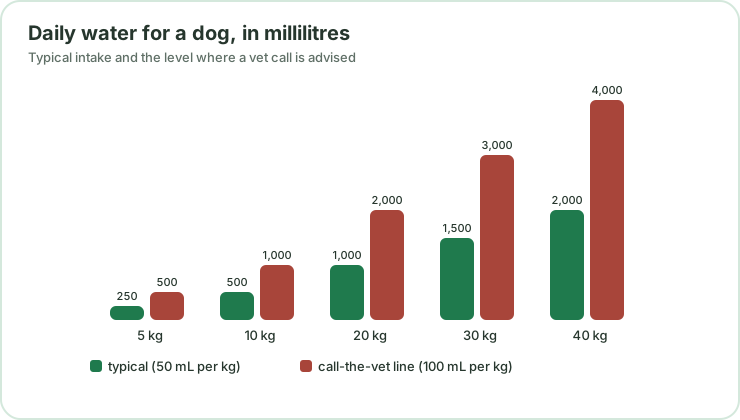
The calculators use 50 mL per kg per day, with a range of 40 to 60. For a 20 kg dog that is 1,000 mL, within 800 to 1,200 mL. A 5 kg dog needs about 250 mL, and a 40 kg dog about 2,000 mL. Intake above 100 mL per kg (2,000 mL for a 20 kg dog) is called polydipsia and is a reason to call your vet.
| Weight | Typical (50 mL/kg) | Range (40–60) | Call-the-vet level (100 mL/kg) |
|---|---|---|---|
| 5 kg | 250 mL | 200–300 | 500 mL |
| 10 kg | 500 mL | 400–600 | 1,000 mL |
| 20 kg | 1,000 mL | 800–1,200 | 2,000 mL |
| 40 kg | 2,000 mL | 1,600–2,400 | 4,000 mL |
Wet food, hot weather, exercise and dry food all change intake. See why is my dog drinking so much water for what to measure, and use the Dog Water Intake Calculator.
Helping a dog drink enough
Keep fresh water in several places, clean bowls daily and refill often. Some dogs prefer wide ceramic or steel bowls to plastic ones. Carry water on walks in warm weather and offer small drinks after exercise. Wet food adds water, but do not restrict the bowl. If a dog suddenly refuses water, call your vet.
Quick summary
- A healthy adult dog drinks about 50 mL per kg a day, with a range of 40 to 60 mL per kg.
- A 20 kg dog drinks about 1,000 mL; more than 100 mL per kg (2,000 mL for 20 kg) is considered excessive.
- Heat, exercise, dry food and age all change what is normal; wet food reduces bowl drinking.
- Measure over two or three normal days with a jug.
- Never restrict water unless your vet advises it, and call the vet about sudden changes.
- Use the Dog Water Intake Calculator to compare your dog’s intake.
Frequently asked questions
How much water should a dog drink a day?
About 50 mL per kg of body weight, within a range of 40 to 60 mL per kg. A 10 kg dog drinks about 500 mL, and a 30 kg dog about 1,500 mL.
How much is too much water for a dog?
Drinking more than about 100 mL per kg a day is called polydipsia and should be discussed with your vet. For a 20 kg dog that is over 2 litres a day.
Does wet food count towards water intake?
Yes. Wet food is mostly water, so a dog eating it may drink less from the bowl. Compare like with like when you measure.
Do dogs drink more in hot weather or after exercise?
Yes. Heat, exercise and dry food all raise normal intake, so measure over several ordinary days before deciding the amount is unusual.
How do I measure my dog's water intake?
Fill the bowl with a measured amount, let your dog drink as usual for 24 hours, then measure what is left, allowing for spills. Repeat on two or three days.
Should I limit my dog's water?
No, not unless your vet tells you to. Fresh water should always be available, and a sudden change in drinking is a reason to call your vet.
What if my dog suddenly drinks much more?
A sudden or lasting increase is a reason to see your vet, especially with other changes such as weight loss, more urination or tiredness.
Sources
- Merck Veterinary Manual — maintenance water about 50 mL/kg/day (range 40 to 60); more than 100 mL/kg/day is polydipsia
- NRC (2006) Nutrient Requirements of Dogs and Cats, National Academies Press
Related calculators
- Dog Water Intake CalculatorEstimate how much water your dog should drink in a day and check whether the amount it drinks is normal.
- Pet Weight ConverterConvert your pet's weight between kilograms, pounds, ounces and grams.
- Dog Food CalculatorTurn your dog's daily calorie need into grams and cups of the food you actually feed, using the energy value printed on the bag.
Keep reading
- Why Is My Dog Drinking So Much Water?Why a dog may drink a lot: normal reasons like heat and food, how to measure intake against about 50 mL per kg, the 100 mL per kg line and when to see the vet.
- How Much Should I Feed My Dog? By WeightHow much to feed a dog by weight: a grams and cups chart, how to read the food label, meals per day, adjusting by body condition and common mistakes.
- Dog Hydration in Hot Weather: A Practical PlanA practical hot-weather hydration plan for dogs: the 50 mL per kg reference, water on walks and in the car, measuring intake and when to call a vet at once.
- Does Wet Food Count Toward a Dog's Water Intake?How much water a dog gets from wet food: moisture percent times grams fed, compared with 50 mL per kg, with tables for 5 to 30 kg dogs on wet, mixed and dry diets.