
Dry cat food is the most common way to feed a cat, and the question “how many grams?” has a surprisingly precise answer once you stop asking the bag. The amounts are small, so errors are large in proportion: a scoop that is 10 grams too much for a cat that needs 63 g is a 16% overfeed, enough to add weight within weeks. This guide gives the formula, a table of grams by weight and food energy for neutered adults, a worked example, advice on cups, treats and adjustments and the cases where a cat’s needs differ. For a deeper look at the energy factors, see how many calories a cat needs.
The formula in three steps
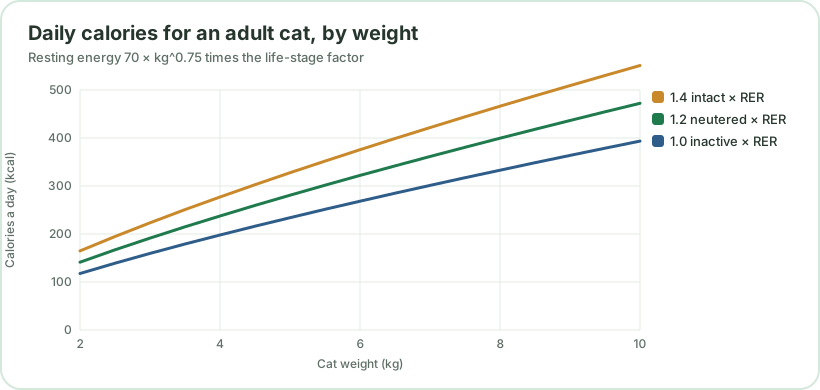
- Resting energy (RER) = 70 × weight in kg ^ 0.75.
- Daily energy = RER × factor. For a neutered adult, 1.2; intact adult, 1.4; inactive or overweight-prone, 1.0; kitten, 2.5.
- Grams = daily energy ÷ (kcal per kg of the food ÷ 1,000).
For a 4 kg neutered cat: RER = 70 × 4 ^ 0.75 = 198 kcal; × 1.2 = 238 kcal. On a food of 3,800 kcal/kg (3.8 kcal per gram), that is 238 ÷ 3.8 = 63 g a day. The Cat Food Calculator and the Cat Calorie Calculator perform the same steps.
Grams by weight and food energy (neutered adult)
| Cat’s weight | Daily kcal (1.2 × RER) | 3,400 kcal/kg | 3,600 kcal/kg | 3,800 kcal/kg | 4,000 kcal/kg |
|---|---|---|---|---|---|
| 2 kg | 141 | 42 g | 39 g | 37 g | 35 g |
| 3 kg | 191 | 56 g | 53 g | 50 g | 48 g |
| 4 kg | 238 | 70 g | 66 g | 63 g | 59 g |
| 5 kg | 281 | 83 g | 78 g | 74 g | 70 g |
| 6 kg | 322 | 95 g | 89 g | 85 g | 81 g |
| 7 kg | 361 | 106 g | 100 g | 95 g | 90 g |
Read across the row for your cat’s weight, and choose the column closest to your food’s energy. If your food is not listed, divide the calories by its kcal per gram. These amounts assume the whole day’s food is dry. The table in our cat feeding chart by weight adds wet and mixed columns.
Other cats, other factors
| Cat type | Factor | 4 kg cat: daily kcal | Grams at 3,800 kcal/kg |
|---|---|---|---|
| Neutered adult | 1.2 | 238 | 63 g |
| Intact adult | 1.4 | 277 | 73 g |
| Inactive or prone to weight gain | 1.0 | 198 | 52 g |
| Weight loss (0.8 × RER at ideal weight) | 0.8 | 158 | 42 g |
The weight-loss row is an illustration of the calculator’s factor for a 4 kg ideal weight, not a plan: weight loss in cats should be supervised by a vet, because rapid loss in cats can be harmful. Kittens use a factor of 2.5 and have their own chart; see the Kitten Food Calculator.
Why cups mislead
Cat portions are small, and kibble density varies. A level scoop that holds 30 g of one food may hold 36 g of another. For a cat that needs 63 g, the difference is meaningful. If your bag only gives cups, weigh a level cup on a kitchen scale and use that. The Dog Food Cups to Grams Calculator works for any kibble if you know the kcal per cup and per kg. Ideally weigh each day’s ration on a scale accurate to 1 g and keep it in a container.
Splitting the ration
Cats do best with small meals. A 63 g ration might be two meals of 31 g, three of 21 g or a puzzle feeder with the whole day’s allowance. See how often to feed a cat for options. Whatever pattern you choose, the sum is the same: the total grams are fixed by the calorie target.
Treats and extras
Treats should stay within 10% of the daily calories. For a cat on 238 kcal, that is 24 kcal; subtract it from the meals, leaving 214 kcal, or 56 g of the 3,800 kcal/kg food. A single dental treat of 2 to 3 kcal is minor, but a lick of cream or a nibble of cheese can add up. Count everything.
Checking the amount works
Weigh monthly and score body condition. For cats, ribs should be easy to feel under a thin layer of padding, with a waist behind the ribs when viewed from above. If weight rises and the ribs are hard to feel, reduce by about 10% and check again in a month. If the cat loses weight without a plan, increase by 10% and call your vet, since unplanned weight loss deserves a check. Keep a log.
| Date | Weight (kg) | Daily grams | Treats | Condition | Notes |
|---|---|---|---|---|---|
When the numbers do not fit
Some cats need more or less than the formula suggests, especially if they are very active, pregnant, nursing, unwell or old. In those cases your vet decides the target. The formula is built on averages and individual cats vary by roughly 10 to 20%, so a monthly check is more important than the first figure.
Dry food and water
Dry food contains little water, so cats on dry food need to get more of their water from the bowl. Provide fresh water in more than one place. If your cat drinks little, ask your vet about adding wet food. For a mixed diet, see how much wet food a cat should eat.
Common mistakes
- Measuring by cup.
- Using the bag’s band instead of the cat’s weight.
- Forgetting treats.
- Topping up the bowl by habit.
- Not weighing the cat.
- Cutting food for an overweight cat without a vet.
- Using an adult amount for a kitten.
Worked examples for four different cats
The arithmetic is the same each time, but the answers differ.
| Cat | Weight | Factor | Daily kcal | Grams at 3,800 kcal/kg |
|---|---|---|---|---|
| Small neutered female | 3 kg | 1.2 | 191 | 50 g |
| Average neutered male | 5 kg | 1.2 | 281 | 74 g |
| Large neutered male | 6 kg | 1.2 | 322 | 85 g |
| Indoor cat prone to weight gain | 5 kg | 1.0 | 234 | 62 g |
The fourth cat weighs the same as the second but eats 12 g less because the vet has set a lower factor. That 12 g is 16% of the portion, which is why a calculation for the individual cat beats a bag chart. Ask your vet whether your cat should be on 1.2 or 1.0, and check again in a month.
Reading the cat food bag
A typical cat food bag shows a table by weight band, for example “3 to 4 kg: 45 to 60 g”. Such tables can be accurate for some cats, but they assume an average cat and a typical food, and they do not include treats. Compare the bag’s range with your calculation; if yours is lower, the cat may be neutered, inactive or on the heavy side, and the bag is probably generous. If yours is higher, check the cat’s condition before feeding more. For a check on any label, see the principles in how to read a dog food label: the adequacy statement and the energy value apply to cat foods as well, though the exact nutrient profile for cats is different.
Kibble size and eating speed
Some cats gulp kibble and then vomit, while others pick at it. A few adjustments, which your vet can build on, may help: split the day’s food into more meals, use a shallow dish, add a puzzle feeder or spread the kibble over a larger surface. None of these changes the calories. If vomiting is frequent, the cat is losing weight or seems unwell, see your vet; do not assume it is greed.
Making the bag last
Planning purchases is easier once you know the daily grams. A 2 kg bag at 63 g a day lasts about 32 days, and the Pet Food Bag Duration Calculator does the sum. Store dry food in a cool, dry place in a sealed container and use it within the time the maker advises. Do not mix new food on top of old; use up the container before refilling, and wash it between bags.
How to work out a bag’s lifetime and cost
Knowing the daily grams lets you plan purchases and costs. A 63 g daily ration uses 1.9 kg in 30 days. A 2 kg bag at 12 costs 6 per kg, so a day costs 0.38 and a month 11.34. The Cat Food Cost Calculator takes the bag price, bag size and daily grams and returns daily, monthly and yearly cost, and the Pet Food Price per 1,000 kcal Calculator compares foods on energy. A cheaper bag with a lower energy value can cost more per day than a pricier bag that is more concentrated, because the cat needs more grams of it.
| Food | Price per kg | kcal per kg | Grams for 238 kcal | Cost per day |
|---|---|---|---|---|
| Bag A | 6.00 | 3,400 | 70 | 0.42 |
| Bag B | 6.00 | 3,800 | 63 | 0.38 |
| Bag C | 8.00 | 4,000 | 59 | 0.48 |
Prices are examples, but the method is general: price per kg × grams per day ÷ 1,000 gives the cost per day.
Checking the scale and the scoop
A kitchen scale accurate to 1 g costs little and makes the whole process reliable. Weigh the first few days’ portions, then weigh a level scoop of the same food and note the number. If you prefer a scoop, mark the level with a pen. Re-weigh the scoop whenever you change food, since the same scoop can hold different weights. Keep the scoop out of the bag to avoid contamination, and wash it periodically.
Cats that need extra attention
Pregnant or nursing cats, growing kittens, seniors with health conditions and cats on weight-loss plans all need advice from a vet, because the usual factors do not apply. Do not use this table for them. The kitten and pregnancy guides in this series cover the typical energy factors, and your vet can set a target for each cat.
Quick summary
- Daily energy = 1.2 × 70 × kg ^ 0.75 for a neutered adult; 238 kcal at 4 kg.
- Grams = kcal ÷ (kcal per kg ÷ 1,000); 63 g at 3,800 kcal/kg.
- Weigh food on a scale, not a cup.
- Keep treats within 10% and subtract them from meals.
- Weigh monthly, score condition and adjust by about 10%.
- Use the Cat Food Calculator for your cat.
Frequently asked questions
How many grams of dry food should a cat eat a day?
It depends on weight and the food's energy. A neutered 4 kg cat needs about 238 kcal, which is about 63 g of a 3,800 kcal/kg dry food.
Why do cat food bags recommend more?
Bag guides cover many cats in wide bands and often err generous. Calculate from calories and check your cat's weight.
How many grams for a 5 kg cat?
About 281 kcal for a neutered adult, or roughly 74 g of a 3,800 kcal/kg dry food.
Should I use cups or grams?
Grams. A cup of kibble varies in weight, and cat portions are so small that a few grams matter.
How do treats change the dry food amount?
Keep treats within 10% of daily calories and subtract them from the meals.
What if my cat is overweight?
Ask your vet for a weight-loss plan. Cat weight loss should be gradual and supervised.
How often should I adjust the amount?
Weigh monthly and adjust by about 10% if the trend is wrong.
Sources
- NRC (2006) Nutrient Requirements of Dogs and Cats, National Academies Press
- AAFP/AAHA (2021) Feline Life Stage Guidelines. Journal of Feline Medicine and Surgery 23:211-233
- WSAVA Global Nutrition Guidelines
Related calculators
- Cat Food CalculatorWork out your cat's daily calories and how to split them between wet and dry food.
- Cat Calorie CalculatorWork out how many calories your cat needs each day, from its weight and life stage.
- Dog Food Cups to Grams CalculatorConvert cups of dog food to grams (and back) using the energy values printed on your bag.
Keep reading
- Cat Feeding Chart by WeightA cat feeding chart by weight with daily calories and grams of dry food, wet food and a half-and-half mix for neutered adult cats, plus treat allowances.
- How Many Calories Does a Cat Need a Day?How many calories a cat needs: the RER formula, factors for neutered, intact, inactive and kitten cats, a calorie table by weight and how to adjust.
- How Much Wet Food Should a Cat Eat a Day?How much wet food a cat needs a day: grams and cans by weight, how kcal per can works, mixing wet with dry and how to avoid overfeeding with pouches and tins.
- Wet vs Dry Cat Food: Calories, Water and CostWet and dry cat food compared on water, calories per gram, grams needed, cost per 1,000 kcal and storage, with a worked example and a mixed-feeding plan.