
The shelf in the pet shop splits cleanly into two: dry kibble in bags and wet food in cans, pouches and trays. Cat owners love to argue about which is better, and the arguments often mix real differences with folklore. The real differences are mostly arithmetic: how much water, how many calories per gram, what it costs for the same energy and how convenient it is. The question of which is healthier for a particular cat is one for your vet, because it depends on the cat’s age, weight, teeth, kidneys and preferences. This guide lays out the facts you need to make an informed choice and to mix the two without overfeeding.
Water: the biggest difference
Typical dry cat food is about 10% water, and typical wet food 75 to 80%. Cats are descended from desert animals, and many drink relatively little; a cat on wet food gets a good share of its water with its meal, while a cat on dry food has to drink more from the bowl. Your vet may recommend wet food for cats that drink little or have certain conditions, but whether it applies to yours is a question for your vet.
| Feature | Dry (typical) | Wet (typical) |
|---|---|---|
| Moisture | About 10% | About 75–80% |
| Energy | About 3,400 to 4,200 kcal/kg | About 800 to 1,200 kcal/kg |
| Grams for the same calories | Fewer | About 3–4 times more |
| Label protein as fed | Higher | Lower (diluted) |
| Storage | Sealed bag | Fridge once opened |
| Mess and smell | Low | Higher |
Because of the water, comparing label percentages across formats misleads; see why wet food looks low in protein.
A worked example for a 4 kg neutered cat
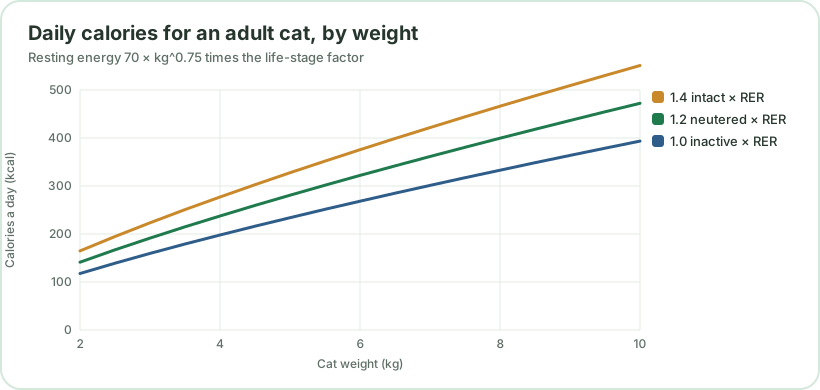
A neutered 4 kg cat needs 1.2 × 70 × 4 ^ 0.75 = 238 kcal a day.
| Food | Energy | Grams a day | Notes |
|---|---|---|---|
| Dry A | 3,400 kcal/kg | 70 g | Lower energy |
| Dry B | 3,800 kcal/kg | 63 g | Typical |
| Dry C | 4,200 kcal/kg | 57 g | Higher energy |
| Wet D | 800 kcal/kg | 298 g | Watery pouch |
| Wet E | 1,000 kcal/kg | 238 g | Typical |
| Wet F | 1,200 kcal/kg | 198 g | Dense pâté |
The cat eats between about 57 and 70 g of dry food or about 200 to 300 g of wet, for the same calories. The wet portions look large, but the cat is eating the same energy. The Cat Food Calculator works out the grams for your food, and the Cat Food Cans per Day Calculator converts grams to cans.
Cost per 1,000 kcal
Price per kilogram is a poor way to compare. Use cost per 1,000 kcal: price per kg ÷ kcal per kg × 1,000.
| Example | Price per kg | kcal per kg | Cost per 1,000 kcal | Cost per day for 238 kcal |
|---|---|---|---|---|
| Dry B | 5.00 | 3,800 | 1.32 | 0.31 |
| Dry premium | 9.00 | 4,000 | 2.25 | 0.54 |
| Wet E | 5.00 | 1,000 | 5.00 | 1.19 |
| Wet premium | 9.00 | 1,100 | 8.18 | 1.95 |
The prices are example figures to show the arithmetic. In this example, wet food costs about four times as much per day as dry. Real prices vary, so run your numbers with the Pet Food Price per 1,000 kcal Calculator. Cost is one factor among several, and many owners choose a mix as a compromise.
Convenience and routine
Dry food is easy to store, measure and leave in a timed feeder. It suits owners who are out all day. Wet food needs refrigeration once opened, spoils if left out and is messier, but many cats find it more appealing, which helps with fussy eaters or cats with a poor appetite. A mixed approach, wet at one meal and dry at another, can give the benefits of both.
Dental and other claims
You will hear that dry food cleans teeth, or that wet food protects kidneys. Such claims have been made for a long time, and the evidence is mixed and depends on the product and the cat. Some dry foods are designed for dental care and carry evidence for it; ordinary kibble is not a toothbrush. If your cat has dental or kidney concerns, your vet is the right person to advise on diet. Do not change a cat’s food because of an advertisement.
Mixed feeding: how to do it
- Work out the daily calories (238 kcal in the example).
- Choose the split: say 50% wet and 50% dry.
- Convert: wet 119 kcal ÷ 1.0 = 119 g; dry 119 kcal ÷ 3.8 = 31 g.
- Divide into meals.
Do not add the wet food on top of the full dry ration, which would double the calories. The same calorie method applies to dogs; see feeding wet and dry dog food together for the pattern. For the amount of wet food alone, see how much wet food a cat should eat.
| Wet share | Wet grams (1.0 kcal/g) | Dry grams (3.8 kcal/g) |
|---|---|---|
| 0% | 0 | 63 |
| 25% | 60 | 47 |
| 50% | 119 | 31 |
| 75% | 179 | 16 |
| 100% | 238 | 0 |
Switching
Cats can be sensitive to change, and many are suspicious of new foods. Switch gradually over a week or more, mixing the new with the old, and watch appetite and stools. Never leave a cat without food for long, since cats that stop eating can become unwell; if a cat refuses to eat for a day, call your vet.
Special cases
Kittens. They need foods labelled for growth, and wet food is often used for weaning; see the kitten feeding chart.
Overweight cats. The format does not matter as much as the calories, and weight loss should be gradual and supervised by your vet.
Cats with health conditions. Follow your vet’s diet advice.
Senior cats. Appetite and teeth change; wet food may be easier to eat. Ask your vet.
Multi-cat homes. Feed separately so that each cat eats its own ration.
Reading the label
Whichever format you choose, check three things on the label: a statement that the food is complete and balanced for your cat’s life stage, the kcal per kg or per can and the moisture content so that you can compare on a dry matter basis. Our guide to dry matter protein calculation shows the conversion.
Common mistakes
- Comparing label protein across formats.
- Feeding wet food on top of a full dry ration.
- Comparing price per kilogram.
- Leaving wet food out for hours.
- Switching suddenly.
- Believing dental or kidney claims without checking.
- Not weighing the cat.
Cats that will not switch
Some cats are loyal to one texture, and trying to switch them leads to hunger strikes. Cats should not go without food for long, so do not wait to see who gives in; if a cat refuses to eat for a day, call your vet. Go much more slowly: begin with a tiny amount of the new food mixed into the old, or placed beside it, and increase over weeks. Warm wet food slightly to bring out the aroma, offer in a shallow dish and try different brands or textures. If your cat has a health condition that makes the switch important, your vet can suggest options.
Cats and water
Cats on dry food need to drink more from the bowl. Provide fresh water in several places, away from the food and tray, and try a wide bowl or a fountain. Observe how much your cat drinks. A cat that drinks a lot more than before, or much less, should be seen by the vet. Wet food adds water, so it can help, but a diet change is not a substitute for a check.
Wet food portions and leftovers
Wet food comes in portions that may not match your cat’s meals. A cat needing 238 kcal on a 85 g pouch of 85 kcal needs 2.8 pouches a day. Open pouches or cans can be covered and kept in the fridge for the time on the label. Warm to room temperature before serving. Discard any left in the bowl after the time the label gives. Freezing portions is possible for some products; check the maker’s advice. The Cat Food Cans per Day Calculator does the division for any can or pouch size.
A one-week trial of mixed feeding
If you are thinking of trying a mix, a trial helps. Choose the split, write the daily grams of each food, and feed for a week while watching weight, stools, drinking and behaviour. Weigh on day one and day seven. Note the cost. Decide at the end whether the cat is eating well, the household finds it practical and the cost is acceptable. If the cat’s weight changes by more than about 1%, adjust the amounts. Talk to your vet if there are any concerns, or if your cat has a health condition that affects its diet.
Common questions about cats and food
Do cats need milk? Adult cats do not need milk, and many cannot digest cows’ milk well; ask your vet.
Is fish a good main diet? A fish-only diet is not complete; feed a complete and balanced cat food.
Can I feed my cat dog food? No. Cats need nutrients in a different balance, and dog food does not supply them.
Is raw food suitable? This needs specialist advice from your vet.
Can cats be vegetarian? Cats are obligate carnivores; ask your vet before considering any such diet.
Environmental and practical notes
Wet food produces packaging waste, and dry food stores easily. Some owners choose by convenience, some by budget, some by what their cat will eat. Whatever you choose, store dry food in its original bag inside a sealed container to keep the label information, rinse cans before recycling and wash bowls daily. Ask your vet if a particular diet suits your cat’s health.
Cats with sensitive stomachs or health conditions
Some cats vomit hairballs, have loose stools or have a diagnosed condition. If your cat has any of these, speak to your vet before changing format. A therapeutic diet may be available in wet or dry form, and your vet will advise which. Keep a log of stools, vomiting and appetite for a few weeks, so the vet can see the pattern.
Quick summary
- Dry cat food is about 10% water and wet about 75–80%.
- A 4 kg neutered cat needs 238 kcal: 63 g of 3,800 kcal/kg dry or 238 g of 1,000 kcal/kg wet.
- Compare cost per 1,000 kcal, not per kilogram.
- Mix by splitting calories, not by adding wet on top of dry.
- Ask your vet about format for health needs and check the adequacy statement.
- Use the Cat Food Calculator for your cat.
Frequently asked questions
Is wet or dry food better for cats?
Neither is better in itself. A complete and balanced food that your cat eats well, keeps at a healthy weight and suits any health needs is the aim. Ask your vet.
How much wet food equals dry food?
By calories, not weight. A 4 kg cat needing 238 kcal eats 63 g of 3,800 kcal/kg dry or 238 g of 1,000 kcal/kg wet.
Does wet food help cats drink enough?
It supplies water, which suits cats that drink little. Fresh water should still be available.
Which is cheaper?
Compare cost per 1,000 kcal. Dry food is often cheaper on that measure, but it depends on the products.
Can I mix wet and dry food?
Yes. Split the daily calories and convert each share to grams so you do not double-feed.
Is dry food bad for cats' teeth or kidneys?
Claims vary. Ask your vet about your cat's dental and kidney health rather than relying on format alone.
How should I store wet cat food?
Cover opened cans, refrigerate and use within the time on the label. Serve at room temperature.
Sources
- NRC (2006) Nutrient Requirements of Dogs and Cats, National Academies Press
- AAFP/AAHA (2021) Feline Life Stage Guidelines. Journal of Feline Medicine and Surgery 23:211-233
- WSAVA Global Nutrition Guidelines
Related calculators
- Cat Food CalculatorWork out your cat's daily calories and how to split them between wet and dry food.
- Cat Food Cans per Day CalculatorFind out how many cans of wet food your cat needs each day, week and month.
- Pet Food Price per 1,000 kcal CalculatorCompare two foods fairly by price per 1,000 calories instead of price per bag.
Keep reading
- How Much Wet Food Should a Cat Eat a Day?How much wet food a cat needs a day: grams and cans by weight, how kcal per can works, mixing wet with dry and how to avoid overfeeding with pouches and tins.
- Why Wet Food Looks Low in Protein on the LabelWhy wet pet food shows low protein on the label: water dilutes every percentage. See the conversion, side-by-side examples and how to compare fairly.
- How Many Grams of Dry Food Does a Cat Need?How many grams of dry food a cat needs a day: a table by weight and food energy for neutered adults, the formula, why cups mislead and how to adjust over a month.
- How Often Should I Feed My Cat? Meals and FeedersHow often to feed a cat: kitten, adult and senior meal patterns, free feeding versus measured meals, puzzle and timed feeders and how to split the day's calories.