
Cats are not dogs, and their feeding habits show it. In the wild, a cat is a small hunter that eats many small meals a day, and domestic cats retain some of that pattern. Some will graze at the bowl through the day, while others gulp a meal and walk away. Owners face a series of choices: how many meals, whether to leave food out, whether to use a timed feeder or a puzzle toy. This guide sets out the options, with the arithmetic to make each work, and explains how to choose by life stage and temperament. As always, your vet can advise on your own cat.
First, fix the daily calories
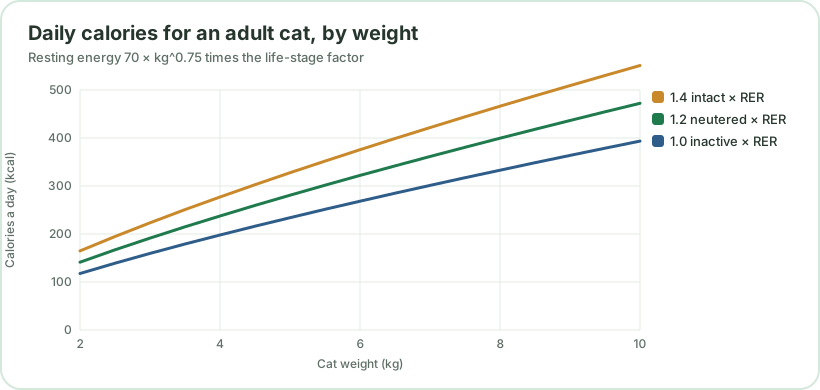
Whatever pattern you choose, the day’s total comes first. For a neutered adult, daily energy is 1.2 × 70 × weight ^ 0.75: 238 kcal for a 4 kg cat. On a dry food of 3,800 kcal/kg, that is 63 g; on a wet food of 1,000 kcal/kg, 238 g. The Cat Food Calculator works it out, and the guide to how many grams of dry food a cat needs shows a table. Once the total is fixed, the number of meals is a matter of dividing.
Typical patterns by stage
| Stage | Common meals a day | Notes |
|---|---|---|
| Young kitten | 4 | Small stomach, high needs |
| Older kitten | 3 | Moving toward adult pattern |
| Adult | 2 to 4 | Small, regular meals suit many cats |
| Senior | 2 to 4 | Smaller portions may be easier; ask your vet |
| Cats with health conditions | As your vet advises | Some need specific timing |
For a kitten, see the kitten feeding chart. In every case, treat the pattern as a starting point and watch how your cat responds.
Splitting the day
| Daily dry food | 2 meals | 3 meals | 4 meals |
|---|---|---|---|
| 50 g | 25 g | 17 g | 13 g |
| 63 g | 32 g | 21 g | 16 g |
| 74 g | 37 g | 25 g | 19 g |
| 85 g | 43 g | 28 g | 21 g |
The same logic applies to wet food. A 238 g day is two meals of 119 g, or four of 60 g. When you give both, work out the calories from each first; see how much wet food a cat should eat. The Pet Meal Size Calculator divides a daily amount for you.
Free feeding versus measured meals
Free feeding means leaving a bowl of dry food out all day. Some cats nibble when they need to and stay lean; others eat to boredom and gain weight. You cannot tell which type you have without measuring, and in a multi-cat household you cannot see who is eating what.
| Free feeding | Measured meals | |
|---|---|---|
| Control of calories | Low | High |
| Spotting appetite changes | Hard | Easy |
| Multi-cat homes | Difficult | Easier with separate feeding |
| Convenience | High | Moderate |
| Suits | Lean, self-regulating cats | Most cats, especially those prone to weight gain |
If you want a middle path, measure the day’s ration into a container in the morning and top up the bowl from it through the day. When the container is empty, food is finished. This gives free access with a fixed total.
Timed and automatic feeders
Automatic feeders release portions at set times. They can help with early-morning begging and with owners who work long hours. Points to check:
- Set each portion by weight and check the first few days.
- Make sure the cat cannot reach the whole hopper.
- Have a back-up if power fails.
- Do not rely on one for more than a day or two without checking on the cat.
- Use only dry food in a dry-food feeder, since wet food needs fridge storage.
Microchip-activated bowls can keep a cat on a prescribed diet in a household of several; ask your vet.
Puzzle feeders and foraging
A puzzle feeder makes a cat work for its food, which can add activity and slow eating. It suits many indoor cats. Put part of the day’s ration in the toy, not extra food. Start easy, so that the cat succeeds, and watch for frustration. Some cats take to puzzles at once, and some ignore them. For senior cats or cats with mobility problems, keep it simple.
Eating too fast
Some cats gulp their food and then bring it up. Possible helps include smaller, more frequent meals, a wide shallow dish, a feeder with ridges to slow eating or scattering kibble. If a cat vomits often, loses weight or seems unwell, see your vet; do not assume it is only greed.
Night feeding and early waking
Many cats wake owners at dawn asking for food. Options include a timed feeder set for early morning, a small evening meal just before bed and consistent routines. Giving in teaches the cat that waking you works, so choose a response and stay with it. If the begging is a sudden change, tell your vet, because increased appetite can be a sign of a health issue.
Multi-cat households
With several cats, watch for bullying at the bowl, and for a shy cat that eats less. Feed in separate places or rooms, and make sure each cat finishes its share. A weekly weigh-in on each cat will show who is gaining or losing. Feeding times and bowls should be arranged so that each cat has its own measured portion.
Hydration
Wet food adds water, and fresh water should be available at all times. Place bowls away from the litter tray and from the food bowl, and in more than one place. Some cats prefer running water. If your cat drinks very little or very much, tell your vet.
Common mistakes
- Topping up the bowl by habit.
- Using the bag guide without calculating.
- Not subtracting treats.
- Free feeding without watching weight.
- Using an automatic feeder without checking portions.
- Ignoring sudden appetite changes.
- Feeding one cat’s diet to all.
A day’s schedule for three kinds of household
The right pattern depends on when you are at home. These schedules divide a 63 g dry ration (4 kg neutered cat); times are illustrations.
| Household | Pattern |
|---|---|
| Someone home all day | 07:00 21 g, 12:30 21 g, 18:00 21 g |
| Out 08:00 to 17:00 | 07:00 32 g, 18:00 32 g, or a timed feeder at midday |
| Irregular shifts | A timed feeder with three portions of 21 g, plus a check-in from a neighbour |
Cats are creatures of habit, and a steady schedule reduces begging. If your hours change, shift the times gradually. For households with a night-owl cat, the last meal is best just before you go to bed, so that the cat is not hungry at 4 am.
Wet food: how often
Wet food spoils more quickly than dry once it is out, so serve small portions and take away what is left after the time the label gives, often within an hour or two, or as the maker advises. A 238 g daily wet ration can be four meals of 60 g. Mixed feeding is easier to manage if the wet food is given at fixed meals and the dry food measured into a container or a feeder. See wet vs dry cat food for the sums.
Kittens, adults and seniors
Kittens need more meals because of small stomachs and high energy needs: commonly four a day when young. They move to three, and then two to four as adults. Seniors may do better on smaller portions more often, especially if their appetite fluctuates or they have dental discomfort. Your vet may suggest a different pattern for any cat with a health condition, such as diabetes, where timing matters. Never change the pattern of a cat on treatment without your vet’s advice.
Signs the pattern is not working
Watch for a cat that:
- Vomits shortly after meals, which may mean eating too fast or a health issue.
- Is frantic at mealtimes, which may mean portions are small or intervals long.
- Leaves food and then begs later, which may mean meals are too large or too frequent.
- Gains or loses weight steadily, which means the total is wrong.
- Wakes you early every day, which suggests the schedule needs an anchor, such as a timed feeder.
Change one thing at a time and give it a couple of weeks. Keep a log of meals, weights and behaviour, and show it to your vet if you are worried.
Feeding several cats
Households with several cats need extra care, because a free-for-all makes it impossible to know who eats what. Practical options include feeding in separate rooms with doors closed until bowls are empty, using microchip-activated bowls where a cat needs a different diet, feeding at different heights if one cat is a climber and another is not and watching for bullying at the bowl. Weigh every cat monthly and write the numbers in a shared log. A cat that is quietly losing weight in a busy household can go unnoticed for weeks.
Travel, boarding and changes
If your cat goes to a cattery or a sitter, give clear written instructions with the grams per meal, the number of meals and the food brand. Pack a little extra food for delays, and do not change the diet just before travel. The Pet Travel Food Calculator works out how much to pack, and our guide to how much pet boarding costs covers the budget. After a trip, return to the usual routine at once.
Questions to take to your vet
Bring a feeding diary showing times, amounts, weights and any vomiting or begging. Ask whether the pattern suits your cat’s age and health, whether free feeding is appropriate, whether a timed feeder is a good idea and what to do about night-time waking. The vet’s answers are more useful when they see real numbers, and the diary also shows whether the problem is the pattern or the total.
A reminder about changes
Whenever you change the number of meals, keep the daily total the same, and weigh monthly to confirm the cat’s weight stays steady.
Quick summary
- Fix the day’s calories first: 238 kcal for a 4 kg neutered cat, or 63 g of 3,800 kcal/kg dry.
- Most adults do well on two to four small meals; kittens on three to four.
- Divide the day’s grams by the number of meals.
- Measured meals beat free feeding for weight control; try a measured container for a middle path.
- Use timed and puzzle feeders with the day’s ration, not extra food.
- Use the Cat Food Calculator and Pet Meal Size Calculator.
Frequently asked questions
How many times a day should I feed my cat?
Two to four small meals suit most adult cats. Kittens often eat three or four times a day. Ask your vet about your cat.
Is free feeding OK for cats?
Some cats self-regulate, but many gain weight. Measured meals or portion-controlled feeders make weight easier to manage.
How do I split the day's food?
Work out grams from calories and divide by the number of meals. 63 g a day is 32 g twice or 16 g four times.
Do cats need to eat at night?
Cats are naturally active at dawn and dusk. A timed feeder can help with early-morning begging.
Are puzzle feeders good for cats?
They can add activity and slow eating. Use part of the daily ration and check the cat can use them.
Should kittens eat more often?
Yes. Small stomachs do better with frequent meals, commonly three or four a day.
What if my cat eats too fast?
Try smaller, more frequent meals, a wide shallow dish or a puzzle feeder. If vomiting is frequent, ask your vet.
Sources
- AAFP/AAHA (2021) Feline Life Stage Guidelines. Journal of Feline Medicine and Surgery 23:211-233
- NRC (2006) Nutrient Requirements of Dogs and Cats, National Academies Press
- WSAVA Global Nutrition Guidelines
Related calculators
- Cat Food CalculatorWork out your cat's daily calories and how to split them between wet and dry food.
- Pet Meal Size CalculatorSplit a daily food amount into meals and see how many grams (and calories) go in each bowl.
- Pet Food Bag Duration CalculatorFind out how many days a bag of pet food will last at the amount you feed.
Keep reading
- How Many Grams of Dry Food Does a Cat Need?How many grams of dry food a cat needs a day: a table by weight and food energy for neutered adults, the formula, why cups mislead and how to adjust over a month.
- Kitten Feeding Chart by Weight and AgeA kitten feeding chart by weight: daily calories at 2.5 times RER, grams of dry and wet food, cans per day, treat limits and a weekly weigh-in log.
- How Much Wet Food Should a Cat Eat a Day?How much wet food a cat needs a day: grams and cans by weight, how kcal per can works, mixing wet with dry and how to avoid overfeeding with pouches and tins.
- Wet vs Dry Cat Food: Calories, Water and CostWet and dry cat food compared on water, calories per gram, grams needed, cost per 1,000 kcal and storage, with a worked example and a mixed-feeding plan.