
A cat feeding chart by weight is the quickest way to see what a sensible daily amount looks like, and it is easy to misuse. The numbers below are for neutered adult cats eating foods of typical energy values, and they are a starting point to check against your own bag and your own cat. This page shows the chart, explains each column and walks through three ways to use it: dry food only, wet food only and a mix. For the reasoning, see our guide on how much to feed a cat.
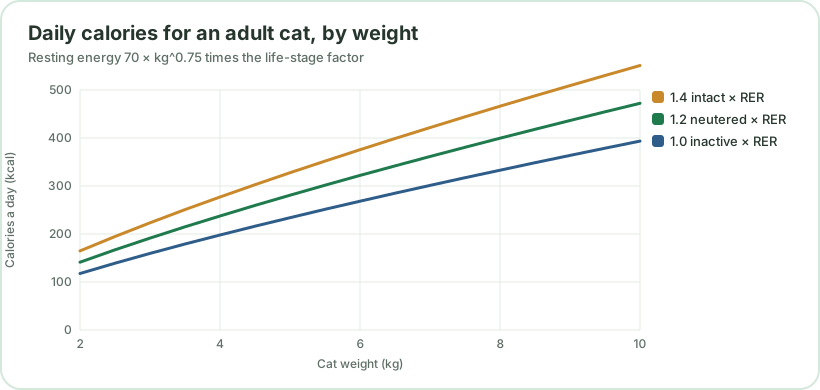
The chart
Weights are in kilograms and pounds. Calories are the daily total for a neutered adult (1.2 × RER). Grams assume a dry food of 3,800 kcal/kg, a wet food of 1,000 kcal/kg, and for the mix, half the calories from each.
| Cat weight | Calories a day | Dry food only | Wet food only | Half and half (wet + dry) | Treat limit (10%) |
|---|---|---|---|---|---|
| 2 kg (4.4 lb) | 141 | 37 g | 141 g | 71 g + 19 g | 14 kcal |
| 2.5 kg (5.5 lb) | 167 | 44 g | 167 g | 84 g + 22 g | 17 kcal |
| 3 kg (6.6 lb) | 191 | 50 g | 191 g | 96 g + 25 g | 19 kcal |
| 3.5 kg (7.7 lb) | 215 | 57 g | 215 g | 107 g + 28 g | 21 kcal |
| 4 kg (8.8 lb) | 238 | 63 g | 238 g | 119 g + 31 g | 24 kcal |
| 4.5 kg (9.9 lb) | 260 | 68 g | 260 g | 130 g + 34 g | 26 kcal |
| 5 kg (11 lb) | 281 | 74 g | 281 g | 140 g + 37 g | 28 kcal |
| 6 kg (13.2 lb) | 322 | 85 g | 322 g | 161 g + 42 g | 32 kcal |
| 7 kg (15.4 lb) | 361 | 95 g | 361 g | 181 g + 48 g | 36 kcal |
| 8 kg (17.6 lb) | 400 | 105 g | 400 g | 200 g + 53 g | 40 kcal |
The Cat Food Calculator accepts your own food energies and the share of wet food you choose, and our cat calorie chart gives other life stages.
What each column means
- Calories a day is the total for the whole day, including treats.
- Dry food only is the grams if the cat eats nothing else.
- Wet food only is the grams if the cat eats only wet food.
- Half and half splits the calories 50:50, so the grams of wet and dry add up to the whole day.
- Treat limit is the maximum for treats, which count within the day’s calories.
Because wet food is mostly water, the same calories weigh much more as wet than as dry. A 4 kg cat needs 63 g of dry food but 238 g of wet food, almost four times as much by weight. That difference alone explains many overfeeding mistakes: a cat given a “bowl of dry” can easily eat double the intended calories.
Using the chart: three situations
1. Dry food only. Find the weight, read the dry grams, weigh it out each day in two to four portions. For a 5 kg cat that is 74 g a day at 3,800 kcal/kg. If your dry food is 3,500 kcal/kg, use 281 ÷ 3.5 = 80 g.
2. Wet food only. Find the weight and read the wet grams. For a 4 kg cat that is about 238 g a day at 1,000 kcal/kg, or about 2.8 cans of 85 g. If your wet food is 800 kcal/kg, use 238 ÷ 0.8 = 298 g. The Cat Food Cans per Day Calculator handles can sizes.
3. A mix. Use the half-and-half column, or choose your own split. For a 4 kg cat on 119 g wet and 31 g dry, a quarter-wet mix would be 60 g wet and 47 g dry. The calories are shared, so the grams change with the share.
A worked example
Milo is a neutered 4 kg cat. He eats about half his calories as wet food (1,000 kcal/kg) and half as dry (3,800 kcal/kg).
- Row: 4 kg. Calories: 238 kcal.
- Wet: 119 kcal ÷ 1.0 = 119 g. Dry: 119 kcal ÷ 3.8 = 31 g.
- In three meals, each is about 40 g wet and 10 g dry.
- Treats: no more than about 24 kcal.
- Weigh Milo monthly; if he gains, cut about 10% of both.
When the chart is wrong for your cat
The chart assumes an average neutered adult. Adjust for your cat:
- Inactive or weight-gain-prone cats use 1.0 × RER, about 17% fewer calories than the chart.
- Intact cats use 1.4 × RER, about 17% more.
- Kittens use 2.5 × RER; see the kitten feeding chart.
- Overweight cats need a vet-agreed plan using the ideal weight.
- Senior and unwell cats may need different diets and amounts; ask your vet.
Checking from the cat
After two to three weeks on the chart’s amount, look at the cat:
- Feel the ribs: they should be easy to feel under a thin layer of padding.
- Look from above for a slight waist.
- Look from the side for a mild belly tuck.
- Check the monthly weight against the last one.
If the cat is gaining, reduce by about 10%; if it is losing weight without a plan, call your vet.
Common mistakes
- Using a generic chart without checking the energy of your food.
- Measuring dry food by cup.
- Ignoring treats and shared human food.
- Feeding wet and dry at full amounts together.
- Assuming a chart for kittens or seniors fits an adult.
- Never weighing the cat.
Feeding more than one cat
In a multi-cat home, the chart is a tool for each cat separately. A practical approach:
| Step | What to do |
|---|---|
| 1 | Weigh each cat and find its row |
| 2 | Write each cat’s daily grams on a card by the food |
| 3 | Feed cats in separate spots or at set times so each eats its own portion |
| 4 | If one cat needs a different food (for example a weight plan), use a feeder that opens only for that cat or feed that cat behind a closed door |
| 5 | Weigh each cat monthly and adjust separately |
A common problem is that the heavier cat eats the lighter cat’s food. A single bowl of dry food available all day makes this almost invisible until one cat has gained a lot.
What a day of feeding looks like
For a 4 kg neutered cat on 119 g of wet food and 31 g of dry food, a day might look like this:
| Time | Food |
|---|---|
| 7 am | 40 g wet food |
| 12 pm | 10 g dry food in a puzzle feeder |
| 5 pm | 40 g wet food |
| 9 pm | 39 g wet food and 21 g dry food |
The key is that the totals match the chart, and every portion is weighed ahead. Many owners set out the day’s portions in labelled containers each morning, so that anyone who feeds the cat uses the same amount.
Dry food: how it looks on the chart
Dry food is easy to overfeed because the portions look small. Here is how little a day’s dry food is for a neutered adult, with a level cup of about 100 g of kibble for reference (weigh your own).
| Cat weight | Dry food a day | Fraction of a 100 g cup |
|---|---|---|
| 3 kg | 50 g | about half |
| 4 kg | 63 g | a little over half |
| 5 kg | 74 g | about three quarters |
| 6 kg | 85 g | a little under one cup |
A scoop that looks “normal” can easily hold a full cup, which would be 50 to 100% more than a cat needs. This is the single most common source of overfeeding in indoor cats.
Using the chart when you change food
If you move from one food to another, recalculate the grams:
- Find the new food’s kcal per kg or kcal per gram.
- Divide the cat’s daily calories by it.
- Change over gradually over seven to ten days, mixing in more of the new food each day.
- Weigh the cat after a month to check the result.
For example, a 5 kg neutered cat needs 281 kcal. On a 3,800 kcal/kg dry food that is 74 g. If the new food is 4,200 kcal/kg, the amount becomes 67 g. The new bag may say a different amount, so use your own sum.
Common situations
A cat that begs. Check the calories first. If the cat is fed correctly and is at a healthy weight, begging is often habit or boredom. Try puzzle feeders, play sessions before meals and spreading food through the day.
A cat that leaves food. Check the portion size, the freshness and any recent changes. If the cat stops eating for more than a day, call your vet.
A cat that eats too fast. A slow feeder or a wide, shallow plate can help. Splitting the day’s food into more meals can too.
A cat that has been neutered recently. Energy needs often fall after neutering, so watch the weight and adjust. Ask your vet.
When to ask your vet
Call your vet if your cat is losing weight without a diet, gaining weight steadily despite the chart, drinking or urinating much more or less than usual, or eating much less for more than a day. Cats hide illness well, so a change in appetite or habits deserves attention even if the cat seems otherwise fine.
Quick summary
- The chart gives daily calories and grams for neutered adult cats by weight.
- A 4 kg cat needs about 238 kcal: 63 g dry, 238 g wet, or about 119 g wet plus 31 g dry.
- Wet food weighs about four times as much as dry food for the same calories.
- Adjust for inactive, intact or overweight cats and check body condition.
- Treats stay within 10% of daily calories.
- Use the Cat Food Calculator with your own food’s numbers.
Frequently asked questions
How much should a 4 kg cat eat a day?
About 238 kcal if neutered. That is roughly 63 g of dry food (3,800 kcal/kg) or 238 g of wet food (1,000 kcal/kg).
How much should a 5 kg cat eat a day?
About 281 kcal if neutered: 74 g of dry food or 281 g of wet food at the energy values in the chart.
How much should a 3 kg cat eat a day?
About 191 kcal if neutered: 50 g of dry food or 191 g of wet food.
Does the chart work for kittens?
No. Kittens use 2.5 times RER. Use the kitten feeding chart.
What if my food has different calories?
Divide the daily calories by your food's kcal per gram. The chart shows typical values only.
How do I feed both wet and dry?
Decide how many calories each provides, then divide each share by its kcal per gram. The chart shows a half-and-half example.
How many treats can my cat have?
About 10% of the day's calories at most, which is 19 to 32 kcal for cats of 3 to 6 kg.
Sources
- NRC (2006) Nutrient Requirements of Dogs and Cats, National Academies Press
- Merck Veterinary Manual — Nutritional Requirements of Small Animals
- WSAVA Global Nutrition Guidelines
Related calculators
- Cat Food CalculatorWork out your cat's daily calories and how to split them between wet and dry food.
- Cat Food Cans per Day CalculatorFind out how many cans of wet food your cat needs each day, week and month.
- Pet Weight ConverterConvert your pet's weight between kilograms, pounds, ounces and grams.
Keep reading
- How Much Should I Feed My Cat? Wet and DryHow much to feed a cat by weight: daily calories, grams of wet and dry food, mixed feeding, meals per day, treats and how to avoid overfeeding.
- How Much Wet Food Should a Cat Eat a Day?How much wet food a cat needs a day: grams and cans by weight, how kcal per can works, mixing wet with dry and how to avoid overfeeding with pouches and tins.
- How Many Calories Does a Cat Need a Day?How many calories a cat needs: the RER formula, factors for neutered, intact, inactive and kitten cats, a calorie table by weight and how to adjust.
- Indoor Cat Calorie NeedsHow many calories an indoor cat needs: RER × 1.0 if inactive versus 1.2 if neutered, a 3 to 6 kg table in kcal and grams, and how to adjust by weight trend.