
Treats feel small, and that is what makes them dangerous for a dog’s waistline. A single biscuit can look like nothing, yet for a small dog it can be a tenth of the day’s food. The guideline that vets use to keep treats in proportion is simple: no more than about 10% of daily calories. This guide turns the rule into numbers for dogs of different sizes, shows how many treats of different sizes that allows, and explains how to count chews, training rewards and “extras” that do not look like treats at all.
The 10% rule
WSAVA and AAHA guidance says treats and extras should provide no more than about 10% of a dog’s daily energy, so that at least 90% comes from a complete and balanced main diet. A dog fed mostly on treats can miss out on nutrients and gain weight, even when it seems to eat the “right” number of calories.
treat allowance (kcal) = 10% × daily calories
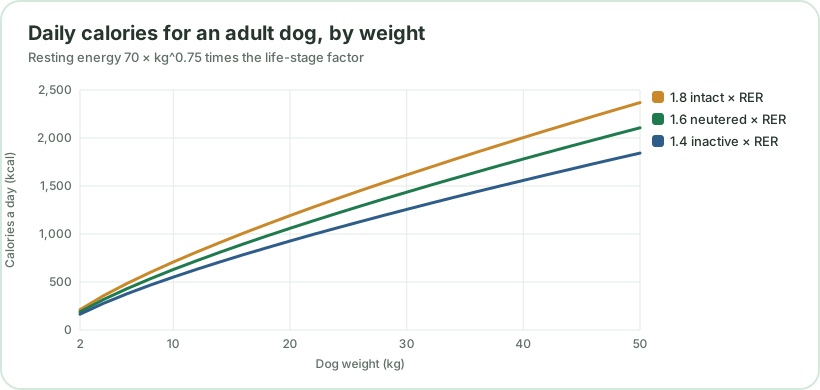
For a neutered adult, daily calories are 1.6 × 70 × weight in kg ^ 0.75. The Dog Treat Calorie Calculator does the sum and tells you how many treats of a given size fit.
Daily treat allowance by weight
| Dog weight | Daily calories (neutered) | Treat allowance (10%) |
|---|---|---|
| 2 kg (4.4 lb) | 188 | 19 kcal |
| 5 kg (11 lb) | 374 | 37 kcal |
| 10 kg (22 lb) | 630 | 63 kcal |
| 15 kg (33 lb) | 854 | 85 kcal |
| 20 kg (44 lb) | 1,059 | 106 kcal |
| 30 kg (66 lb) | 1,436 | 144 kcal |
| 40 kg (88 lb) | 1,781 | 178 kcal |
| 50 kg (110 lb) | 2,106 | 211 kcal |
How many treats is that?
The number of treats depends on how big each one is. The table shows whole treats within the allowance.
| Dog weight | 10 kcal treats | 20 kcal treats | 30 kcal treats | 50 kcal treats |
|---|---|---|---|---|
| 2 kg | 1 | 0 | 0 | 0 |
| 5 kg | 3 | 1 | 1 | 0 |
| 10 kg | 6 | 3 | 2 | 1 |
| 20 kg | 10 | 5 | 3 | 2 |
| 30 kg | 14 | 7 | 4 | 2 |
| 40 kg | 17 | 8 | 5 | 3 |
A 2 kg dog is allowed 19 kcal: a single small treat. A 40 kg dog can have 17 of the same small treats. This is why a biscuit that is a reasonable treat for a large dog is a meal for a small one.
What counts as a treat
Anything that is not the main complete meal counts, including:
- Biscuits and training treats.
- Dental chews and chew sticks.
- Rawhide and other long-lasting chews.
- Food used to hide tablets.
- Table scraps and licked-out dishes.
- Toppers and extras added to meals.
- Food used as rewards in training classes.
Our guide to dog treat calories shows how to read labels and weigh treats, and the Pet Treat Energy Converter turns kcal per 100 g and the weight of one treat into calories per treat.
A worked example
A neutered 20 kg dog eats 1,059 kcal a day.
- Treat allowance: 106 kcal.
- A dental chew is 60 kcal, which is already more than half the allowance.
- A handful of training treats, 10 small pieces of 4 kcal each, is 40 kcal.
- Total so far: 100 kcal, which is within the allowance.
- Any extra, such as a biscuit from a visitor of 30 kcal, would take the dog over the limit, so the owner reduces the dinner by about 30 kcal, about 8 g of a 3,600 kcal/kg food.
The simple rule is that treats are not extra: they are part of the day’s food, so the meals shrink when treats are given.
Adjusting meals when treats are given
Instead of tracking every calorie, many owners take the allowance out of the meals in advance:
| Dog | Daily calories | Treat allowance | Calories for meals | Grams of a 3,600 kcal/kg food in meals |
|---|---|---|---|---|
| 10 kg | 630 | 63 | 567 | 158 g |
| 20 kg | 1,059 | 106 | 953 | 265 g |
| 30 kg | 1,436 | 144 | 1,292 | 359 g |
If treats are always at or below the allowance, you can feed that smaller meal every day, and use the 10% for treats. On days when there are no treats, the dog is slightly underfed; either top up with a little kibble or accept the small difference. For the main calculation, use the Dog Food Calculator.
Dogs on a weight loss plan
On a plan, the allowance shrinks with the daily budget. For a 30 kg dog with a 25 kg goal on 783 kcal a day, 10% is about 78 kcal, which is two or three small treats a day. Some owners use pieces of the day’s kibble as treats so that the rewards are free of extra calories. See our dog weight loss plan for the full routine.
Puppies and small dogs
Puppies need many small rewards for training, and the allowance is a share of a much larger daily total at 3.0 × RER under 4 months. A 5 kg puppy under 4 months needs about 702 kcal and may have 70 kcal of treats. Small dogs are the group most at risk of treats taking over the day, since a 2 kg dog’s whole allowance is 19 kcal.
Common mistakes
- Treating the 10% rule as extra on top of the full meal.
- Forgetting chews and scraps.
- Giving large biscuits to small dogs.
- Using a treat’s weight on the pack as its calorie content.
- Counting calories on some days and not others.
- Letting several family members give treats without telling each other.
A day of treats for three dogs
Seeing a whole day’s treats added up makes the rule real. The numbers are illustrations.
| Pip (3 kg) | Rosie (15 kg) | Duke (35 kg) | |
|---|---|---|---|
| Daily calories (neutered) | 255 | 854 | 1,612 |
| Treat allowance (10%) | 26 kcal | 85 kcal | 161 kcal |
| Morning walk reward | 1 piece of kibble (1 kcal) | 3 pieces of kibble (9 kcal) | 5 pieces of kibble (15 kcal) |
| Dental chew | none (60 kcal would be 230% of her allowance) | half a chew (30 kcal) | one chew (60 kcal) |
| Training session | 6 pieces of 2 kcal (12 kcal) | 10 pieces of 3 kcal (30 kcal) | 20 pieces of 3 kcal (60 kcal) |
| Evening treat | a 10 kcal biscuit | a 15 kcal biscuit | two 15 kcal biscuits (30 kcal) |
| Total | 23 kcal | 84 kcal | 165 kcal |
| Compared with allowance | within | within | 4 kcal over |
Pip’s day shows the squeeze on a small dog: a dental chew would blow the whole allowance, so she gets a different kind of reward. Duke’s day is a few calories over, which the owner corrects by taking about one gram of kibble out of dinner. The point is not perfection but a habit of counting.
Treats that do not look like treats
Several things that dogs eat do not feel like treats but count as one:
- Food in puzzle toys. If it is not part of the measured meal, it is extra.
- Peanut butter or paste used to hide a tablet. Count it.
- A lick of yoghurt or a bit of cheese. Count it, and ask your vet which foods are suitable.
- Food from other pets’ bowls. Feed dogs apart if one is on a plan.
- Toppers and gravies added to dry food.
- Rewards from neighbours, groomers and shops. Ask them to use a treat from your jar.
One way to cope is a “treat jar” that is filled each morning with the day’s allowance. When the jar is empty, treats are over.
Treats and health conditions
Some dogs need extra care with treats. A dog with food allergies or sensitivities, a dog with a medical diet or a dog on a weight plan may have strict limits on what is acceptable. Ask your vet for a list of suitable treats and the maximum amount. Prescription diets in particular are not balanced if the dog gets a lot of other food, so the treat allowance may be lower than the usual 10%.
Treat counts by dog size
The 10% rule gives a daily treat allowance in calories. Convert it to pieces using the treat’s kcal.
| Dog | Daily need | 10% allowance | Pieces at 3 kcal | Pieces at 30 kcal |
|---|---|---|---|---|
| 5 kg | 365 | 36 | 12 | 1 |
| 10 kg | 593 | 59 | 19 | 2 |
| 20 kg | 1,059 | 106 | 35 | 3 |
| 30 kg | 1,436 | 144 | 48 | 4 |
A small dog has very little room for large treats, which is why tiny pieces matter. Check the daily need for your own dog with the Dog Calorie Calculator and the allowance with the Dog Treat Calorie Calculator. For training specifically, read training treats without weight gain.
Counting treats across a household
When several people feed one dog, treats add up unseen. A visitor gives a biscuit, a child shares a snack, and the daily allowance is gone before the walk. Put the day’s treats in a labelled jar each morning, and tell everyone that only the jar is allowed. When it is empty, treats are finished for the day. This also makes the numbers visible: you can see in the evening how many were used, and adjust dinner to match.
Quick summary
- Treats should stay within about 10% of daily calories.
- Allowances: 63 kcal for a 10 kg dog, 106 kcal for 20 kg, 144 kcal for 30 kg (neutered adults).
- A 20 kg dog can have three 30 kcal biscuits or ten 10 kcal treats.
- Chews, scraps and training rewards all count.
- Reduce meals by the calories you give as treats.
- Use the Dog Treat Calorie Calculator for your dog.
Frequently asked questions
How many treats can a dog have a day?
Up to about 10% of its daily calories. That is about 63 kcal for a 10 kg neutered dog, 106 kcal for 20 kg and 144 kcal for 30 kg.
Where does the 10% rule come from?
WSAVA and AAHA guidance that treats and extras should not exceed about 10% of daily calories so the main diet stays balanced.
Do dental chews count?
Yes. Chews, dental sticks and anything else that is not part of the main meals count toward the 10%.
Do training treats count?
Yes. Use small pieces and subtract their calories from the meals on training days.
How do I know how many calories are in a treat?
Check the label for kcal per treat or per 100 g and weigh a treat to calculate. The treat energy converter helps.
Should I reduce meals when I give treats?
Yes, by the same number of calories, or keep treats within the 10% allowance and reduce meals slightly.
Can a dog on a weight loss plan have treats?
Yes, but the allowance is 10% of a smaller total, so only a few small treats.
Sources
- WSAVA Global Nutrition Guidelines: treats and extras at most about 10% of daily calories
- AAHA (2014) Weight Management Guidelines for Dogs and Cats
- NRC (2006) Nutrient Requirements of Dogs and Cats, National Academies Press
Related calculators
- Dog Treat Calorie CalculatorCheck how many treats your dog can have a day without unbalancing its diet — the 10% rule.
- Pet Treat Energy ConverterTurn kcal per 100 g and the weight of one treat into the calories in each treat.
- Dog Food CalculatorTurn your dog's daily calorie need into grams and cups of the food you actually feed, using the energy value printed on the bag.
- Dog Calorie CalculatorSee how many calories your dog needs a day: its resting energy requirement (RER) and daily maintenance energy (MER) for its life stage.
Keep reading
- Dog Treat Calories: Reading Labels and CountingHow to find the calories in dog treats: kcal per treat or per 100 g, weighing a treat, worked label examples, a counting log and how treats fit into the daily total.
- Training Treats Without Weight GainHow to use treats in dog training without weight gain: count them within the 10% allowance, use part of the daily food and adjust meals on training days.
- How Many Calories Does a Dog Need? RER, MERLearn how to calculate a dog's daily calories with RER and MER, see every life stage factor, a calorie table by weight and how to adjust the result.
- Low-Calorie Dog Treats and Rewards: How to ChooseHow to choose low-calorie dog treats and rewards: reading kcal per treat, cutting pieces small, using the daily kibble, non-food rewards and a budget by size.