
Treats are how we say “good dog”, and they are one of the quickest ways to add unnoticed calories. A single biscuit that looks small to us can be a tenth of a small dog’s day. The challenge is to keep the rewards that motivate your dog while keeping total calories under control. This guide explains what “low calorie” really means, how to find calories in a treat, ways to shrink and swap, how to use the day’s meal for rewards, non-food alternatives and a treat budget by dog size. For the rules on how many, see how many treats a dog can have; for counting, see dog treat calories.
What “low calorie” means
A treat is low in calories if it has few kcal per piece and fits the allowance for the number of pieces you give. Labels like “light”, “lite” or “healthy” are not a guarantee. Compare:
| Treat | Weight | kcal per 100 g | kcal per piece |
|---|---|---|---|
| Small training treat | 1 g | 300 | 3 |
| Soft treat, cut in four | 1.25 g | 360 | 4.5 |
| Standard biscuit | 10 g | 380 | 38 |
| Large dental chew | 40 g | 300 | 120 |
| Kibble piece | 0.4 g | 380 | 1.5 |
(Illustrative values; read your own labels.) The calculation is: kcal per piece = kcal per 100 g × weight in grams ÷ 100. A large chew can have more calories than a small dog’s allowance for the whole day. The Dog Treat Calorie Calculator and the Pet Treat Energy Converter do the sums, including conversion between kcal per 100 g and per kg.
The treat budget by dog size
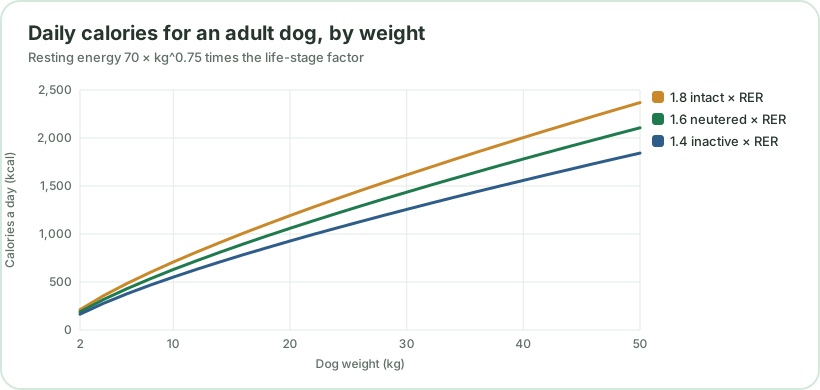
Treats should stay within 10% of daily calories. For neutered adults at 1.6 times resting energy:
| Dog weight | Daily calories | Treat allowance (10%) | Pieces at 3 kcal | Pieces at 38 kcal |
|---|---|---|---|---|
| 5 kg | 374 | 37 | 12 | 1 |
| 10 kg | 630 | 63 | 21 | 1 |
| 20 kg | 1,059 | 106 | 35 | 2 |
| 30 kg | 1,436 | 144 | 48 | 3 |
| 40 kg | 1,781 | 178 | 59 | 4 |
A 5 kg dog gets one standard biscuit and little else; 12 small training pieces would use the same budget. Choosing small pieces multiplies the number of rewards you can give.
Strategy 1: make treats smaller
Cut soft treats into pea-size or smaller. Most dogs care about getting a reward, not how big it is. A 4 kcal piece instead of a 38 kcal biscuit gives you nine rewards for the same cost. For hard biscuits, break them with your hands or use a small cutter. Keep small pieces in a pouch for training.
Strategy 2: use the day’s kibble
The simplest low-calorie reward is the dog’s own food. Measure the day’s meals, set aside part of the kibble in a pouch for training and give the rest at mealtime. Whatever is left in the pouch at night goes in the bowl. Rewards then cost nothing extra. For dogs that value kibble less, mix a few higher-value treats with it. See training treats without weight gain for a worked session.
Strategy 3: swap in non-food rewards
Many dogs work for things other than food.
| Reward | Notes |
|---|---|
| Praise and petting | Works for people-focused dogs |
| A game of tug or fetch | Good for play-motivated dogs |
| A sniff break | Many dogs love it |
| Going through a door or to the park | Real-life rewards |
| A favourite toy | Short bursts |
| A short chase or run | Within the dog’s fitness |
Mix them in so that food is one of several. A trainer can help you find what your dog values most.
Strategy 4: choose treats with the label in mind
When you shop, read for:
- kcal per 100 g or per treat. If it is missing, ask the maker.
- Size of the treat. Smaller is more flexible.
- Ingredients you know your dog tolerates.
- A statement of use, such as complementary food or treat.
- Texture. Soft treats are easy to cut; hard ones are not.
Avoid giving anything your vet has told you to avoid. If your dog has allergies or a health condition, ask your vet which treats are suitable.
Strategy 5: count everything
Dental chews, rawhide, chews, bully sticks, bits of cheese, peanut butter in a toy, scraps and the remains of your toast all count. Track them for a week. Many owners find that a day with “no treats” still includes a surprising number of calories. A notepad on the fridge or a note on your phone works. The total over the week is what matters, not any single day.
On a weight-loss plan
For a dog losing weight, the calorie target comes from the plan (1.0 times resting energy for the goal weight in our calculator), and treats must come out of it. For a 16 kg goal weight, that is 560 kcal, so a 10% allowance is 56 kcal. A single biscuit of 38 kcal would use two-thirds of the allowance. In this case, plan treats around tiny pieces and the dog’s own kibble. See our dog weight loss plan and the troubleshooting guide if the weight does not move: dog not losing weight.
Fruit and vegetable treats
Some owners use small pieces of vegetables as low-calorie rewards. Dogs differ in what they tolerate, and some foods are unsuitable for dogs, so ask your vet for a list that suits your dog before trying any, and count the calories. Introduce a new food in a tiny amount, and watch for stomach upsets. Do not use human foods as a substitute for a balanced diet.
A weekly treat plan example
| Day | Training session | Treat plan |
|---|---|---|
| Monday | 10 minutes, 25 pieces | 25 kibble pieces from the day’s meal |
| Tuesday | Walk rewards | 10 small soft pieces (4 kcal each) |
| Wednesday | Rest day | Praise and play |
| Thursday | 10 minutes | Kibble from the pouch |
| Friday | Visit to the vet | 5 higher-value pieces (5 kcal each) |
| Saturday | Long walk | Sniff break and 10 kibble pieces |
| Sunday | Free | One dental chew, replace 120 kcal from dinner |
The chew on Sunday is balanced by reducing dinner, so the weekly total remains on target. The plan is a template; the principle is to decide the rewards in advance.
Common mistakes
- Trusting words like “light”.
- Giving a whole biscuit as a reward.
- Forgetting chews and scraps.
- Not subtracting treats from meals.
- Using high-calorie treats for every cue.
- Giving the same size treat to a 5 kg dog and a 30 kg dog.
- Ignoring non-food rewards.
Questions to ask your vet
- How many treats can my dog have each day?
- Which treats are safe for my dog?
- Should I change anything on a weight-loss plan?
- Are dental chews worth it?
- What vegetables can I use?
Building a treat pouch for a walk
Before a walk or a training session, pack a pouch so that rewards are ready, counted and small. A simple recipe: measure the dog’s kibble for the day, set aside a tenth of the calories for the pouch, and add a handful of higher-value pieces for the hardest tasks. For a 20 kg dog with 106 kcal of treats, the pouch could hold 20 kibble pieces of 1.5 kcal (30 kcal) and 15 soft pieces of 4 kcal (60 kcal), with 16 kcal spare. Count how many you used on return, and subtract the calories from dinner. Over a week the habit makes the allowance second nature.
Rewards for different jobs
Not every task needs the same reward. Use the cheapest reward that works.
| Job | Suggested reward | Why |
|---|---|---|
| Easy cues at home (sit, down) | Kibble or praise | Low effort, high repetition |
| Recall in a quiet place | Small soft treat | Moderate value |
| Recall near distractions | Best treat plus a game | High value |
| Calm greeting visitors | Kibble scattered on a mat | Slows the dog down |
| Vet or groomer visits | Small high-value pieces | Builds positive associations |
| Long-term behaviour like loose-lead walking | Mix of food, sniff breaks and praise | Varied rewards keep interest |
A trainer can help you grade rewards by value and tell you when to fade food.
Fading treats gradually
As behaviours become reliable, you can reward less often. Move from every success to every second or third, then to random rewards, and add life rewards such as a sniff or a throw of the ball. The dog continues to work because it never knows which time will pay off. Fading treats lowers calories automatically, and it makes the dog less dependent on food. Do not fade too fast, or the behaviour may slip; step back if it does.
Treat testing for fussy dogs
If your dog turns up its nose at low-calorie options, test a few with the same trainer’s approach: offer a line of five different pieces, see which are eaten fastest, and use the best for hard tasks. Dogs often value texture and smell more than size. A pea-sized piece of a soft treat may work as well as a big one. Count the calories of the winners, and rotate them so that they stay exciting.
A note on dental chews and long-lasting chews
Chews occupy a dog for a long time, and many owners use them as a calming tool. The calories can be large, so check the label and the weight. A chew of 120 kcal for a 10 kg dog with a 63 kcal treat allowance is almost double the allowance. If you use chews, plan them: count the calories, subtract them from meals and give them on days with fewer other treats. Ask your vet whether a given chew is suitable for your dog, because hard chews can injure teeth and some can cause blockages. Supervise chewing, and take away small remains.
Teaching children to treat sensibly
Children love giving treats. Give them a small jar of the dog’s own kibble and teach them to hand out one piece at a time for a sit or a down. Explain that the dog’s tummy is small and that too many treats are not kind. Supervise young children, and make sure they wash their hands after. A visual aid, such as a chart with 20 stickers for the day, makes the limit concrete.
Quick summary
- Low calorie means few kcal per piece, not a label word.
- kcal per treat = kcal per 100 g × grams ÷ 100.
- A 20 kg neutered dog has about 106 kcal of treats a day: 35 small pieces or 3 biscuits.
- Cut treats small, use the day’s kibble and mix in non-food rewards.
- Count chews and scraps; subtract treats from meals.
- Use the Dog Treat Calorie Calculator.
Frequently asked questions
What makes a treat low calorie?
Few kcal per piece. A label may say 'light', but check kcal per 100 g and weigh a piece to find kcal per treat.
How do I work out calories per treat?
kcal per 100 g × weight of one treat in grams ÷ 100. A treat of 5 g at 360 kcal per 100 g has 18 kcal.
How many treats can my dog have?
Treats stay within about 10% of daily calories. A neutered 20 kg dog needs 1,059 kcal, so about 106 kcal of treats.
Can I use kibble as treats?
Yes. Measure part of the day's meal for training and count it as meal calories, not extra.
Are vegetables good low-calorie treats?
Some may be, but safety varies by food and dog. Ask your vet which are suitable and count their calories.
What non-food rewards work?
Praise, play, tug, a short game, access to something the dog wants or a sniffing break.
How should I change treats on a weight-loss plan?
Keep the plan's calorie target and fit treats inside it, using small pieces. Your vet may adjust the allowance.
Sources
- WSAVA Global Nutrition Guidelines: treats at most about 10% of daily calories
- AAHA (2014) Weight Management Guidelines for Dogs and Cats
- NRC (2006) Nutrient Requirements of Dogs and Cats, National Academies Press
Related calculators
- Dog Treat Calorie CalculatorCheck how many treats your dog can have a day without unbalancing its diet — the 10% rule.
- Pet Treat Energy ConverterTurn kcal per 100 g and the weight of one treat into the calories in each treat.
- Dog Calorie CalculatorSee how many calories your dog needs a day: its resting energy requirement (RER) and daily maintenance energy (MER) for its life stage.
Keep reading
- How Many Treats Can a Dog Have a Day?How many treats a dog can have a day: the 10% rule, a chart of treat counts by weight and treat size, counting chews and training rewards and what to cut at meals.
- Dog Treat Calories: Reading Labels and CountingHow to find the calories in dog treats: kcal per treat or per 100 g, weighing a treat, worked label examples, a counting log and how treats fit into the daily total.
- Training Treats Without Weight GainHow to use treats in dog training without weight gain: count them within the 10% allowance, use part of the daily food and adjust meals on training days.
- Weight Gain After Neutering: Adjust the FoodWhy dogs and cats gain weight after neutering and how to prevent it: the lower energy factors, calorie examples, a weigh-in plan and questions for your vet.