
“One dog year is seven human years” is probably the most repeated fact about pets, and it is wrong. It is not completely absurd, which is why it survives, but it fails at both ends of life and ignores the single biggest influence on how a dog ages: its size. This guide takes the rule apart, shows where it works and where it breaks, compares it with the two better methods and gives you something more useful to do with your dog’s age than multiply by seven. For a chart by size, see our dog years to human years chart.
What the rule says
The rule says that a dog of age n is 7 × n in human years. A 1-year-old is 7, a 5-year-old is 35, a 10-year-old is 70 and a 15-year-old is 105. It is a straight line: every year counts the same.
Where it goes wrong
Dogs do not age in a straight line. In the first year or two they go from newborn to adult, and in later years they age more slowly. The rule underestimates the young and, for large dogs, overestimates or underestimates the old depending on size.
| Dog’s age | Seven-to-one rule | Size chart (small / medium / large / giant) | Epigenetic formula |
|---|---|---|---|
| 1 year | 7 | 15 / 15 / 15 / 15 | 31 |
| 2 years | 14 | 24 / 24 / 24 / 24 | 42 |
| 5 years | 35 | 36 / 39 / 42 / 45 | 57 |
| 7 years | 49 | 44 / 49 / 54 / 59 | 62 |
| 10 years | 70 | 56 / 64 / 72 / 80 | 68 |
| 12 years | 84 | 64 / 74 / 84 / 94 | 71 |
| 15 years | 105 | 76 / 89 / 102 / 115 | 74 |
| 20 years | 140 | 96 / 114 / 132 / 150 | 79 |
At one year the rule gives 7 when a one-year-old dog is a young adult, sexually mature and close to full size. For a medium dog at 7 years the rule happens to agree with the chart (49), and at 10 years it is within 6. For a giant breed at 10 years it falls well short (70 against 80), and for a small dog at 15 it is far too high (105 against 76). So the rule works in a narrow band and nowhere else.
The two better methods
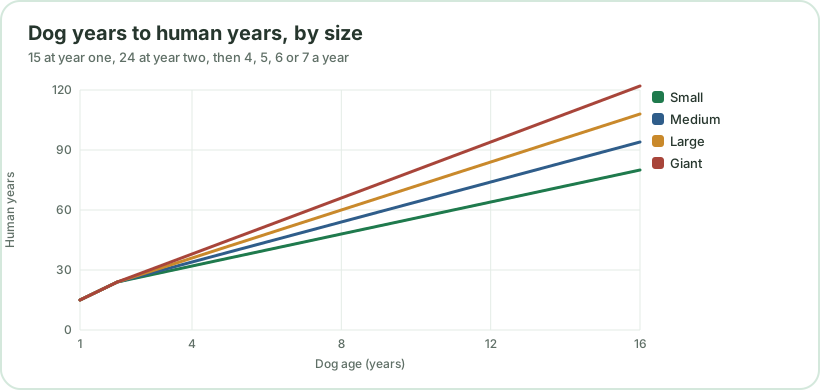
The size chart. It gives 15 human years for the first dog year and 9 for the second, then adds a fixed number of years for each later dog year: 4 for small dogs, 5 for medium, 6 for large and 7 for giant dogs. It reflects the fact that large dogs tend to have shorter lives. It is a rule of thumb, and published versions differ by a few years.
The epigenetic formula. From a 2020 study (Wang et al., Cell Systems) that compared DNA methylation in dogs and people: human age = 16 × ln(dog age) + 31. It was built from 104 Labrador retrievers, so it may fit other breeds less well, and it gives one answer for every size.
Our Dog Age Calculator shows both, and our guide on how old your dog is in human years walks through the steps.
Why the rule felt right
A medium dog of 8 to 10 years is a decent match for the rule: the size chart gives 54 to 64 and the rule gives 56 to 70. Many owners compare their own middle-aged dog and conclude that the rule works. It also has the advantage of being easy to say. The trouble starts when you look at young dogs, giant dogs or very old small dogs.
What the first two years really mean
A puppy goes from birth to near-adult size in the first year, and dogs are usually sexually mature well before their second birthday. That is why the chart gives 15 for the first year and a further 9 for the second, more than twice the rule’s 7 for year one. Our guide to feeding a puppy shows how fast energy needs change in that window.
Why size matters so much
Large and giant breeds tend to have shorter lives than small breeds. A study of dog longevity (McMillan et al., 2024) analysed breed lifespans and found that breed matters for how long dogs live. The size chart builds that pattern in by adding more years per dog year for larger dogs. The reasons for the pattern are still being researched, and individual dogs vary a great deal within every breed. The practical point is that a Great Dane and a Chihuahua of 8 years old are not at the same stage of life.
A worked comparison
A 10-year-old Labrador-sized dog of 30 kg (a large dog):
- Seven-to-one rule: 70.
- Size chart: 24 + 6 × 8 = 72.
- Epigenetic formula: 16 × ln 10 + 31 ≈ 68.
The three agree within a few years for this dog. Now a 10-year-old small terrier of 7 kg:
- Rule: 70.
- Size chart: 24 + 4 × 8 = 56.
- Formula: about 68.
The rule is too high by 14, which matters if you use the number to decide when to start senior check-ups.
What to do with your dog’s age
Rather than debating which number is right, use age to plan:
- Check-ups. AAHA’s life stage guidelines describe the senior stage as roughly the last quarter of a dog’s expected lifespan. A dog expected to live 12 years is a senior from about 9.
- Diet and weight. Needs change with age; see our guide to dog calories.
- Exercise and comfort. Joint comfort and mobility matter more with age.
- Talking to your vet. The Dog Life Stage Calculator places your dog in a stage from its age and expected lifespan.
Common mistakes
- Multiplying by seven for every dog.
- Ignoring size.
- Treating the human-year number as exact.
- Using a puppy’s age in human years to decide how much to feed.
- Assuming an older dog is “too old” for care or training.
- Never asking the vet what stage your dog is in.
Questions to ask your vet
- Which life stage is my dog in?
- When should we begin senior check-ups?
- Is there anything about my dog’s breed or size that changes the timeline?
- How should diet and exercise change with age?
- Which signs of ageing should I watch for?
Where the idea may have come from
Nobody can say for sure who first said it, but the logic is easy to see. Many dogs live around 10 to 15 years, and people live around 70 to 80, so dividing one by the other gives a number near seven. That calculation treats the whole of life as one steady slope, which is the flaw. It tells you nothing about the pace at different ages, and it ignores size. The rule survives because it is easy to remember and gives plausible answers for the middle of life, which is the age most owners are asking about.
Why dogs age unevenly
Three factors make dog ageing uneven:
- Fast early development. Within months a puppy is learning, running and approaching adult size. Within two years it is sexually mature.
- Size differences. Large breeds tend to age faster and live shorter lives, and giants faster still.
- Individual variation. Genes, health, diet and care affect the pace.
The result is that no straight line can describe all dogs. The chart and the formula are both attempts to bend the line.
What you can say instead
If you want to describe your dog’s age to a friend, here are alternatives that are more accurate than “seven”:
| Instead of | Try |
|---|---|
| “My 1-year-old is 7” | “My 1-year-old is young adult, like a teenager” |
| “My 10-year-old is 70” | “My 10-year-old is a senior, somewhere between 56 and 80 in human terms depending on size” |
| “My 15-year-old is 105” | “My 15-year-old is very old for her size” |
| “He is 49” | “He is mid-life by the size chart” |
The goal is to use the number as a picture of the life stage rather than as a conversion. For the full tables, see our dog years to human years chart.
What the evidence says about breeds
Studies of dog longevity show that breed and size influence lifespan, and that some breeds have notable risks of earlier death. This is why a single number for all dogs will not do. If you are curious about your own breed, ask your vet, who knows the conditions that are more common in it and can suggest what to watch for as your dog ages.
Why seven stuck
The 7:1 rule is easy to remember and roughly matches a lifespan of about 70 years in people against about 10 in dogs. But dogs mature quickly in their first two years and then age at rates that depend on size, so a single multiplier cannot be right. A 1-year-old dog is not 7: it is closer to a teenager, which is why the chart gives about 15. For a more careful approach, the Dog Age Calculator offers a simple chart and a size-based one. See how old is my dog in human years for the table.
A better way to talk about dog age
Instead of one multiplier, talk in life stages: puppy, young adult, mature adult, senior and geriatric. AAHA’s life stage guidelines describe them, and the start of each depends on the dog’s size. Large breeds reach each stage earlier than small ones. If you want a number, use a chart that counts the first two years differently, and say clearly that it is approximate.
Three things to remember
First, a dog’s first year is packed with development: by twelve months most dogs are sexually mature and close to adult size, so a 1-year-old is nearer a teenager than a seven-year-old child. Second, ageing speeds differ by size, with giant breeds ageing faster in later life than small dogs. Third, no chart replaces your vet’s judgement about your dog’s health. Use the number to understand life stage, plan check-ups and talk about your dog, and leave medical decisions to a professional.
Quick summary
- The seven-to-one rule is a myth: it is wrong at one year (about 15 or 31, not 7) and for large and small dogs in later life.
- The size chart gives 15 for year one, 24 for year two, then adds 4, 5, 6 or 7 years per dog year by size.
- The epigenetic formula, 16 × ln(age) + 31, gives about 68 at 10 years for any dog.
- For a 10-year-old dog the answers range from 56 to 80 on the chart, depending on size.
- Use age to plan check-ups, diet and comfort, with your vet.
- Use the Dog Age Calculator to see both methods.
Frequently asked questions
Is one dog year seven human years?
No. It is a rough rule that is wrong at most ages. Dogs mature far faster in the first two years and then age at a rate that depends on size.
Why does the seven-year rule persist?
It is simple and easy to remember, and it gives an answer that feels plausible for a middle-aged dog.
How old is a 1-year-old dog in human years?
About 15 on the size chart and about 31 on the epigenetic formula. The rule gives 7.
How old is a 2-year-old dog in human years?
About 24 on the size chart and about 42 on the epigenetic formula. The rule gives 14.
Is the rule right for any age?
It comes close for a medium dog at around 10 years (70 against 64 on the size chart), which is part of why it feels right.
What should I use instead?
The size chart, which adds more years per dog year for larger dogs, or the epigenetic formula, 16 × ln(age) + 31. Both are estimates.
Does this change how I care for my dog?
Life stage matters more than the number. Use age to plan check-ups, diet and exercise with your vet.
Sources
- Wang T. et al. (2020) Quantitative translation of dog-to-human aging by conserved remodeling of the DNA methylome. Cell Systems
- AAHA (2019) Canine Life Stage Guidelines. Journal of the American Animal Hospital Association 55:267-290
- McMillan K.M. et al. (2024) Longevity of companion dog breeds: those at risk from early death. Scientific Reports
Related calculators
- Dog Age CalculatorConvert your dog's age into human years, taking size into account.
- Dog Life Stage CalculatorFind out which AAHA life stage your dog is in and when it becomes a senior, from its age and estimated lifespan.
- Dog Age from Birth Date CalculatorEnter your dog's birth date and size to see its exact age and its age in human years.
Keep reading
- Dog Years to Human Years: Chart by SizeSee how old your dog is in human years with a size-based chart, the newer epigenetic formula, the dog life stages and why 7 to 1 is wrong.
- Cat Years to Human Years: Age ChartA clear cat age chart from kitten to 20 years, how the AAFP/AAHA scale works, the cat life stages and how long cats usually live.
- Dog Age From Birth Date: Exact Years and MonthsHow to work out a dog's exact age from its birth date in years, months, weeks and days, then convert it to human years with a size chart and the epigenetic formula.
- Why Do Big Dogs Age Faster Than Small Dogs?Why large dogs tend to have shorter lives than small ones: what research shows, how dog-year charts add more years for big breeds and what it means for care.