
New puppy owners worry about water as much as food. Is the puppy drinking enough? Too much? Should the bowl come up at night? The honest answer to “how much” is that no single number fits every puppy, but you can use a reference, measure what your puppy actually drinks and know which signs mean a call to the vet. This guide explains the adult reference figure and what it means for puppies, how to measure intake, what changes it, how it connects to house-training and when to worry. It is general information; your vet can tell you what is right for your puppy.
The adult reference
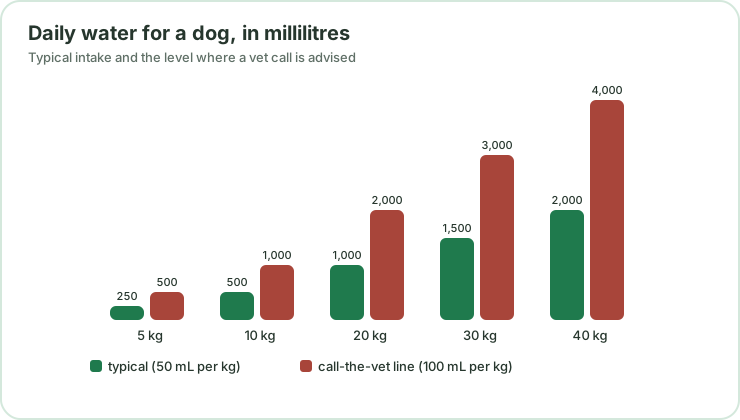
The Merck Veterinary Manual gives maintenance water for dogs of about 50 mL per kg of body weight per day, with a range of 40 to 60, and describes more than 100 mL per kg per day as excessive drinking (polydipsia). Our Dog Water Intake Calculator uses these figures. Puppies are not small adults: they are growing, have higher energy needs and may drink differently. So treat the reference as a yardstick for comparison rather than a target. See how much water a dog should drink for adults.
| Puppy weight | 40 mL/kg | 50 mL/kg | 60 mL/kg | 100 mL/kg (call-the-vet level) |
|---|---|---|---|---|
| 2 kg | 80 mL | 100 mL | 120 mL | 200 mL |
| 3 kg | 120 mL | 150 mL | 180 mL | 300 mL |
| 5 kg | 200 mL | 250 mL | 300 mL | 500 mL |
| 8 kg | 320 mL | 400 mL | 480 mL | 800 mL |
| 12 kg | 480 mL | 600 mL | 720 mL | 1,200 mL |
The numbers are adult-reference arithmetic applied to puppy weights. A puppy may drink more or less than the middle column and be perfectly healthy; a figure well above the right-hand column is the one that needs attention.
Fresh water all day
The general advice from vets is that puppies should have fresh, clean water available throughout the day, and be encouraged to drink after play, after meals and after sleep. Use a stable bowl that the puppy cannot tip, wash it daily and refill often. Offer water in more than one place if you have a large home. Do not restrict water to try to reduce accidents; instead, use a regular toilet routine. Our guide to how many times a day a puppy should eat lines meals up with toilet trips, and the same goes for drinks.
What changes intake
| Factor | Effect on drinking from the bowl |
|---|---|
| Wet food | Lower (the food contains water) |
| Dry food | Higher |
| Hot weather | Higher |
| Exercise and play | Higher |
| Teething | Variable; chewing the bowl is common |
| Salty treats | Higher |
| Illness | Can increase or decrease |
| Medicines | Some change thirst; ask your vet |
A puppy on wet food at 3.0 times resting energy gets a good share of its water with meals; the same puppy on dry food drinks more. When you measure, record the food type, weather and activity.
How to measure intake
- Use a measuring jug and fill the bowl with a known amount in the morning.
- At the end of the day, measure what is left and add any refills.
- Note spills and any other sources, such as a garden bowl or a fountain.
- Record the number for each of three days.
- Divide by the puppy’s weight in kg to get mL per kg.
For example, a 5 kg puppy drinks 320 mL on day one, 280 on day two and 300 on day three: average 300 mL, which is 60 mL per kg, within the upper part of the adult reference range. That is nothing to worry about on its own. A puppy drinking 600 mL a day at 5 kg would be at 120 mL per kg, above the 100 mL per kg line, and worth a call.
Water and house-training
Puppies who drink more need to go out more, and puppies have little bladder control. This is why house-training plans focus on routine: out after waking, after meals, after play, after drinking and before bed. If a house-trained puppy suddenly has more accidents and seems to be drinking much more, tell your vet; it may be a sign of a health problem. Do not scold. Ask your vet or trainer about a night-time plan, since it depends on age.
Signs of too little water
Young puppies can become dehydrated quickly, especially if they are unwell, have vomiting or diarrhoea or are in hot weather. Warning signs include lethargy, dry or sticky gums, sunken eyes, loss of appetite and not wanting to play. If you see any of these, or if your puppy is drinking very little and seems unwell, call your vet promptly.
Signs of too much water
A puppy that suddenly drinks far more than usual, constantly goes to the bowl or has frequent accidents needs a check. Causes can range from the harmless (salty food, hot weather) to the treatable but important. Our guide to why a dog may be drinking so much water explains the measurement and the vet’s approach.
Water on the move
Carry water and a small bowl on walks and in the car. Offer small drinks during and after exercise, and in warm weather. Do not let a puppy gulp huge amounts quickly after hard play; offer small amounts and rest. Avoid drinking from puddles or ponds, where hazards can lurk; ask your vet about the risks in your area.
Keeping the bowl clean
Wash the bowl every day with hot soapy water, and rinse well. Biofilm builds up on bowls, and puppies chew. Stainless steel and ceramic are easy to clean; plastic can hold odours and be chewed. Replace bowls that are scratched or cracked. A fountain needs regular cleaning and filter changes if you use one.
Common mistakes
- Restricting water to reduce accidents.
- Not measuring when worried.
- Forgetting wet food’s water.
- Leaving a dirty bowl.
- Ignoring a sudden change.
- Applying the adult figure as a strict target.
- Waiting too long to call the vet about a puppy that is off its water.
Questions to ask your vet
- How much should my puppy drink?
- Should I limit water at night?
- When should I worry about too much or too little?
- Is the water in our area safe for puppies?
- What should I do on hot days?
A three-day measuring sheet
Copy this sheet and fill it in for three consecutive days. Use a measuring jug, and keep the conditions as normal as you can.
| Day 1 | Day 2 | Day 3 | |
|---|---|---|---|
| Date | |||
| Weather and activity | |||
| Food type (dry, wet, mixed) | |||
| Water in the bowl at the start (mL) | |||
| Water added during the day (mL) | |||
| Water left at the end (mL) | |||
| Total drunk (mL) | |||
| Puppy weight (kg) | |||
| mL per kg |
Add the three mL-per-kg figures and divide by three. Compare the average with the reference range of 40 to 60 and the 100 mL per kg line. If it is much higher or lower, or if the puppy seems unwell, take the sheet to your vet.
Puppies, teething and chewing the bowl
Teething puppies chew everything, including bowls, and water splashed everywhere is not the same as water drunk. A heavy ceramic or stainless-steel bowl is harder to tip, and a clip-on bowl in a crate keeps water from spilling. If your puppy plays in the water, measure by filling a separate small bowl that is topped up at set times. Note how much goes down after each fill, not just at the end of the day.
Travel and warm weather
On car journeys and in warm weather, offer water often and in small amounts. A puppy that pants heavily, drools or seems weak in the heat needs to be cooled and checked by a vet. Never leave a puppy in a parked car. Carry a bottle and a small bowl on walks, and avoid hard exercise in the hottest part of the day. If your puppy is travel sick, ask your vet about water and meal timing before the trip.
Hydration and house-training schedules
A schedule for the day links water, meals and toilet trips. Younger puppies need toileting very often, commonly after waking, after meals, after play and after drinking. A sample day for a puppy of about ten weeks: wake and toilet; breakfast and water; toilet; play; nap; toilet; and so on. Offer water at set times if your trainer advises, but do not withhold it, and make sure it is always available during the day. At night, ask your vet or trainer what is best for your puppy’s age; many puppies need a late toilet trip and one in the night.
Water quality and safety
Fresh tap water is suitable in most places, but check local advice. Clean, wash and refill bowls daily. Do not allow puppies to drink from stagnant puddles, ponds or sea water, which can carry parasites, bacteria or salt. Take water on walks. If your puppy shows vomiting or diarrhoea after drinking from an outdoor source, call your vet.
When to involve your vet about drinking
Tell your vet if your puppy drinks much more than the reference range, if it is not drinking, or if you see other signs such as vomiting, diarrhoea, lethargy or loss of appetite. Take your three-day measuring sheet. Young puppies can deteriorate quickly, and early advice makes a difference. Our guide on why a dog may drink so much water explains how a vet approaches the problem.
Checklist for a hydrated puppy
- Fresh water always available, in a stable bowl.
- Bowl washed daily.
- Water offered after play, meals and naps.
- Water carried on trips.
- Intake measured if you are worried.
- Toilet trips scheduled around drinks.
- Vet called for very high or very low drinking, or any sign of illness.
Questions to ask your vet
- How much should my puppy drink for its size and age?
- Should I limit water at night?
- What counts as too much or too little?
- Does my puppy’s food change how much it drinks?
- What do I do on hot days?
Quick summary
- Offer fresh water all day, and do not restrict it unless your vet says so.
- The adult reference is about 50 mL per kg a day (40 to 60); above 100 mL per kg is a call-the-vet level.
- Wet food, dry food, heat and exercise change intake; measure for three days.
- Plan toilet trips around drinks, meals and play.
- Call the vet for a puppy that drinks very little and seems unwell, or drinks far more than usual.
- Use the Dog Water Intake Calculator.
Frequently asked questions
How much water should a puppy drink a day?
There is no single figure. The adult reference is about 50 mL per kg a day (40 to 60). Puppies have their own needs, so measure and ask your vet.
Should I limit a puppy's water?
Do not restrict water unless your vet advises it. Offer fresh water through the day, and take the puppy out regularly for toilet breaks.
When is a puppy drinking too much?
Above about 100 mL per kg a day, or a sudden or lasting increase, is a reason to call your vet.
Does wet food count?
Wet food contains a lot of water, so a puppy on wet food drinks less from the bowl. Fresh water should still be available.
How do I measure intake?
Fill the bowl with a measured amount, subtract what is left and note spills. Do it over three days.
What about water at night?
Ask your vet or trainer; many puppies need toilet breaks at night whether or not water is available.
My puppy is not drinking. What do I do?
If a puppy drinks little and seems tired, has dry gums or is unwell, call your vet promptly, since young puppies can become dehydrated quickly.
Sources
- Merck Veterinary Manual — maintenance water about 50 mL/kg/day (range 40 to 60); more than 100 mL/kg/day is polydipsia
- NRC (2006) Nutrient Requirements of Dogs and Cats, National Academies Press
Related calculators
- Dog Water Intake CalculatorEstimate how much water your dog should drink in a day and check whether the amount it drinks is normal.
- Puppy Food CalculatorCalculate how much a growing puppy needs, how many meals a day, and how much per meal.
- Puppy & Kitten Age CalculatorFind your puppy's or kitten's exact age in weeks, months and days from its birth date.
Keep reading
- How Much Water Should a Dog Drink a Day?How much water a dog should drink: about 50 mL per kg a day, a chart by weight, how to measure intake at home and when drinking a lot is a reason to call the vet.
- Why Is My Dog Drinking So Much Water?Why a dog may drink a lot: normal reasons like heat and food, how to measure intake against about 50 mL per kg, the 100 mL per kg line and when to see the vet.
- Puppy Feeding Chart: Calories by Age StageA puppy feeding chart with calories and grams by weight for two stages: under 4 months and 4 months to adult, plus meals per day and how to move to adult food.
- Dog Hydration in Hot Weather: A Practical PlanA practical hot-weather hydration plan for dogs: the 50 mL per kg reference, water on walks and in the car, measuring intake and when to call a vet at once.