
Cats are small, so small mistakes matter. A few extra grams of dry food a day can add up to a steadily heavier cat, while too little food is a problem for a different set of reasons. This guide explains how to work out how much to feed a cat from its weight, how to turn calories into grams of wet and dry food, how to split the day between the two, and how to keep treats and snacks in check.
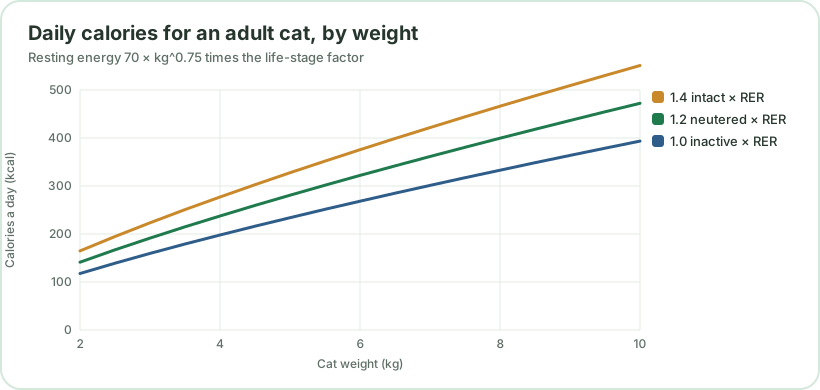
Cats’ energy needs in one formula
Vets start from the resting energy requirement (RER), the energy a cat uses at rest:
RER (kcal/day) = 70 × weight in kg ^ 0.75
A cat’s daily maintenance energy (MER) multiplies RER by a life stage factor from NRC, Merck and WSAVA sources:
| Cat | Factor × RER |
|---|---|
| Neutered adult | 1.2 |
| Intact adult | 1.4 |
| Inactive or weight-gain-prone adult | 1.0 |
| Weight loss (use ideal weight) | 0.8 |
| Kitten | 2.5 |
The factors are lower for cats than for dogs. That is why a pet owner who feeds a cat as if it were a small dog may overfeed it. Kittens are the exception, and we cover them in how much a kitten should eat.
Daily calories by weight
| Cat weight | RER | Neutered adult (1.2 ×) | Intact adult (1.4 ×) | Weight-loss budget (0.8 × RER of ideal weight) |
|---|---|---|---|---|
| 3 kg (6.6 lb) | 160 | 191 | 223 | 128 |
| 4 kg (8.8 lb) | 198 | 238 | 277 | 158 |
| 5 kg (11 lb) | 234 | 281 | 328 | 187 |
| 6 kg (13 lb) | 268 | 322 | 376 | 215 |
Values are kcal a day. For the weight-loss column the weight in the first column is the cat’s ideal weight, not the current one. A cat should never be put on a diet without the vet’s agreement, because cats that eat too little can develop serious liver problems.
From calories to grams
Pet food labels list energy per kg, per 100 g, per can or per cup. To convert:
grams = calories ÷ (kcal per kg ÷ 1,000)
Because wet food is mostly water and dry food is not, the same calories weigh very different amounts:
| Cat weight | Wet food only (1,000 kcal/kg) | Dry food only (3,800 kcal/kg) | Half the calories from each |
|---|---|---|---|
| 3 kg | 191 g | 50 g | 96 g wet + 25 g dry |
| 4 kg | 238 g | 63 g | 119 g wet + 31 g dry |
| 5 kg | 281 g | 74 g | 140 g wet + 37 g dry |
| 6 kg | 322 g | 85 g | 161 g wet + 42 g dry |
The amounts assume the foods listed. Your wet food may be 700 or 1,200 kcal/kg and your dry food may be 3,500 or 4,200, so read the label. The Cat Food Calculator takes your own numbers and the share of wet food you choose.
A worked example
Take Milo, a neutered adult cat weighing 4 kg, fed half of his calories as wet food (1,000 kcal/kg) and half as dry (3,800 kcal/kg).
- RER = 70 × 4 ^ 0.75 ≈ 198 kcal.
- MER = 1.2 × 198 ≈ 238 kcal a day.
- Half from wet: 119 kcal, which is 119 g of wet food.
- Half from dry: 119 kcal, which is 31 g of dry food.
If Milo’s wet food comes in 85 g cans, that is about one and a half cans. The Cat Food Cans per Day Calculator works out cans per day, week and month for any can size and energy.
Wet, dry or mixed?
Neither wet nor dry is automatically right for every cat. What matters is that the food is complete and balanced for your cat’s life stage and that total calories are controlled. A few practical differences:
- Wet food has high water content, which some owners like for cats that drink little, and it is easy to portion by can or pouch.
- Dry food is convenient and calorie-dense, which makes it easy to overfeed by eye.
- Mixed feeding gives variety and convenience, but you must count both foods towards the daily total.
Whatever you choose, always provide fresh water, and ask your vet before changing a cat’s diet, especially if your cat has a health condition.
How often to feed
Cats naturally eat several small meals. Many owners feed two to four meals a day, and some use puzzle feeders or timed feeders to spread food out. Free-feeding dry food from a full bowl suits some cats but makes it hard to track how much is eaten, and it can lead to weight gain in cats that eat for boredom. The right pattern is the one that keeps the daily total correct and your cat comfortable. Divide the daily amount into equal portions in advance so everyone in the household feeds the same amount.
Treats
WSAVA and AAHA advise keeping treats at no more than 10% of daily calories. For a 4 kg neutered cat that is about 24 kcal, which is only a handful of small treats. The Cat Treat Calorie Calculator shows how many treats of a given size fit. If your cat gets treats, remove a matching amount of calories from the meals.
Checking that you are feeding the right amount
Weigh your cat every month, and check body condition by sight and touch:
- You should feel the ribs easily under a thin layer of padding.
- From above, a slight waist behind the ribs should be visible.
- From the side, the belly should tuck up slightly (some cats have a loose flap of skin on the belly that is normal, so ask your vet if you are unsure).
If your cat is gaining weight steadily, reduce the daily amount slightly and ask your vet for a target weight. If your cat is losing weight without a diet, or if appetite changes suddenly, contact your vet. Our dog weight loss plan explains a similar approach for dogs, but cat plans must be agreed with a vet.
Indoor cats, multi-cat homes and seniors
Indoor cats are usually less active and are often the ones that gain weight, so the neutered factor of 1.2 (or 1.0 for inactive cats) is the right starting point.
Several cats in one home. Feed cats separately if one is overweight or on a special diet. Microchip-operated feeders can help in households where one cat needs different food.
Senior cats. Appetite and weight change with age, and some older cats lose weight while others gain. Regular weigh-ins and vet check-ups matter more than any chart. Our cat age chart explains the cat life stages.
Common mistakes
- Feeding by the bag chart without checking calories.
- Counting only the main meals and forgetting treats and shared human food.
- Using a cup or scoop for dry food rather than a scale.
- Changing foods suddenly, which can upset the stomach and cause refusal.
- Starting a weight-loss diet without the vet.
- Ignoring a sudden change in appetite or drinking.
Water and wet food
Cats vary in how much they drink, and wet food contributes a large share of water because it is mostly water. This is one reason some owners include wet food. Always offer fresh water, and consider several water bowls in different rooms or a drinking fountain if your cat seems to ignore a single bowl. If you notice your cat drinking much more or much less than usual, tell your vet, since changes in drinking can signal health problems.
Feeding routines that suit cats
Cats are natural hunters, and many do better when feeding involves some effort:
- Puzzle feeders and snuffle mats slow down eating and add mental exercise.
- Hiding small portions around the home encourages foraging.
- Timed feeders can help if your schedule is irregular.
- Separate feeding stations reduce stress in multi-cat homes.
The aim is to keep the total at the planned amount while making mealtimes more interesting. Plan the day’s portions in the morning and divide them into labelled containers, so every person who feeds the cat uses the same measure.
Changing food safely
A sudden switch can upset a cat’s stomach and may lead to a cat refusing the new food. Over seven to ten days, mix a little more of the new food into the old each day. Because energy density changes between foods, recalculate the grams using the new label. Cats that stop eating altogether for more than a day need a vet check, because going without food is more serious in cats than in dogs.
A monthly cat check
- Weigh your cat on the same scale. Kitchen scales work for small cats, or weigh yourself holding the cat and subtract.
- Feel the ribs and look from above as described above.
- Note any changes in appetite, drinking or litter habits.
- Adjust the daily amount by a small step if weight is drifting.
| Date | Weight | Daily grams | Treats | Notes |
|---|---|---|---|---|
| Starting point |
Multi-cat homes
When cats share a home, matching food to each cat gets harder. If one cat is overweight or on a special diet, separate meal spaces help. Closed doors during mealtimes, feeders that open only for a specific cat or feeding in different rooms are common solutions. Weigh each cat separately; one cat’s weight gain can be the other’s lean look.
A quick routine for busy owners
If you want a plan that takes five minutes a week:
- Once: work out your cat’s calories with the calculator and the grams for your food.
- Weigh the daily amount into a container each morning, or for several days at once.
- Use only that container for meals, plus a pre-counted number of treats.
- Weigh the cat on the first of each month and write it down.
- If the weight moves by more than about 5%, adjust the container by 10%.
That is all most healthy adult cats need. The rest of this guide helps with unusual situations.
Quick summary
- Calories first: 70 × kg ^ 0.75 × 1.2 for a neutered adult cat (1.4 intact, 1.0 inactive).
- A 4 kg neutered cat needs about 238 kcal a day: about 238 g of 1,000 kcal/kg wet food or 63 g of 3,800 kcal/kg dry food.
- For mixed feeding, split calories first, then convert each share to grams.
- Keep treats under 10% of the day and weigh the cat monthly.
- Never start a weight-loss diet without your vet.
- Use the Cat Food Calculator for your cat’s numbers.
Frequently asked questions
How much should I feed my cat a day?
Work out calories from weight: a neutered adult cat needs about 1.2 × 70 × kg ^ 0.75 kcal. A 4 kg cat needs roughly 238 kcal, then convert to grams using the food's kcal per kg.
How much wet food should a cat eat a day?
At 1,000 kcal/kg, a 4 kg neutered adult needs about 238 g of wet food a day if wet food is the only food. Foods differ, so use the kcal on the label.
How many grams of dry food does a cat need?
At 3,800 kcal/kg, a 4 kg neutered adult needs about 63 g a day if dry food is the only food. Dry food is far more calorie-dense than wet.
How often should I feed my cat?
Many owners feed two to four small meals, and puzzle feeders can spread food through the day. Keep the total the same and ask your vet what suits your cat.
Do intact cats need more food than neutered cats?
Yes. The factor is 1.4 for intact adult cats against 1.2 for neutered ones, so a 4 kg intact cat needs about 277 kcal versus 238.
How do I feed a cat that needs to lose weight?
Vets use about 0.8 times the resting energy of the ideal weight and aim for slow loss. Do not start a diet without your vet, because cats can become ill if they eat too little.
Why is my cat always hungry?
Hunger can come from habit, boredom or a medical cause. If appetite changes suddenly, or your cat is also drinking or losing weight, tell your vet.
Sources
- NRC (2006) Nutrient Requirements of Dogs and Cats, National Academies Press
- Merck Veterinary Manual — Nutritional Requirements of Small Animals
- WSAVA Global Nutrition Guidelines (incl. 9-point BCS charts)
- AAHA (2014) Weight Management Guidelines for Dogs and Cats
Related calculators
- Cat Food CalculatorWork out your cat's daily calories and how to split them between wet and dry food.
- Cat Calorie CalculatorWork out how many calories your cat needs each day, from its weight and life stage.
- Cat Food Cans per Day CalculatorFind out how many cans of wet food your cat needs each day, week and month.
- Cat Treat Calorie CalculatorCheck how many treats your cat can have a day without unbalancing its diet: the 10% rule.
- Cat Food Cost CalculatorSee what it costs per day, month and year to feed your cat, from its calorie need and the price of the bag.
Keep reading
- How Much Should a Kitten Eat? By AgeHow much to feed a kitten by weight and age: the 2.5 times RER rule, grams of wet and dry food, meals per day, weaning and when to switch to adult food.
- Cat Years to Human Years: Age ChartA clear cat age chart from kitten to 20 years, how the AAFP/AAHA scale works, the cat life stages and how long cats usually live.
- How Many Calories Does a Dog Need? RER, MERLearn how to calculate a dog's daily calories with RER and MER, see every life stage factor, a calorie table by weight and how to adjust the result.
- Indoor Cat Calorie NeedsHow many calories an indoor cat needs: RER × 1.0 if inactive versus 1.2 if neutered, a 3 to 6 kg table in kcal and grams, and how to adjust by weight trend.