
Cats are small, so treats loom large. A single teaspoon of cream, a few pieces of a rich treat or a nibble of cheese can be a tenth of a cat’s day, and a cat that is given several such extras can quietly take in a quarter more than it needs. Yet treats are a lovely part of life with a cat: they help with training, with giving medicines and with bonding. The key is to make them count, literally. This guide explains the 10% rule, gives allowances by cat weight, shows how many pieces that means at common calorie levels and offers ways to reward without piling on calories. The Cat Treat Calculator gives your own numbers.
The 10% rule
WSAVA’s global nutrition guidelines suggest that treats and extras should make up no more than about 10% of daily calories. The other 90% should come from a complete and balanced food. The rule exists for two reasons: treats are usually not nutritionally balanced, and they are an easy source of excess energy.
treat allowance = 10% of daily calories
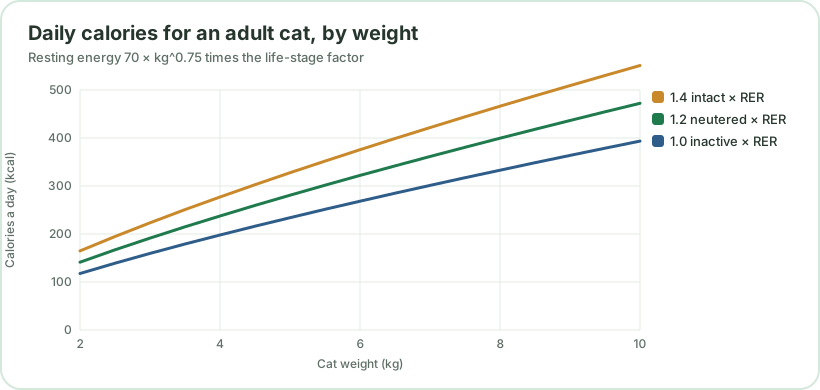
Daily calories for a neutered adult are 1.2 × 70 × weight ^ 0.75. The Cat Calorie Calculator gives the figure for any weight.
Allowance by weight
| Cat | Daily kcal | Treat allowance (10%) | Meals after treats |
|---|---|---|---|
| 3 kg | 191 | 19 | 172 |
| 4 kg | 238 | 24 | 214 |
| 5 kg | 281 | 28 | 253 |
| 6 kg | 322 | 32 | 290 |
An inactive or overweight-prone cat (factor 1.0) has less: 198 kcal at 4 kg, so 20 kcal of treats. A cat on a weight-loss plan has even less, and your vet should set the allowance.
How many pieces is that?
Treats vary from about 1 kcal to more than 10 kcal each. The table shows pieces per day within the allowance for a 4 kg cat (24 kcal).
| Kcal per piece | Pieces a day |
|---|---|
| 1 | 24 |
| 2 | 12 |
| 3 | 8 |
| 5 | 4 |
| 8 | 3 |
| 12 | 2 |
Check the label for kcal per treat or per 100 g. Calories per piece = kcal per 100 g × weight of one piece ÷ 100. The Pet Treat Energy Converter switches between kcal per 100 g, per kg and per treat.
Subtracting from meals
Treats come out of the daily total, so the meals shrink. For a 4 kg cat on dry food of 3,800 kcal/kg: without treats, 63 g; with 24 kcal of treats, meals are 214 kcal, or 56 g. A difference of 7 g is a level teaspoon, but over a year it is 2.5 kg of food. If treats are given and the meals are not reduced, the cat takes in 10% extra: 24 kcal a day is 8,760 kcal a year, a steady surplus.
Counting everything
It helps to list what counts. Beyond bought treats, count:
- Dental sticks and chews.
- Licks of cream, butter or yoghurt.
- Scraps of meat or fish.
- Food used to hide medicine.
- Milk, if given.
- Anything from a plate.
Keep a tally on the fridge or in a note on your phone. Many owners find that a day with “no treats” still includes several extras.
Reward ideas that are not food
| Reward | Notes |
|---|---|
| Play with a wand toy | Satisfies the hunting urge |
| Praise and gentle stroking | Many cats love attention on their terms |
| A new box or paper bag | Cheap and entertaining |
| Window perch access | Environmental enrichment |
| A short brushing session | If your cat enjoys it |
| A puzzle feeder with a few kibbles | Count the kibble |
Using the day’s own kibble as treats keeps calories under control. Measure the daily ration, set aside a handful for rewards and give the rest in the bowl.
Treats for medicine and vet visits
Treats can help with giving medicine or going to the vet, if your vet agrees that food is suitable. Use very small pieces, count them and ask your vet about the best approach. Do not hide medicine in food unless your vet says it is safe, since some medicines must be given on an empty stomach or in a particular way.
Treats and weight
Weigh your cat monthly and score body condition. If weight rises, cut treats first. Our guide to how many calories a cat needs explains the targets, and the cat feeding chart by weight shows grams by weight and food energy. For dogs, see how many treats a dog can have.
Common mistakes
- Giving treats on top of full meals.
- Not knowing the calories per piece.
- Counting only bought treats.
- Using treats as the main way to show love.
- Giving large pieces.
- Ignoring weight changes.
- Feeding treats from a bag without measuring.
Worked examples for three cats
| Cat | Weight | Factor | Daily kcal | Treat allowance | Meals after treats | Dry food (3,800 kcal/kg) |
|---|---|---|---|---|---|---|
| Young neutered | 3.5 kg | 1.2 | 215 | 22 | 193 | 51 g |
| Indoor neutered | 5 kg | 1.0 | 234 | 23 | 211 | 56 g |
| Active intact | 4 kg | 1.4 | 277 | 28 | 249 | 66 g |
For the indoor cat prone to gain, the allowance is 23 kcal, which is two or three pieces of a 8 kcal treat. If the owner gives a handful, say eight pieces, that is 64 kcal, 27% of the day, which would add weight within weeks.
Treat types and what to look for
| Treat type | Usual calories | Notes |
|---|---|---|
| Small crunchy treats | 1 to 3 kcal each | Easy to count; tiny |
| Soft treats | 2 to 5 kcal each | Can be broken in half |
| Dental treats | 2 to 10 kcal each | Check label |
| Lickable pastes | 5 to 15 kcal a serving | Count the serving size |
| Freeze-dried meat | 1 to 5 kcal a piece | Weigh for accuracy |
| Fish flakes or tuna | Varies | Not a complete food; ask your vet |
The calorie ranges are illustrations of what is commonly sold; always read your own label. Choose treats with an ingredient list you recognise, and avoid anything your vet has told you not to give. Treats should be complementary foods, not substitutes for meals.
Using treats for training and enrichment
Cats can be clicker trained, learn to come when called, accept a carrier or tolerate nail trims, all with tiny rewards. Use a pea-sized piece, and break treats into quarters. Hide a few treats around the home so the cat can forage, which adds exercise. Count them all within the 24 kcal allowance for a 4 kg cat. If your cat is overweight, ask your vet for advice on reducing treats without losing the benefits of training; non-food rewards often work as well.
Questions owners ask in more depth
My cat only gets five treats, but she is gaining weight. Why? Five treats of 10 kcal each is 50 kcal, 21% of a 238 kcal day. Check the calories per treat and count other extras.
Can treats help an overweight cat lose weight? Not directly; they add calories. Used in tiny amounts they help training and medication, and your vet can set the plan.
Should I give treats at set times? A routine, such as a few treats at the same time each evening, helps limit begging and makes counting easier.
What about treats for a multi-cat household? Give each cat its own measured treats, preferably separately, and weigh each cat.
Are treat balls good? They add activity; fill them from the day’s ration of kibble, not extra.
Is catnip a treat? It has no calories to speak of, but ask your vet if your cat has any condition that could be affected. Safety questions about plants and substances belong with your vet.
Treats for kittens, seniors and cats on diets
Kittens have higher calorie needs per kilogram (2.5 times resting energy), so their 10% allowance in kcal is larger than an adult of the same weight. A 2 kg kitten needing 295 kcal has 29 kcal of treats. But kittens are also learning habits, and a kitten that gets rich treats may refuse its balanced food. Use small amounts. For senior cats, the allowance depends on the daily target your vet sets; some seniors need extra calories, and some need fewer. For cats on diets, use treats sparingly, and count them within the plan; ask your vet.
| Cat | Daily kcal | Allowance (10%) |
|---|---|---|
| Kitten, 2 kg | 295 | 29 |
| Adult neutered, 4 kg | 238 | 24 |
| Inactive adult, 5 kg | 234 | 23 |
| Cat on a diet, ideal 4 kg (0.8 factor) | 158 | 16 |
Even the diet allowance of 16 kcal can be several tiny pieces if you choose low-calorie treats and cut them small.
A weekly treat plan
Plan the week: Monday, 6 pieces of 2 kcal for nail trims; Tuesday, none; Wednesday, 8 pieces for play; Thursday, none; Friday, a 12 kcal dental treat; Saturday, 6 pieces; Sunday, none. That averages about 5 kcal a day, well within the allowance, leaving room for occasional extras.
Keeping a treat tally
A tally helps. Keep a small card on the fridge with the day’s allowance written on it, for example 24 kcal, and cross off treats as they are given: each tick is 2 or 3 kcal. When the allowance is used, treats stop. Everyone in the household uses the same card, including visitors and children. Replace the card weekly, and weigh the cat monthly. If the weight is steady, the system works; if it rises, trim the allowance by a third and tell your vet if the rise continues. A tally turns a vague intention into a habit that sticks.
When your cat begs
Begging is common, and it often works, which is why it continues. Choose a response and keep to it: ignore the begging, offer play or a puzzle feeder, or give a counted treat at a fixed time. Do not respond to every request, because variable rewards are the strongest reinforcers. Check that the daily food is enough and that your cat is not hungry because the portion is too small; if you are unsure, ask your vet. A cat that is suddenly much hungrier than usual should be checked.
Quick summary
- Treats stay within about 10% of daily calories.
- A neutered 4 kg cat has about 24 kcal: 12 pieces of 2 kcal or 3 of 8 kcal.
- Subtract treat calories from meals so the total stays on target.
- Count dental sticks, licks and scraps too.
- Use play, praise and the day’s kibble as rewards.
- Use the Cat Treat Calculator for your cat.
Frequently asked questions
How many treats can a cat have a day?
Up to about 10% of daily calories. For a neutered 4 kg cat that is about 24 kcal, or 12 pieces of 2 kcal.
Where does the 10% rule come from?
WSAVA's nutrition guidelines suggest treats and extras stay at most about 10% of daily calories.
How do I find the calories in a cat treat?
Use kcal per treat or kcal per 100 g × the treat's weight ÷ 100.
Do treats replace part of the meal?
Yes. Subtract the treat calories from the daily food so the total stays on target.
Are dental treats counted?
Yes. They have calories, so count them.
Can I give human food as treats?
Ask your vet which foods are safe, and count the calories.
What if my cat is overweight?
Keep treats very small and within the plan from your vet, or use non-food rewards.
Sources
- WSAVA Global Nutrition Guidelines: treats and extras at most about 10% of daily calories
- NRC (2006) Nutrient Requirements of Dogs and Cats, National Academies Press
Related calculators
- Cat Treat Calorie CalculatorCheck how many treats your cat can have a day without unbalancing its diet: the 10% rule.
- Cat Calorie CalculatorWork out how many calories your cat needs each day, from its weight and life stage.
- Pet Treat Energy ConverterTurn kcal per 100 g and the weight of one treat into the calories in each treat.
Keep reading
- How Many Calories Does a Cat Need a Day?How many calories a cat needs: the RER formula, factors for neutered, intact, inactive and kitten cats, a calorie table by weight and how to adjust.
- How Many Treats Can a Dog Have a Day?How many treats a dog can have a day: the 10% rule, a chart of treat counts by weight and treat size, counting chews and training rewards and what to cut at meals.
- Cat Feeding Chart by WeightA cat feeding chart by weight with daily calories and grams of dry food, wet food and a half-and-half mix for neutered adult cats, plus treat allowances.
- How Overweight Is My Cat? Percent Over IdealHow far over ideal weight is a cat? (current − ideal) ÷ ideal × 100, the 10% per body-condition-point rule, a 4 kg ideal table and a worked 5.4 kg cat.