
If your dog has been mated, the next question is when the puppies are due. The short answer is about 63 days, but the exact count depends on which date you start from. This guide explains the dog gestation period, how to count from mating, ovulation or the LH surge, how to confirm a pregnancy, how to prepare for whelping and when to call your vet.
How long is a dog pregnant?
Dog pregnancy lasts about 63 days from ovulation. Because mating and ovulation do not always happen on the same day, the Merck Veterinary Manual gives three ways of counting:
| Counting from | Due date is about | Normal range |
|---|---|---|
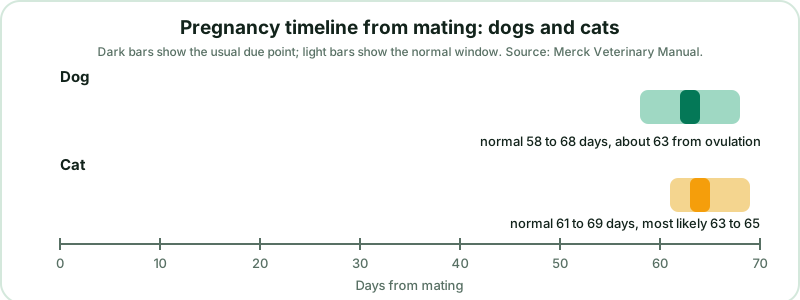
| Mating | 63 days | 58 to 68 days |
| Ovulation (from a progesterone test) | 63 days | 62 to 64 days |
| LH surge (identified by a vet) | 65 days | 64 to 66 days |
Counting from mating is the least exact because sperm can survive for several days and ovulation timing varies. If your vet has measured ovulation or the LH surge, use that date instead. In everyday terms, a dog is pregnant for about nine weeks, or just over two months.
A worked example
A dog mated on 1 October 2026 has these dates:
| Date type | Earliest normal | Due around | Latest normal |
|---|---|---|---|
| From mating | 28 November | 3 December | 8 December |
| From ovulation on 1 October | 2 December | 3 December | 4 December |
| From LH surge on 1 October | 4 December | 5 December | 6 December |
Enter your own date and type in the Dog Pregnancy Due Date Calculator, or use the Dog Pregnancy Week Calculator to see which day and week of pregnancy she is in today.
Why dogs have a wide window
Why can puppies arrive over ten days when the “average” is 63? Two reasons:
- Sperm survive for days. A mating that happens a few days before ovulation still results in pregnancy, so counting from mating includes that gap.
- Ovulation is not tied to mating. Unlike cats, dogs ovulate on their own schedule during estrus. Concannon’s review describes the hormone changes that signal it. Without a hormone test, the exact day is unknown.
This is why the same mating can produce different due dates depending on the method. If you plan a litter, ask your vet about progesterone testing before mating, because it narrows the window to a few days.
Pregnancy week by week: counting the days
Counting from the mating date, week 1 is days 0 to 6, week 2 is days 7 to 13, and so on. The table is only a way to count; ask your vet what to expect at each stage.
| Week | Days from mating |
|---|---|
| 1 | 0 to 6 |
| 2 | 7 to 13 |
| 3 | 14 to 20 |
| 4 | 21 to 27 |
| 5 | 28 to 34 |
| 6 | 35 to 41 |
| 7 | 42 to 48 |
| 8 | 49 to 55 |
| 9 | 56 to 62 |
| 10 | 63 to 69 |
Most puppies are born in week 9 or 10, which is why the normal window of 58 to 68 days spans both.
The stages of a dog pregnancy in plain terms
Without going into medical detail, it helps to think of three broad phases:
| Phase | Roughly | What owners usually do |
|---|---|---|
| Early | Weeks 1 to 3 | Often nothing visible; keep her routine and book a vet visit |
| Middle | Weeks 4 to 6 | Confirmation by ultrasound; ask your vet about food and exercise |
| Late | Weeks 7 to 9 and the due window | Prepare the whelping space; keep vet and out-of-hours numbers ready |
These are broad groupings for planning, not medical stages. Your vet will tell you what to look for in your dog.
How to confirm a pregnancy
You cannot be sure from how your dog looks or behaves. Your vet can confirm a pregnancy in two ways:
- Ultrasound, from about 25 days after mating.
- A blood test (relaxin), which detects a hormone made during pregnancy.
A vet visit also lets you plan the whelping, ask about food and exercise, and learn the warning signs. Some dogs show a “phantom pregnancy” with symptoms that look real, which is another reason to have a vet confirm.
Feeding a pregnant dog
A pregnant dog does not eat like an ordinary adult. Her needs change during pregnancy and lactation, and the right plan depends on her size, condition and litter. Ask your vet rather than using the standard Dog Food Calculator, which is built for normal adult dogs. Do not change her diet suddenly, and do not start supplements without checking with your vet.
Exercise and routine
Most pregnant dogs can keep a gentle routine, but how much is right depends on her health and stage. Ask your vet. Avoid rough play and jumping late in pregnancy, and keep her away from other dogs who may carry infections unless your vet says it is safe.
Preparing for the birth
- Choose a whelping space: quiet, warm, clean and easy to reach. A normal crate is usually too small; see our guide to what size crate a dog needs for how to think about space, and ask your vet about a whelping box.
- Keep your vet’s out-of-hours number and the nearest emergency clinic’s details by the phone.
- Note the dates so you know what is normal and when to call.
- Ask your vet what to have ready at home and what to watch for.
- Introduce the space early so she is comfortable using it.
When to call the vet
Call your vet straight away if:
- There are no puppies by the latest normal date (day 68 from mating).
- She has strong straining for 30 to 60 minutes without a puppy.
- There are more than 2 to 4 hours between puppies while she still has more to deliver.
- She has green discharge without a puppy.
- She seems unwell at any point during the pregnancy.
If in doubt, call. Whelping problems can become urgent quickly.
After the puppies arrive
Keep her quiet, warm and well watered, and watch that every puppy is feeding and warm. Ask your vet when to bring her and the litter for a check and when the puppies should start vaccinations. Later, when the puppies are growing, the Puppy Age Calculator tracks their age in weeks.
Dog and cat pregnancy compared
If you share a home with both species, remember the timelines are close but not the same. Cats are pregnant for about 63 to 65 days from mating, with a narrower window because they ovulate after mating. Our guide to how long cats are pregnant has the table and a worked example, and the Cat Pregnancy Due Date Calculator handles the cat dates.
Before the pregnancy: the heat cycle
Every planned litter starts with timing. A dog is fertile during estrus, and the exact window is hard to see without a hormone test. Our guide to how long a dog stays in heat explains the stages and how often they come, and the Dog Heat Cycle Calculator estimates the next season. If you do not want puppies, speak to your vet about the options.
Common mistakes with dog due dates
- Treating day 63 as exact. It is the middle of a window.
- Counting from the day she was “tied” without noting repeated matings. If she mated on several days, work from the first date and expect a wider window.
- Using the cat calculator for a dog. The timelines differ.
- Feeding a pregnant dog like a normal adult. Ask your vet.
- Waiting too long to call. If something looks wrong, call early.
Keeping a record of the mating
Good records make due dates more accurate. Write down every date the two dogs were together, even if you are not sure the mating “worked”. If your vet ran progesterone tests, keep the results and the date of each test. When you call the clinic you will be asked for the dates, so having them in one place saves time.
| Record | Why it matters |
|---|---|
| All mating dates | Sets the earliest and latest possible due dates |
| Progesterone test dates | Can pinpoint ovulation and narrow the window |
| Date of vet confirmation | Starts the clock for ultrasound follow-up |
| Weekly notes | Appetite, weight, behaviour and any discharge |
| Calendar dates for the window | Easier to follow than counting days |
If there were two matings three days apart, for example 1 October and 4 October, work out the window from both and expect the birth to fall within the combined range. A vet can usually refine it with an ultrasound.
Litter size and why it affects timing
Litter size varies with breed and with the individual dog, and your vet can usually estimate it with an ultrasound or an X-ray later in pregnancy. Larger litters can sometimes arrive a little earlier and smaller litters a little later, but that is a general tendency rather than a rule. Treat any estimate of the puppy count as approximate, and do not assume the whelping is finished until your vet, or the signs you were told to watch for, say so.
Phantom pregnancy
Some dogs show signs of pregnancy, such as nesting, milk and weight change, without being pregnant. This can follow a heat. If your dog shows these signs and was not mated, or the vet finds no puppies, ask about it. It is another reason to have the pregnancy confirmed instead of relying on how she looks.
Why we do not give pregnancy feeding amounts
A pregnant or nursing dog needs more food than a normal adult, but how much depends on her size, condition and the number of puppies. A table of amounts would not suit every dog, so the calculators on this site are built for normal adult dogs and puppies, and we leave pregnancy and nursing to your vet. They will weigh her, set a plan and change it as the pregnancy goes on.
Choosing and trusting the date you use
Three practical rules keep the dates sensible. First, always use the earliest mating date as the start of your “earliest normal” day and the latest mating date as the start of your “latest normal” day. Second, if a progesterone test or the LH surge was identified, switch to that date, because it is more precise than the mating date. Third, when your vet’s ultrasound gives a different estimate, follow the vet, who has seen your dog. The calculator is a planning tool that helps you ask better questions, not a replacement for the examination.
Quick summary
- A dog is pregnant for about 63 days from ovulation, or 58 to 68 days from mating.
- If a vet measures ovulation or the LH surge, use that date; it narrows the window.
- A dog mated on 1 October is due around 3 December, with a normal range of 28 November to 8 December.
- Confirm pregnancy with ultrasound from about 25 days or a blood test.
- Ask your vet about food, the whelping space and warning signs.
- Use the Dog Pregnancy Due Date Calculator with the best date you have.
Frequently asked questions
How long are dogs pregnant?
About 63 days from ovulation. From mating, puppies usually arrive 58 to 68 days later because sperm can survive several days.
How can I tell if my dog is pregnant?
Your vet can confirm by ultrasound from about 25 days or by a blood test (relaxin).
When should I call the vet during whelping?
If there is no puppy after 30 to 60 minutes of strong straining, more than 2 to 4 hours between puppies, or green discharge without a puppy.
Why is there a range of dates?
Mating and ovulation do not always happen on the same day, so counting from mating is less exact. The range of 58 to 68 days shows the normal spread.
What if I know the ovulation date from a progesterone test?
Use it: the due date is 63 days later, give or take a day. If a vet identified the LH surge, birth is around 65 days after it.
Should I change my dog's food during pregnancy?
Pregnant and nursing dogs have different feeding needs, so ask your vet instead of using the standard adult food amount.
How many weeks is a dog pregnant?
About nine weeks. Most puppies arrive in week 9 or 10 counted from the mating date.
Sources
- Merck Veterinary Manual — Management of Reproduction in Dogs and Cats
- Concannon P.W. (2011) Reproductive cycles of the domestic bitch. Animal Reproduction Science 124:200–210
Related calculators
- Dog Pregnancy Due Date CalculatorEstimate your dog's due date and the normal whelping window.
- Dog Pregnancy Week CalculatorSee which day and week of pregnancy your dog is in, counted from the mating date, and how many days remain.
- Dog Heat Cycle CalculatorPredict your dog's next season and the stages of the heat cycle.
Keep reading
- How Long Does a Dog Stay in Heat? StagesA dog's heat usually lasts about 2 to 3 weeks and comes around every 7 months on average. Learn the four stages, how often it happens and when to call the vet.
- How Long Are Cats Pregnant? Due Date GuideCat pregnancy lasts about 63 to 65 days. See the timeline, how to count from the mating date, what is normal and when to call the vet.
- What Size Crate Does My Dog Need?Measure your dog's length and height, add 5 to 10 cm (2 to 4 in) and match the result to the crate maker's inside measurements. Includes examples and puppy tips.
- Whelping Checklist: Prepare for PuppiesA practical whelping checklist: the due window from mating, the whelping space, supplies to gather, records to keep, weeks-before timeline and when to call your vet.